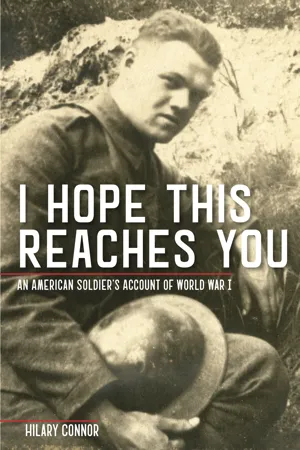
I Hope This Reaches You: An American Soldier's Account of World War I begins in May 1917 with Byron Fiske Field (1897â1968) boarding a morning train bound for Detroit with one objective in mind: to help the United States win the war against Germany. A pacifist at heart, Field had just finished his freshman year at Albion College where he was studying to be a Methodist missionary. Although he found the idea of killing another human to be at odds with his Christian beliefs, like other Americans he was convinced of the righteousness of World War Iâthe war to end all warsâand he was determined to do his part.
In recounting Field's story, Hilary Connor relied on four principal sources of information found in a footlocker issued to Field as a member of the 168th Ambulance Company in the 42nd Divisionâor as it was more famously known, the Rainbow Division. The first of these sources is a handwritten diary kept by Byron from February 1918 to July 1919. The second cache of firsthand information is contained in two books that were co-authored by Field and other select Company members in the late winter and early spring of 1919, recounting events and personal experiences of the warâ The History of Ambulance Company 168 and Iodine and Gasoline. The third and perhaps most extraordinary source is a collection of over three hundred letters written by Field during the war to his parents and college girlfriend. Included in many of the letters are mementos ranging from the petals of regional flowers in bloom to Red Cross notices to church service programs and other pieces of everyday life that proved invaluable in helping to create a broader and richer historical context. The last category of material is a voluminous collection of personal papers, including academic articles, speech notes, and opinion pieces, written by Field in the decades following the war. The breadth of materials is only further enhanced by the benefit of one hundred years hindsight, lending itself to a more thorough understanding of many of the momentous events that occurred during those years.
I Hope This Reaches You is a tapestry of human experience woven from the narrative threads of love, loss, loyalty, sacrifice, triumph, and tragedy that will call to any reader of historical memoirs.
Frequently asked questions
Yes, you can cancel anytime from the Subscription tab in your account settings on the Perlego website. Your subscription will stay active until the end of your current billing period. Learn how to cancel your subscription.
At the moment all of our mobile-responsive ePub books are available to download via the app. Most of our PDFs are also available to download and we're working on making the final remaining ones downloadable now. Learn more here.
Perlego offers two plans: Essential and Complete
Essential is ideal for learners and professionals who enjoy exploring a wide range of subjects. Access the Essential Library with 800,000+ trusted titles and best-sellers across business, personal growth, and the humanities. Includes unlimited reading time and Standard Read Aloud voice.
Complete: Perfect for advanced learners and researchers needing full, unrestricted access. Unlock 1.4M+ books across hundreds of subjects, including academic and specialized titles. The Complete Plan also includes advanced features like Premium Read Aloud and Research Assistant.
Both plans are available with monthly, semester, or annual billing cycles.
We are an online textbook subscription service, where you can get access to an entire online library for less than the price of a single book per month. With over 1 million books across 1000+ topics, weâve got you covered! Learn more here.
Look out for the read-aloud symbol on your next book to see if you can listen to it. The read-aloud tool reads text aloud for you, highlighting the text as it is being read. You can pause it, speed it up and slow it down. Learn more here.
Yes! You can use the Perlego app on both iOS or Android devices to read anytime, anywhere â even offline. Perfect for commutes or when youâre on the go. Please note we cannot support devices running on iOS 13 and Android 7 or earlier. Learn more about using the app.
Yes, you can access I Hope This Reaches You by Hilary Connor in PDF and/or ePUB format, as well as other popular books in History & Historical Biographies. We have over one million books available in our catalogue for you to explore.
May 24, 1917. After five days of continuous rain, clear skies had conspired with waterlogged ground and a faint breeze to envelop the Jackson Railroad Station in a cloud of fog. Although somewhat unexpected, for southern Michigan this was nothing new. According to legend, a young Indian brave who had gone out on a hunt was the first to disappear in such a mist. Ever since, this phenomenon had been called the Potawatomi Curtain.
As the morning train bound for Detroit pulled into the station, Byron Fiske Field waited his turn to board. No sooner had he entrained than the shrill blast of the conductorâs whistle set the wheels in motion. After clearing the station, the train picked up speed and glimpses of downtown Jackson flashed by in the window like so many street scenes in a hand-cranked stereopticon. Before long, there was nothing left to look at but endless acres of Michigan farmland.
It had been an exceptionally cool springâthe most unpromising in thirty-one years. The fields of wheat and sugar beets were still an uncertain mixture of green and brown. Whether this yearâs crop would be able to make up for lost time was the cause of much concern. At the age of nineteen, though, hope springs eternal regardless of circumstance. Byron was no exception to that rule. By the time the train passed an orchard of cherry trees, the morning fog had lifted, and clusters of pink floated against a bright blue sky. To Byron, the future looked limitless.
On April 6, Congress had declared war on Germany. Byron was eager to answer his countryâs call to duty. Others he knew had already enlisted, but Byronâs options were limited. Plagued with bad eyesight, Byron knew that heâd almost certainly be rejected for military service. On earlier forays into Detroit, army, navy and Marine Corps recruiters had told him so. Which wasnât entirely bad newsâa pacifist at heart, Byron had other plans.
Byron had just finished his freshman year at Albion College, where he was studying to be a Methodist missionary. Although the idea of killing another human being was at odds with his Christian beliefs, like other Americans he was convinced of the righteousness of this war, the war to end all wars, and he was determined to do his part. Given his limited vision, Byron figured that his best chance of getting overseas was to volunteer to serve in a medical unit where the physical requirements to enlist were less stringent and he wouldnât be expected to fire a gun. Heâd heard that the Red Cross corps was looking for volunteers.
Still, Byron was leaving nothing to chance. In an abundance of caution he had come armed with a letter from the family doctor attesting to his general fitness, and he had even memorized eye charts down to the smallest type. At five feet, eleven inches tall and a solid 190 pounds, Byron was an impressive physical specimen. Not to mention bright. More important, though, he wasnât particular about the type of work heâd be asked to do. He was more than willing to serve in any position, from orderly to litter bearer to ambulance driver, just to be in the thick of itâsupremely confident that his innate talent would be readily apparent to superior officers and that heâd soon be given greater responsibility. Maybe even a promotion.
Byron was not alone in his enthusiasm. The train was loaded with itâpassenger cars filled with the resolve of young men eager to enlist. This groundswell of support represented a recent change. Prior to Americaâs declaration of war, most citizens had viewed the conflict in Europe as a far-off, ill-defined affair of little significance to their lives. As Byron recollected in an essay written after the war:
We were at playâor workâat study. The days were filled with hours in the classroom, the chambers, and along the river in canoes. Spring suns had barely melted the last snows into the grass. Already we were thinking of the summer days when vacation would be with us, and we wouldnât have to go a-hurrying to âeight oâclocks,â or give answer for too frequent cuts from classes.
Oh yes, we read the newspapers, in the same detached way that any college boy scans the news for information about what is doing in the outside world. Our chief source of outside information however was the letter from home, and that was confined chiefly to remarks about the health and financial condition of our own family.
We did read of the warâoff there in Europe. Yes, we even heard occasional reference made to it in our class in European History, although the professor was more concerned in our knowledge of the significance of the Battle of Tours or Poitiers than Verdun or the Somme. The latter was too recent to be of immediate historical significance to himâit hadnât been seasoned in foolscap and leather binding yet.
We read of âatrocities,â of White Papers and Red Papers, of the Russian revolt, of Gallipoliâbut for the most part they were âoutside our world.â Spring was coming, and the annual class games, the walks which had been deprived us through the fields and woods, alone, or with our damozels.
Then came April 6âand war. Still remote. As a high school boy, I had watched the Princess Pats being recruited in 1914. They had seemed just like any other âsoldiersââthey were going over to Europe to get into a war about something or other. Some acquaintances had been filled with a spirit of adventure, or, thinking deeply, of a desire to do the right thing, as they saw it, and had gone over to Windsor, opposite Detroit, and joined up with the Canucks.
But here we were in it. Newspaper reading took on a new significance. âPlatitudinousâ remarks of President Wilson were now accepted as too coldly matter-of-fact. We were pledged to support a Causeââto help make the world safe for democracy.â We were involved directly, it seemed, because we refused to be dictated about when and where ships flying our flags could goâsort of a War of 1812 attitude. We were on the side of Right tooâthere could be no doubt about itâthe other side had committed atrocities, had violated international law, had tried to take advantage of certain innocent peoples. We were a kind of eleventh hour âdefenders of the faith.â
For Byron and other self-fashioned crusaders on the train that morning, it would be just two short hours and nine more stops on the Michigan Central Railroad line before they reached Detroit, and destiny. To pass the time Byron engaged in small talk with the girlfriend of a former high school classmate. Sheâd recognized him on boarding the train and had taken the open seat beside him. Despite not being able to recall her name, Byron managed to hold up his end of the conversation. Just before reaching downtown Detroit, the train stopped and the young lady departed. Byron began to talk with a passenger seated opposite him, explaining that he was on his way to Detroit to enlist in any medical unit that would have him in order to fight in the Great War.
It was then that a man seated across the aisle spoke up, saying that he was already enrolled in one of the units. Byron smiled back, somewhat surprised. The man explained that he couldnât help but overhear Byron, then asked if he might be of some assistance. The man affected a sleek, almost elegant, bearingâByron sized him up as a âMichigan Man.â Before continuing, the man politely waited to be invited into the conversation. Byron didnât hesitateâas the son of a general business agent, Byron had been schooled in the importance of cultivating connections in life no matter how inconsequential they might at first appear to be. After following up with a firm handshake and proper introduction, Byron went on to explain that he was hoping to enroll in an ambulance companyâalthough, truth be told, he had no idea what his prospects for success were. For better or worse, Byron had decided to go it alone. He had not spoken to anyone about wanting to enlist; if his parents were acquainted with any of the officers in charge of an ambulance company, he was in no position to avail himself of their contacts. Byronâs parents didnât have the slightest idea that he was even thinking about enlistmentâmuch less on his way to Detroit to actually do it. If they had, they would have done everything in their power to prevent it. Byron knew that the prospect of another family tragedy in the making would have been too much for them to endure. Years before, Byronâs parents had had to commit his older brother, Ralph, to the Michigan Home for the Feebleminded. The possibility that they could lose their only other child in a war that many viewed as one of choice, not necessity, was a risk that they were not willing to assume. To the extent that any young man filled with patriotic zeal was capable of understanding this, Byron did. Still, he was determined to answer his countryâs call to duty and until that deed was done, Byron was prepared to keep his own counsel.
In his quest to enlist, Byron had not entirely forsaken his parents, though. College tuition was a costly family expense. Byron appreciated that and had waited for the semester to end before he made any attempt to enlist in an ambulance company. He just hoped that in doing so he hadnât left it too lateâcollege credits didnât carry much weight in the army, and save unbridled patriotism, Byron knew that he possessed no skills of particular interest or use to a medical unit. In their stead, he had come armed with a packet of letters attesting to his good character, and in a sleight of hand that would have done a magician proud, he quickly produced those letters from his briefcase, then waited patiently while the man looked them over. Handing the letters back, the man seemed suitably impressed, remarking that Byron appeared to be âthe boyâ then.
For the remainder of the trip, Byron asked endless questions, and to the best of his ability the man attempted to provide answers down to the smallest detailâof which there were plenty. Each ambulance company would be comprised of a captain, four lieutenants, one top cutter plus six additional sergeants, and some 120 privates, in addition to cooks, wagoners, and saddlers. Routine tasks would be shared equallyâall of the enlisted men being required to wear a lot of different hats. Which suited Byron just fine. Given that many of the American ambulance companies would be motorized, and that Byron was an experienced driver, he hoped that his familiarity with automobiles would set him apart from other recruits whose families couldnât afford to buy a motorcar, though he was more than willing to work as a litter bearer if need be.
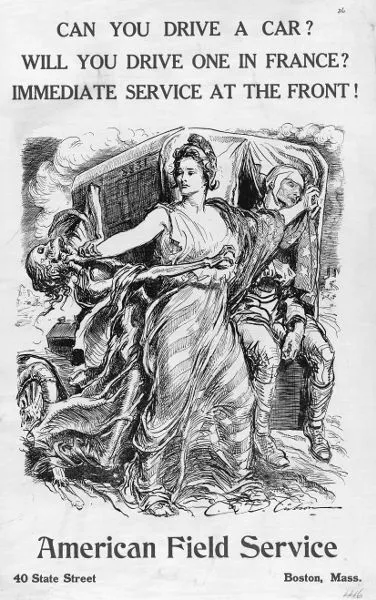
âCan You Drive a Car?â American Field Service recruiting poster, illustrated by Charles Dana Gibson, 1917. (Library of Congress.)
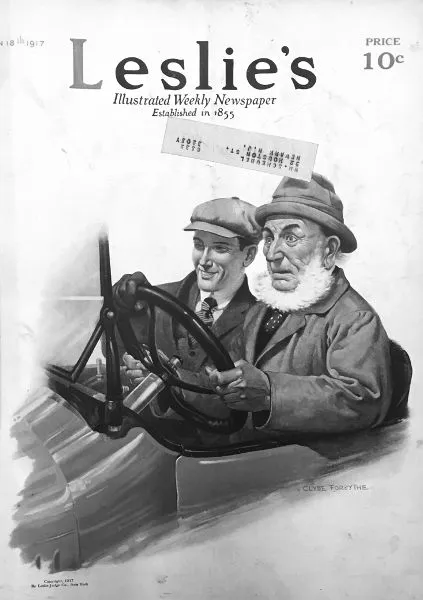
Student driver. Front cover of Leslieâs Weekly, January 18, 1917.
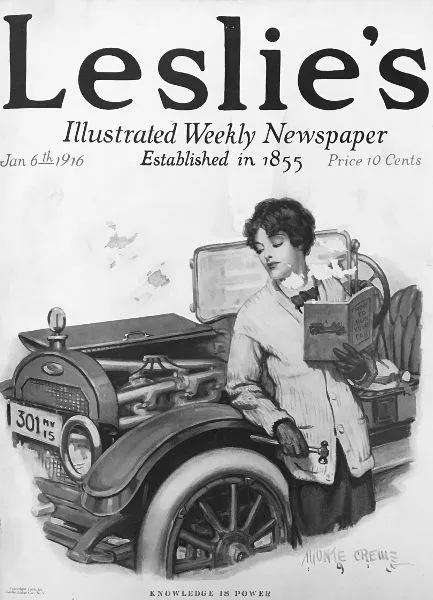
âKnowledge Is Power.â Front cover of Leslieâs Weekly, January 6, 1916.
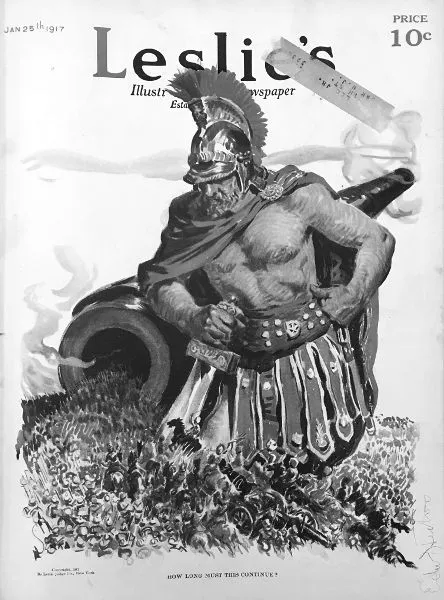
âHow Long Must This Continue?â Front cover of Leslieâs Weekly, January 25, 1917.
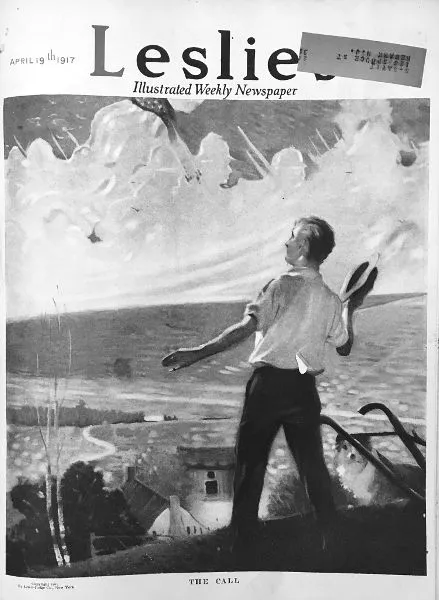
âThe Call.â Front cover of Leslieâs Weekly, April 19, 1917.
As Byron would soon learn, getting the wounded out of the line of fire was just the first part of a very dangerous and arduous job. Before the broken and bloodied bodies of wounded soldiers could be extracted from the field of battle, they would have to be treatedâwith splints, bandages, or whatever it tookâthen carried by litter to a dressing station, which could be thousands of yards away. In the mud and mayhem at the front, yards would seem like miles, the dead and dying everywhere. On finally reaching a dressing station, the next order of business for medical personnel was to triage the woundedâan emergency assessment procedure in which the worst battlefield casualties with the best chance of survival were prioritized, then given stopgap medical treatment to stabilize their condition so that they could be driven to a base hospital where they would be operated onâassuming they were still alive. The rest of the wounded would have to wait their turnâor die.
For Byron, all this was yet to come. At this point, he was no more capable of envisioning the unimaginable than anyone else who had never been subjected to the horrors of warâespecially this war. There had never been anything like it. To truly know it, one had to experience it. Simply doing that would prove to be the challenge of a lifetime.
As the train pulled into the depot in Detroit, the two men made arrangements to meet after Byron had checked into his room at the Library Park Hotel. After that, the man would take Byron over to meet Mr. Jones, the supervisor in charge of the state Red Cross.
From Byronâs perspective, limited vision notwithstand...
Table of contents
Cover
Title Page
Copyright Page
Dedication
Contents
Prologue
A Note on the Text
1. Answering the Call
2. The Worldâs Greatest Advertising Adventure
3. Marking Time
4. Passing Muster
5. This Is No Sunday School
6. Over There
7. Culture Shock
8. The Handwriting on the Wall
9. The Valley Forge Hike
10. Remember Jesus Christ
11. Baptism by Fire
12. There Must Be a Kind God Above
13. A Scene That Would Shock the World for All Eternity