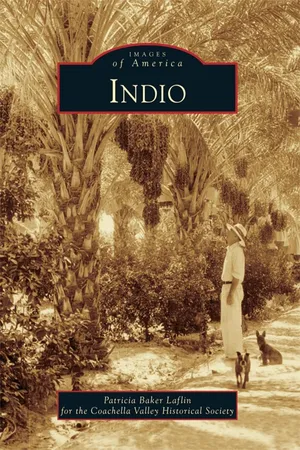
Located halfway between Los Angeles and Yuma, Arizona, Indio came into being as a railroad town in 1876 when the Southern Pacific Railroad completed this last link in its southern transcontinental route. Settling this arid land took ingenuity and courage, and Indios early residents had both. In the 1930s, Indio became a mining town when 92 miles of tunnel were dug through its eastern mountains for the Los Angeles Aqueduct, the largest construction project in the United States during the Depression. World War II brought Gen. George Pattons Desert Tank Corps to train nearby and crowd into Indio for rest and relaxation. The completion of the Coachella Branch of the All-American Canal brought Colorado River water to the desert in the late 1940s, and a land boom ensued. Today Indios reputation as the Date Capital of the United States and City of Festivals is long held and well deserved.
- 128 pages
- English
- ePUB (mobile friendly)
- Available on iOS & Android
eBook - ePub
Indio
About this book
Trusted by 375,005 students
Access to over 1.5 million titles for a fair monthly price.
Study more efficiently using our study tools.
Information
Three
CREATING A COMMUNITY

A. G. Tingman, shown here with his wife, is called “the Father of Indio.” He came to the valley as a railroad construction boss in 1877 and became telegrapher and station agent in 1883. He built Indio’s first store northwest of the depot in 1885 and became Indio’s first postmaster on July 3, 1888. This was the second post office in the valley, the first being located near Palm Springs in the area now occupied by Smoke Tree Ranch. He homesteaded and laid out the original town site, drilled a well for his home and store, and built a corral for travelers, prospectors, and freighters. He obviously caught the gold bug because he sold his store in 1903 and devoted himself to prospecting until his death at the Full Moon Mine, north of Niland, in 1925.

The home and store of Indio pioneer merchant and developer Albert Tingman are shown in this photograph believed to have been taken in 1900. The store is on the left and the home on the right under the fan palms. The buildings were situated in what would now be the middle of Indio Boulevard, east of Fargo Street and north of Bliss Street.

This 1938 photograph of the original Tingman store was taken when the building was moved to eliminate a bottleneck in Indio Boulevard, known at that time as Highway 99. It had been the first home of the Indio Date Palm newspaper and the Jeffery Furniture Store.

This tent house was typical of many first homes in Indio in 1907. Most families had a small garden and chickens to provide fresh meat and vegetables. Staple groceries could be ordered from Ralph Grocery Company in Los Angeles. They were delivered by train.

Relief from the extreme summer heat was afforded by a palm-leaf structure built to completely cover the tent house. This was the home of pioneers James and Elizabeth Moore from 1907 to 1910.

James Moore is pictured in this 1937 photograph. He, his wife, Elizabeth, and their young son, Otho, drove a team into the valley in 1898 and stayed for a while with Elizabeth Moore’s brother at his homestead where the present Date Festival Grounds are located. The property was covered with mesquite trees, and the house was little more than a shack. Nevertheless, in 1899, James and his family came to settle permanently, arriving by train in an “Immigration Car.” It was loaded with farming equipment at the Monrovia, California, siding and unloaded at the Indio siding, and included a well rig, several tons of hay, lumber, nails, rolls of wire, and a milk cow. This time, they had their own homestead.

Elizabeth Moore, shown in this 1937 photograph, was characterized by her contemporaries and later residents as the “Pioneer Mother of Indio.” In 1899, the family stayed with her brother, Lincoln Casebeer, until their own simple tent house was ready. It was the first of a number of small homes where the family lived in the early days. Elizabeth Moore said that the early homesteaders battled continuously against burros, coyotes, jackrabbits, and wild cattle. There was the noise of shotgun fire from every homestead. The rabbits were good for stew, but the burros were the greatest nuisances. Prospectors were plentiful, and they pastured their burros in Albert Tingman’s corral, but they didn’t stay pastured. Settlers barricaded their precious vegetable gardens with hay bales surrounded with barbed wire, but the animals got in anyway. Elizabeth Moore said, “The homestead was a noisy, dusty place until we drove those tramps out into the desert.” She was one of the original members of the Altruain Literary Club, organized in 1912.

Th...
Table of contents
- Title Page
- Copyright Page
- Table of Contents
- ACKNOWLEDGMENTS
- INTRODUCTION
- One - INDIO’S FIRST PEOPLE
- Two - THE SOUTHERN PACIFIC RAILROAD ARRIVES
- Three - CREATING A COMMUNITY
- Four - INDIO WAS A MINING TOWN
- Five - WORLD WAR II CHANGED INDIO
- Six - WATER SHAPED DEVELOPMENT
- Seven - PARADES, PAGEANTS, FESTIVALS, AND FUN
Frequently asked questions
Yes, you can cancel anytime from the Subscription tab in your account settings on the Perlego website. Your subscription will stay active until the end of your current billing period. Learn how to cancel your subscription
No, books cannot be downloaded as external files, such as PDFs, for use outside of Perlego. However, you can download books within the Perlego app for offline reading on mobile or tablet. Learn how to download books offline
Perlego offers two plans: Essential and Complete
- Essential is ideal for learners and professionals who enjoy exploring a wide range of subjects. Access the Essential Library with 800,000+ trusted titles and best-sellers across business, personal growth, and the humanities. Includes unlimited reading time and Standard Read Aloud voice.
- Complete: Perfect for advanced learners and researchers needing full, unrestricted access. Unlock 1.5M+ books across hundreds of subjects, including academic and specialized titles. The Complete Plan also includes advanced features like Premium Read Aloud and Research Assistant.
We are an online textbook subscription service, where you can get access to an entire online library for less than the price of a single book per month. With over 1.5 million books across 990+ topics, we’ve got you covered! Learn about our mission
Look out for the read-aloud symbol on your next book to see if you can listen to it. The read-aloud tool reads text aloud for you, highlighting the text as it is being read. You can pause it, speed it up and slow it down. Learn more about Read Aloud
Yes! You can use the Perlego app on both iOS and Android devices to read anytime, anywhere — even offline. Perfect for commutes or when you’re on the go.
Please note we cannot support devices running on iOS 13 and Android 7 or earlier. Learn more about using the app
Please note we cannot support devices running on iOS 13 and Android 7 or earlier. Learn more about using the app
Yes, you can access Indio by Patricia Baker Laflin in PDF and/or ePUB format, as well as other popular books in History & North American History. We have over 1.5 million books available in our catalogue for you to explore.