- 128 pages
- English
- ePUB (mobile friendly)
- Available on iOS & Android
eBook - ePub
Burlington
About this book
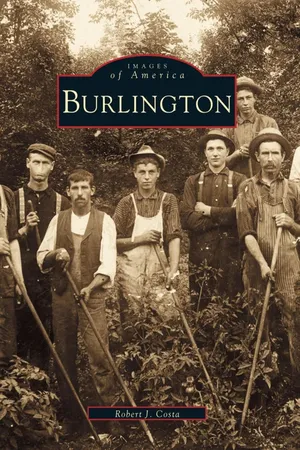
Drawing upon the John Fogelberg collection, the Burlington Historical Commission collection, and the Crawford collection of photographs, this book presents a vision of Burlington that few will recognize.
Known as Shawshin by the Native Americans who originally inhabited the region, the town of Burlington has a rich history dating to Colonial and Revolutionary War days. In Burlington, you will see the people, places, and events that are known today only as legends or place-names. Meet Marshall Simonds, whose generous gift in 1905 gave the town a beautiful park and Burlington Common, as well as its first high school. Experience how townspeople used to celebrate the Fourth of July with a large bonfire on the hill at Simonds Park. Learn of mysteries and disasters, such as the collapse of the parsonage building on the town common after a move in 1956. Explore the historic homes and the buildings and early businesses, which feature scenes from the Reed Ham Works to aerial views of the emerging Burlington Industrial Park. See the images of the Walker, Crawford, and Skelton farms, which showcase the town's fast-disappearing agricultural history.
Trusted by 375,005 students
Access to over 1.5 million titles for a fair monthly price.
Study more efficiently using our study tools.
Information
Seven
HISTORIC BURLINGTON HOUSES

Once considered the finest mansion in Burlington, the Dr. Nathaniel L. Frothingham house still stands (although much altered) at 6 Spruce Hill Road. The house was built for one of Burlington’s and Boston’s leading citizens of the mid-19th century, Rev. Dr. Nathaniel L. Frothingham. Frothingham was best known as the pastor of the First Church, Boston. He and his wife, Ann Gorham Brooks, fell in love with Burlington’s natural beauty. Their son Ward is credited with acquiring the land and having the house built in 1853.
(Courtesy of the Burlington Archives, No. 167.)

The Winn family were some of the earliest settlers of the Woburn-Burlington area. Edward Winn began the family line in America when he landed in 1640 and helped establish the town of Woburn in 1642. Several generations later, Timothy Winn built this house in 1732 on the corner of today’s Winn Street and Newbridge Avenue. This photograph shows the farm in its original location in the 1930s before it was dismantled and moved to Wellesley, where it stands today.
(Courtesy of the Burlington Archives, No. 57.)

Timothy Winn (1712–1800)—town father, state representative, and notable Burlington citizen of the 18th century—built this house in 1732 on the corner of what is today Winn Street and Newbridge Avenue. The house remained in the Winn family until World War I, when it was sold and made into a multifamily unit with the addition of an ell. It was then purchased, dismantled, moved, and reconstructed in Wellesley in 1938. The house is now one of 61properties that make up the Hunnewell Estates Historic District at Washington Street and Pond Road in Wellesley and Natick.
(Courtesy of the Burlington Archives, No. 176.)

The Lt. Reuben Kimball homestead (also known as the Bell-Foster house), located at 28Bedford Street, was probably built c. 1785 and was once part of a 95-acre farm. Reuben Kimball served in the Revolutionary War and was active in Burlington school affairs in the 1790s. The Bell family owned the property through much of the 19th century, and the hill was sometimes referred to as “Bell’s Hill.”
(Courtesy of the Burlington Archives, No. 480.)

This imposing structure, currently located at 67 Center Street, was built by Hugh Stewart and was completed sometime in 1899. Hugh Stewart and his wife, Elizabeth, were born in Ireland. They moved from Cambridge to Burlington in the 1890s. Stewart became an active citizen and was on the first board of park commissioners. In 1909, this commission laid out the first baseball diamond at Simonds Park. Today, the Fellowship Bible Church uses this house as its parsonage.
(Courtesy of the Burlington Archives, No. 516.)

Timothy Winn—the grandson of Edward Winn, one of the founders of the town of Woburn—built in 1732 the largest and most beautiful farmhouse ever constructed in Burlington. This measured drawing was produced by Henry J. Welsh for the Works Progress Administration’s Historical American Buildings Survey during the Great Depression. This drawing shows the classic design of the entrance hall, known for its fine Georgian-style paneling.
(Courtesy of the Burlington Archives, No. 513.)

Once considered one of the finest Colonial-style buildings in Burlington, the William Winn mansion now proudly stands in Wellesley. This measured drawing shows the fireplace wall of one of the upstairs bedrooms. The house was well known for it beautiful wood paneling. The study was done during the Great Depression as part of the WPA program called the Historical American Buildings Survey.
(Courtesy of the Burlington Archives, No. 60.)

The John Winn house, at 13 Wyman Street, is one of Burlington’s oldest and most remarkable historic struct...
Table of contents
- Title Page
- Copyright Page
- Table of Contents
- Acknowledgments
- INTRODUCTION
- One - CELEBRATIONS AND DISASTERS
- Two - APRIL 19, 1775: REVOLUTION
- Three - SCHOOLS AND SCHOOLHOUSES
- Four - LANDSCAPES
- Five - PORTRAIT GALLERY
- Six - FARMS, FARMHOUSES, AND BARNS
- Seven - HISTORIC BURLINGTON HOUSES
Frequently asked questions
Yes, you can cancel anytime from the Subscription tab in your account settings on the Perlego website. Your subscription will stay active until the end of your current billing period. Learn how to cancel your subscription
No, books cannot be downloaded as external files, such as PDFs, for use outside of Perlego. However, you can download books within the Perlego app for offline reading on mobile or tablet. Learn how to download books offline
Perlego offers two plans: Essential and Complete
- Essential is ideal for learners and professionals who enjoy exploring a wide range of subjects. Access the Essential Library with 800,000+ trusted titles and best-sellers across business, personal growth, and the humanities. Includes unlimited reading time and Standard Read Aloud voice.
- Complete: Perfect for advanced learners and researchers needing full, unrestricted access. Unlock 1.5M+ books across hundreds of subjects, including academic and specialized titles. The Complete Plan also includes advanced features like Premium Read Aloud and Research Assistant.
We are an online textbook subscription service, where you can get access to an entire online library for less than the price of a single book per month. With over 1.5 million books across 990+ topics, we’ve got you covered! Learn about our mission
Look out for the read-aloud symbol on your next book to see if you can listen to it. The read-aloud tool reads text aloud for you, highlighting the text as it is being read. You can pause it, speed it up and slow it down. Learn more about Read Aloud
Yes! You can use the Perlego app on both iOS and Android devices to read anytime, anywhere — even offline. Perfect for commutes or when you’re on the go.
Please note we cannot support devices running on iOS 13 and Android 7 or earlier. Learn more about using the app
Please note we cannot support devices running on iOS 13 and Android 7 or earlier. Learn more about using the app
Yes, you can access Burlington by Robert J. Costa in PDF and/or ePUB format, as well as other popular books in History & North American History. We have over 1.5 million books available in our catalogue for you to explore.