John C. Calhoun, Southern statesman and vice president under Andrew Jackson, once said, the Lenoir estate in Loudon County is the most princely property in Tennessee. It has all the picturesque environments and attractive surroundings of an English baronial estate. In 1890, the Lenoir estate became Lenoir City thanks to a group of forward-thinking businessmen from New York City and Knoxville who saw the value and potential of the property once given to Gen. William Lenoir in appreciation for his exemplary Revolutionary War service. Surrounded by the meandering Tennessee River, the town was the perfect setting for water-driven industries such as flour and cotton mills, barges, and ferries. Today Lenoir City is a growing town that offers residents and visitors abundant recreational, shopping, and dining venues. It is located in Loudon County, the Lakeway to the Smokies.
- 128 pages
- English
- ePUB (mobile friendly)
- Available on iOS & Android
eBook - ePub
Lenoir City
About this book
Trusted by 375,005 students
Access to over 1.5 million titles for a fair monthly price.
Study more efficiently using our study tools.
Information
Four
EDUCATION

The twin buildings that served as the Lenoir City schools were built on the corner of C Street and Second Avenue between 1902 and 1904. The identical two-story buildings played host to local school children for many years. The structures were replaced by Nichols Elementary School in 1924.

The Lenoir City schoolmarms pictured here are, from left to right, the following: Sophie Simpson, Tennie Griffitts, Ruby Harris, Bertha Perry, F. E. Russell, Pauline Atkins, and Meta Cardwell. The photograph was taken in 1910 at the twin buildings, which served as an elementary school.

On March 6, 1908, the Lenoir Brick Company and G. W. Stansberry were contracted to erect a high school building in Lenoir City at a cost of $13,092.10. The Lenoir City High School, shown here in 1912, was finished in 1909. Eventually the building became part of a campus complex that consisted of a grammar school built in 1913 and a gymnasium building erected in 1922 by community volunteers. The buildings, located on Fourth Avenue, were razed in 1981.
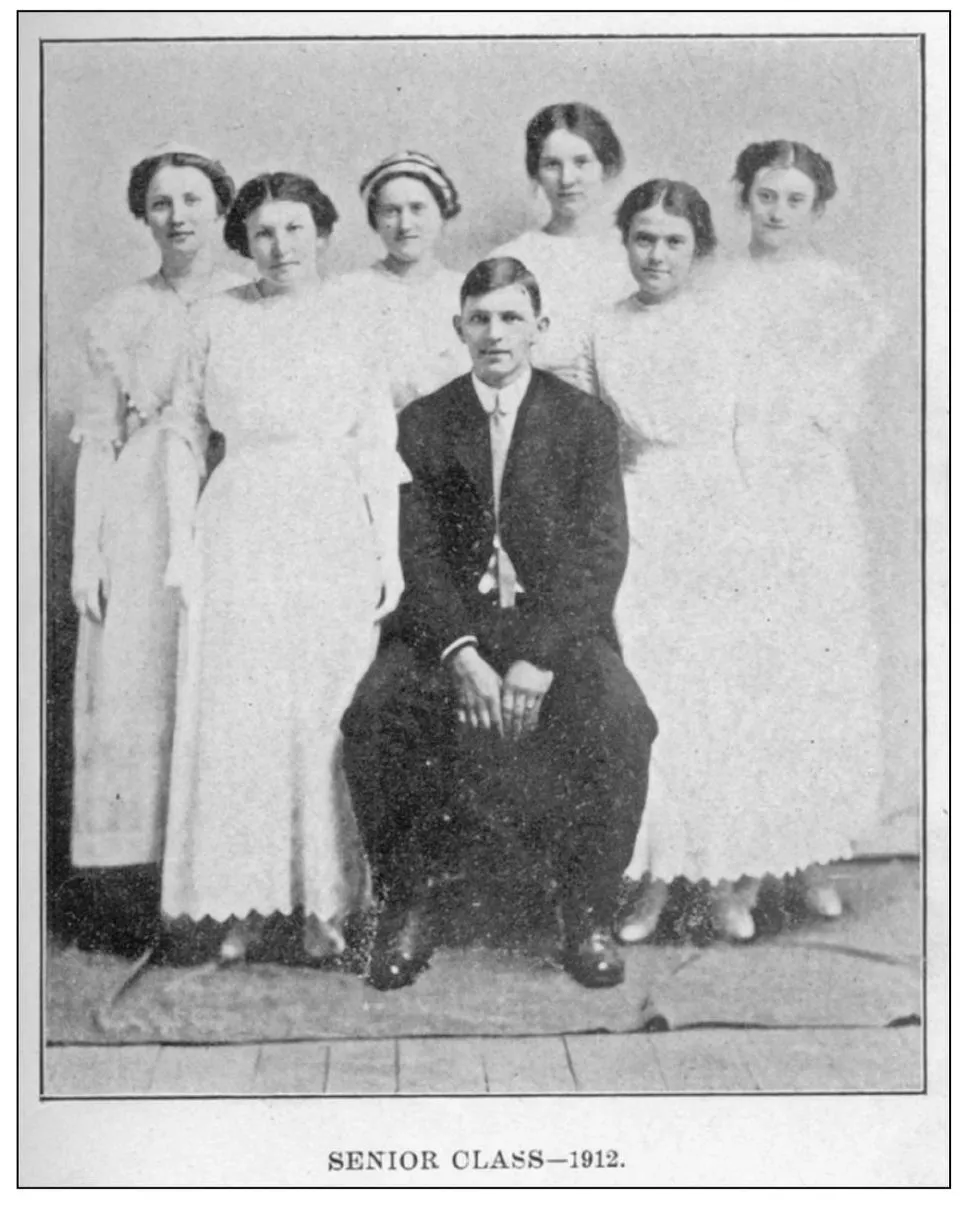
In 1912, the first Lenoir City High School class consisted of one boy and six girls. They are, from left to right, the following: Frances Bewley, Lou Anderson, Jane Morton, Clyde Hackney, Effie Harrison Jones, Ethel Thompson, and Lola Alexander. Clyde, in his black suit, made a nice contrast to the ladies all dressed in white.

Students stand on the back porch of the Lenoir City High School in the early 1910s. The only two identified are Hazel Foute (standing to the right of the pole) and Pearl Fisher (second from right).

Students worked at different tables in this early science lab at the Lenoir City High School in the early 1910s: the girls type up their findings at the far left table, anatomy charts are hung behind the middle table, and the students watch attentively as the teacher performs a scientific demonstration at the table on the right. The only person identified in this photograph is Anna Mae Fisher (second from right).

Members of the 1917 Lenoir City High School sewing club were, from left to right, Lillie Hodge, Eva Morrison, Lissie Brown, Flora Soward, Beulah Wesson, Eileen Long, Gladys Jones, Estelle Pair, and Una Winchester. These students, like others in high school sewing clubs across the country at the time, may have contributed to efforts in World War I by providing hospital nightshirts and khaki handkerchiefs, among other items.

These lovely ladies were members of the 1917 Lenoir City High School cooking club. The members pictured here are, from left to right, the following: Daisy Duff, Lillie Hodge, Beulah Wesson, Eileen Long, and Ezerine McAllister. The girls would have learned the latest in cookery and kitchen sciences. Note the pristine white aprons that constituted the club’s uniforms.

These unidentified school children hold up signs celebrating Armistice Day. On November 12, 1919, Pres. Woodrow Wilson proclaimed the first Armistice Day, “a day dedicated to the cause of world peace” and commemorating the end of World War I. The holiday was renamed Veteran’s Day in 1954 to honor all veterans and is celebrated on November 11 to denote the signing of the armistice that ended the First World War, as major hostilities were formally ended on the 11th hour of the 11th day of the 11th month in 1918.

Sporting chic bobbed hair, loose fitting dresses, and fancy shoes, these unidentified early 1920s Lenoir City High School students were certainly dressed for success. The Roaring Twenties was a time of prosperity and new opportunities for young women. In 1928, women would earn 39 percent of the college degrees given in the United States, up from 19 percent at the beginning of the 20th century.

In 1930, the combined faculties of the Lenoir City Schools posed for t...
Table of contents
- Title Page
- Copyright Page
- Dedication
- Table of Contents
- ACKNOWLEDGMENTS
- FOREWORD
- INTRODUCTION
- One - THE EARLY YEARS
- Two - CAR WORKS AND HOSIERY MILL
- Three - OTHER BUSINESSES
- Four - EDUCATION
- Five - RELIGION
- Six - CELEBRATIONS
- Seven - TRANSPORTATION
- Eight - THE DAM
- Nine - HOUSES
- Ten - PEOPLE
Frequently asked questions
Yes, you can cancel anytime from the Subscription tab in your account settings on the Perlego website. Your subscription will stay active until the end of your current billing period. Learn how to cancel your subscription
No, books cannot be downloaded as external files, such as PDFs, for use outside of Perlego. However, you can download books within the Perlego app for offline reading on mobile or tablet. Learn how to download books offline
Perlego offers two plans: Essential and Complete
- Essential is ideal for learners and professionals who enjoy exploring a wide range of subjects. Access the Essential Library with 800,000+ trusted titles and best-sellers across business, personal growth, and the humanities. Includes unlimited reading time and Standard Read Aloud voice.
- Complete: Perfect for advanced learners and researchers needing full, unrestricted access. Unlock 1.5M+ books across hundreds of subjects, including academic and specialized titles. The Complete Plan also includes advanced features like Premium Read Aloud and Research Assistant.
We are an online textbook subscription service, where you can get access to an entire online library for less than the price of a single book per month. With over 1.5 million books across 990+ topics, we’ve got you covered! Learn about our mission
Look out for the read-aloud symbol on your next book to see if you can listen to it. The read-aloud tool reads text aloud for you, highlighting the text as it is being read. You can pause it, speed it up and slow it down. Learn more about Read Aloud
Yes! You can use the Perlego app on both iOS and Android devices to read anytime, anywhere — even offline. Perfect for commutes or when you’re on the go.
Please note we cannot support devices running on iOS 13 and Android 7 or earlier. Learn more about using the app
Please note we cannot support devices running on iOS 13 and Android 7 or earlier. Learn more about using the app
Yes, you can access Lenoir City by Kate Clabough in PDF and/or ePUB format, as well as other popular books in History & North American History. We have over 1.5 million books available in our catalogue for you to explore.