Norfolk has been a center of African-American life since this countrys humble beginnings, when indentured African servants arrived in 1619 to the Tidewater region. Since that time, the African-American population has endured the atrocities of slavery, poverty, and inequality, and has emerged, through a remarkable combination of hard work, perseverance, and faith, as a vibrant community and an integral component to the identity and success of Norfolk and surrounding areas.
- 128 pages
- English
- ePUB (mobile friendly)
- Available on iOS & Android
eBook - ePub
Norfolk, Virginia
About this book
Trusted by 375,005 students
Access to over 1.5 million titles for a fair monthly price.
Study more efficiently using our study tools.
Information
Five
ENSURING PROSPERITY
By the turn of the century, Norfolk’s African-American population had made significant strides toward economic survival. This was accomplished certainly not by being integrated into the mainstream of Norfolk’s workforce, but by seizing each employment opportunity no matter how small or menial. An examination of the City Directory of the first decade reveals the areas where African Americans were heavily concentrated. They were proprietors of eating houses, tailoring shops, barber shops, shoe repair shops, laborers of all types, household servants, waiters, and laundresses. A few who had had the advantages of a complete education were letter carriers. This occupation actually was regarded as quite prestigious within the African-American community since it implied an advanced level of literacy and knowingness. Also, it was guaranteed steady employment with government benefits. Often letter carriers’ families were at the center of the social pecking order.
For the African-American community in Norfolk, the time between 1900 and 1939 was exciting and promising. Booker T. Washington’s philosophy of economic enfranchisement through preparedness, training, self-help, and separation served as the model for Norfolk’s aspiring business community. These years could quite appropriately be called the period of the American Dream. The expectation was that each and every African American could reach her or his full potential. This time was also, it must not ever be forgotten, a time of the harsh restrictions of segregation, Jim Crow, and the men of the sheets. Nevertheless, excitement filled the air and much was accomplished towards the goal of establishing economic prosperity.
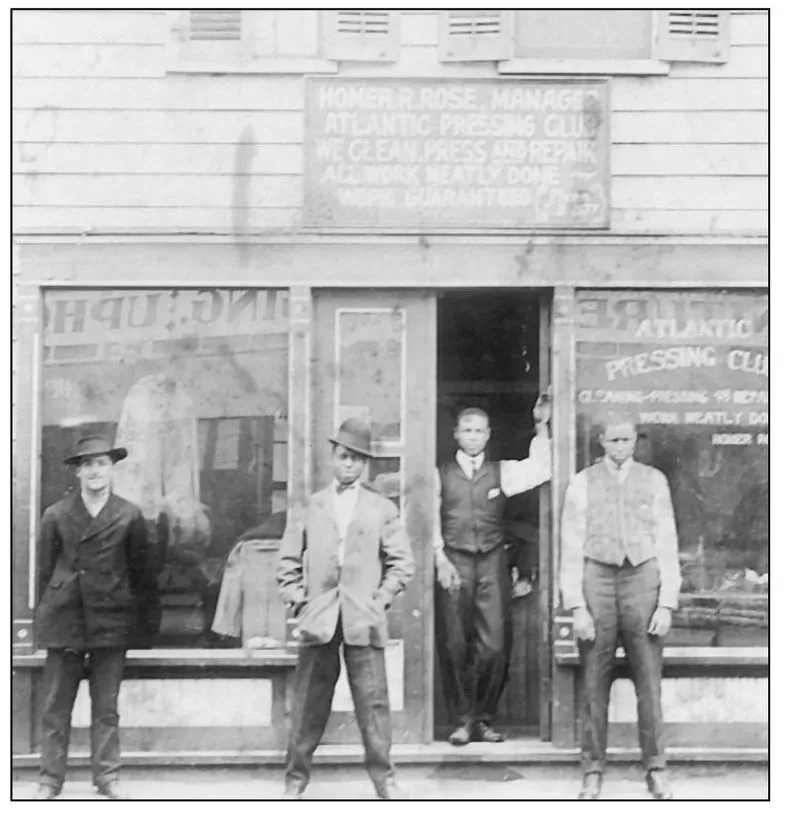
J. Homer Rose is pictured in front of his Atlantic Pressing Club, a cleaning and pressing business. Like many other African-American businesses, such as Charles Carter’s Tailoring, Goldie Garrett’s Millinery, and Alston’s Rubber, Rose targeted Norfolk’s European-American community for his customer base. The advantage of this strategy became evident as the Depression approached. African-American workers were the most vulnerable to losing their jobs. Because the large percentage of their customers were African American, many of the Church Street merchants either were just able to squeak by or went bankrupt as their customers’ economic prospects diminished.
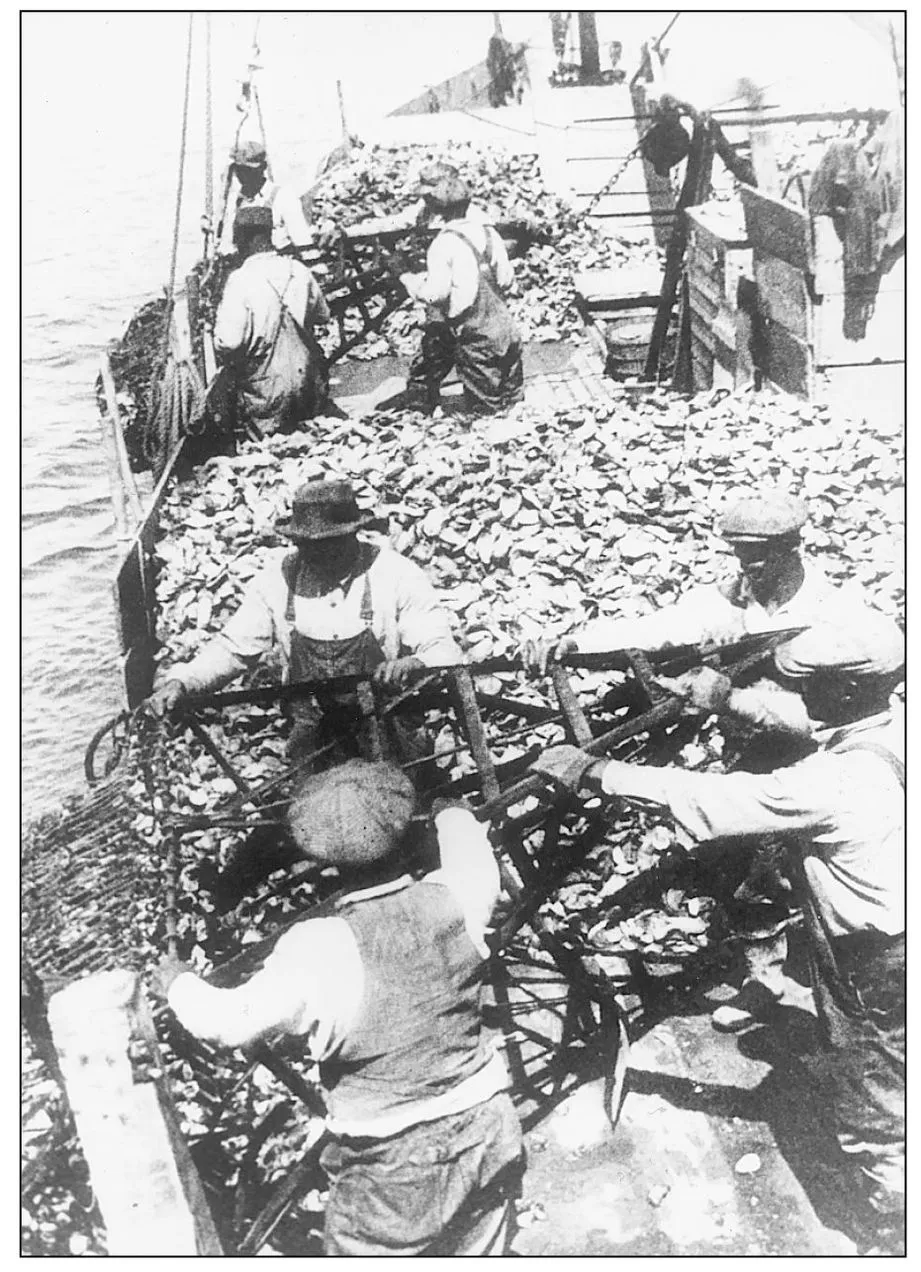
Oyster fishermen are unloading the oyster nets at the dock. There were many who excelled at this work and formed businesses of their own. Most notably was M.J. McPherson, who during his prime, cornered the market on the Lynnhaven oyster and crab market.

Cotton workers at the cotton warehouses unload cotton. Note the worker in the center who seems to have a bail of cotton on his scale for weighing. Norfolk was the major port of exportation for cotton grown in Virginia and the Carolinas.
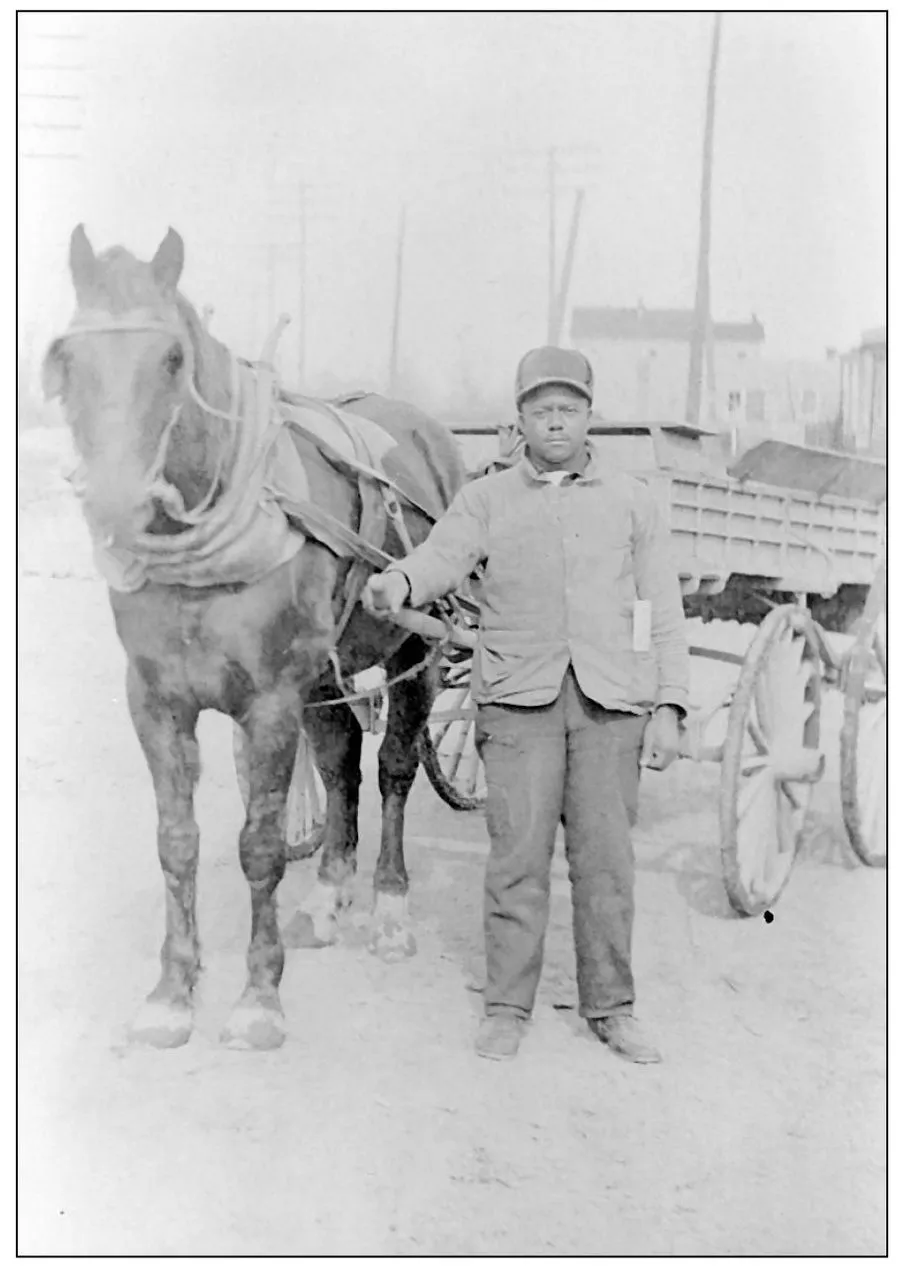
Another occupation available during this period was delivery person. Here James Jordan is posing beside his horse and delivery carriage. While this kind of work was often tedious, the hours long, and the pay meager, it provided those who could do it with steady employment for their families. There were no benefits, such as health insurance or dental plans, as we know them today.

Dock work was plentiful and readily available to African Americans during the 1800s as well as at the turn of the century. At one time the great majority of haulers of materials from the docks to the factories and warehouses were African Americans. Here a crew of rope workers are pictured on the rope walk.

Above: This photo was found among those in the Isabelle and Carroll Walker Collection at the Kirn Branch of the Norfolk Public Library, Sargent Memorial Room. The caption written on the back says, “Burial of Martin L. Hundley at Forest lawn. Mr. Cox is on the right.” The significance of the deceased and the man at the right is not known. What the photograph does suggest is that this funeral is for a person who was important in the Klan movement in Norfolk and that he was a well-known member of the Norfolk European-American community. It also frames the context of the time period in which African Americans were ensuring their prosperity.

Frank Guy, shown with his wife, Annie, was a waiter by occupation. He decided early on...
Table of contents
- Title Page
- Copyright Page
- Table of Contents
- ACKNOWLEDGMENTS
- INTRODUCTION
- One - ANTEBELLUM NORFOLK
- Two - FEEDING THE SPIRIT
- Three - SURVIVING FREEDOM
- Four - ESTABLISHING LITERACY
- Five - ENSURING PROSPERITY
- Six - PUBLIC EDUCATION
- Seven - FAMILIES
- Eight - LEISURE AND MEDICAL CARE
Frequently asked questions
Yes, you can cancel anytime from the Subscription tab in your account settings on the Perlego website. Your subscription will stay active until the end of your current billing period. Learn how to cancel your subscription
No, books cannot be downloaded as external files, such as PDFs, for use outside of Perlego. However, you can download books within the Perlego app for offline reading on mobile or tablet. Learn how to download books offline
Perlego offers two plans: Essential and Complete
- Essential is ideal for learners and professionals who enjoy exploring a wide range of subjects. Access the Essential Library with 800,000+ trusted titles and best-sellers across business, personal growth, and the humanities. Includes unlimited reading time and Standard Read Aloud voice.
- Complete: Perfect for advanced learners and researchers needing full, unrestricted access. Unlock 1.5M+ books across hundreds of subjects, including academic and specialized titles. The Complete Plan also includes advanced features like Premium Read Aloud and Research Assistant.
We are an online textbook subscription service, where you can get access to an entire online library for less than the price of a single book per month. With over 1.5 million books across 990+ topics, we’ve got you covered! Learn about our mission
Look out for the read-aloud symbol on your next book to see if you can listen to it. The read-aloud tool reads text aloud for you, highlighting the text as it is being read. You can pause it, speed it up and slow it down. Learn more about Read Aloud
Yes! You can use the Perlego app on both iOS and Android devices to read anytime, anywhere — even offline. Perfect for commutes or when you’re on the go.
Please note we cannot support devices running on iOS 13 and Android 7 or earlier. Learn more about using the app
Please note we cannot support devices running on iOS 13 and Android 7 or earlier. Learn more about using the app
Yes, you can access Norfolk, Virginia by Ruth A. Rose in PDF and/or ePUB format, as well as other popular books in History & North American History. We have over 1.5 million books available in our catalogue for you to explore.