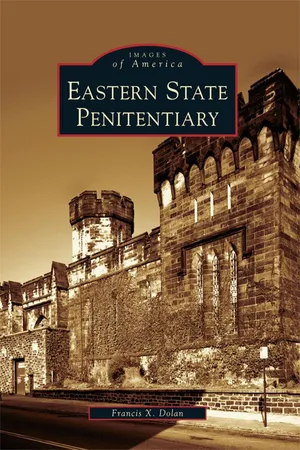
- 128 pages
- English
- ePUB (mobile friendly)
- Available on iOS & Android
eBook - ePub
Eastern State Penitentiary
About this book
The most significant building project of its time, Eastern State Penitentiary was designed to reshape the minds of its inmates, rather than break their spirits.
It was believed that by keeping prisoners isolated in the chapel-like cells the inner light of their souls would emerge, leading them to discover penitence. In reality, the isolation was nearly impossible to maintain, and the lofty goals of the founders crumbled in the 20th century, much like the building itself. Originally located on the outskirts of Philadelphia, the city eventually expanded and swallowed up the prison. Its unique location became problematic, and numerous escapes and riots threatened the civilian populace in the area. The prison was home to such well-known figures as Chicago mob boss Al Capone and bank robber Willie Sutton, once the most wanted man in America. Eastern State Penitentiary chronicles the history of this massive prison from its opening in 1829 to its closing and abandonment in 1971, and finally to the rebirth of the prison in the 1990s as a thriving historic site and national historic landmark
Trusted by 375,005 students
Access to over 1.5 million titles for a fair monthly price.
Study more efficiently using our study tools.
Information
One
A CITY WITHIN A CITY

This etching from 1855 shows the original seven-cell block design envisioned by the architect John Haviland. This design was completed in 1836, seven years after the prison was opened, and 14 years after construction began. In this facility, 450 inmates could be housed. To the residents of the city, the prison was an ominous sight and a constant reminder of what would happen should one run astray of the law. This etching was made by Samuel Cowperthwaite, inmate No. 2954. How Cowperthwaite obtained such detailed knowledge of the prison’s layout is unknown. This image was a gift from Norman Johnston. (Courtesy of the Eastern State Penitentiary Historic Site Archives.)

Built in an area known as Francisville about two miles outside of Philadelphia, Eastern State Penitentiary occupied a former cherry orchard that was 12 acres in size. Costing almost $800,000, it was one of the most expensive building projects in the world. The massive stonewalls of the prison are approximately a half mile in length, over 30 feet high, 8 feet thick at the base, and extend another 10 feet underground. (Courtesy of the Eastern State Penitentiary Historic Site Archives.)
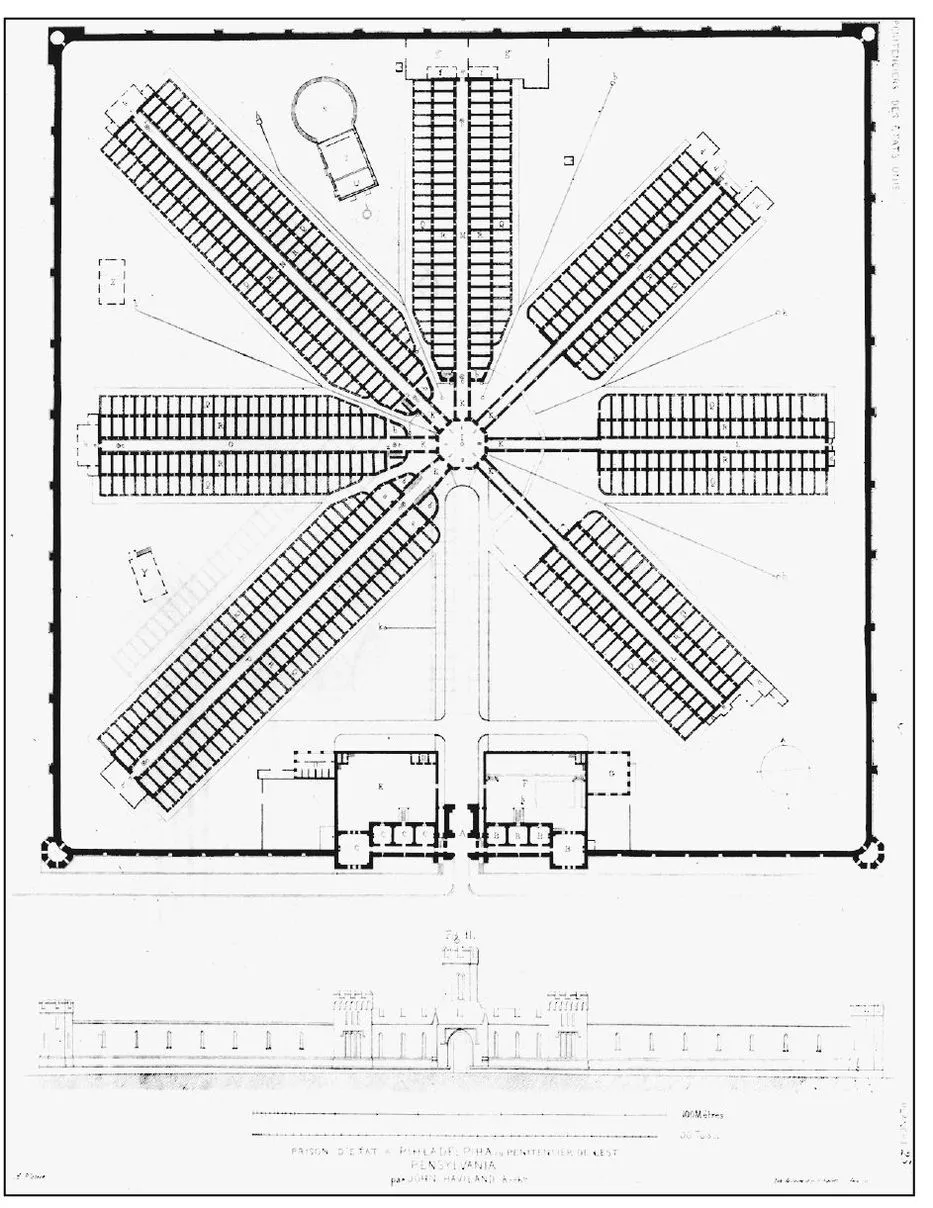
This image is from the book Rapports sur les penitenciers des Etats-Unis by Frederic-Auguste Demetz and Giollaume-Abel Blouet. The centrally located observation hub allowed the overseers to monitor the entire building from one spot. This radial design has proven itself to be very influential, spawning over 300 prisons around the world that have copied this “hub and spoke” plan. In addition to the seven cell blocks, the penitentiary also had a stand alone building that served a pump house.

The neo-Gothic facade of Eastern State Penitentiary was designed by architect John Haviland to strike fear into the hearts of those who thought of committing a crime. Built atop a hill, the prison was visible for miles and was in stark contrast to the rural landscape around it. Many of the local residents were immigrants from Europe, and for them, the castle-like structure conjured up thoughts of dungeons and torture, remnants of a feudal system that dominated Europe for a time. This image was from the 1924 annual report.

Arrow slit windows adorn the outer walls, and battlements encircle the tops of the towers. However, neither of these features are functional and were intended solely to contribute to the imposing facade of the building. The stone used to build the walls is primarily Wissahickon Schist and Gneiss, which came from quarries in the Philadelphia region. This image was the gift of an anonymous donor. (Courtesy of the Eastern State Penitentiary Historic Site Archives.)

Built into the walls of the prison is the three-story administrative building. Some of the rooms located inside were the warden’s office, the original intake facility, laundry, kitchen, hospital, and the residence for the warden and his family. In the 1880s, the warden’s office was moved into the prison, only to have it return to the administrative building later on due to security concerns. This is the an early photograph taken of the penitentiary, from around 1897. This image is from the book Warden Cassidy on Prisons and Convicts by Michael J. Cassidy.
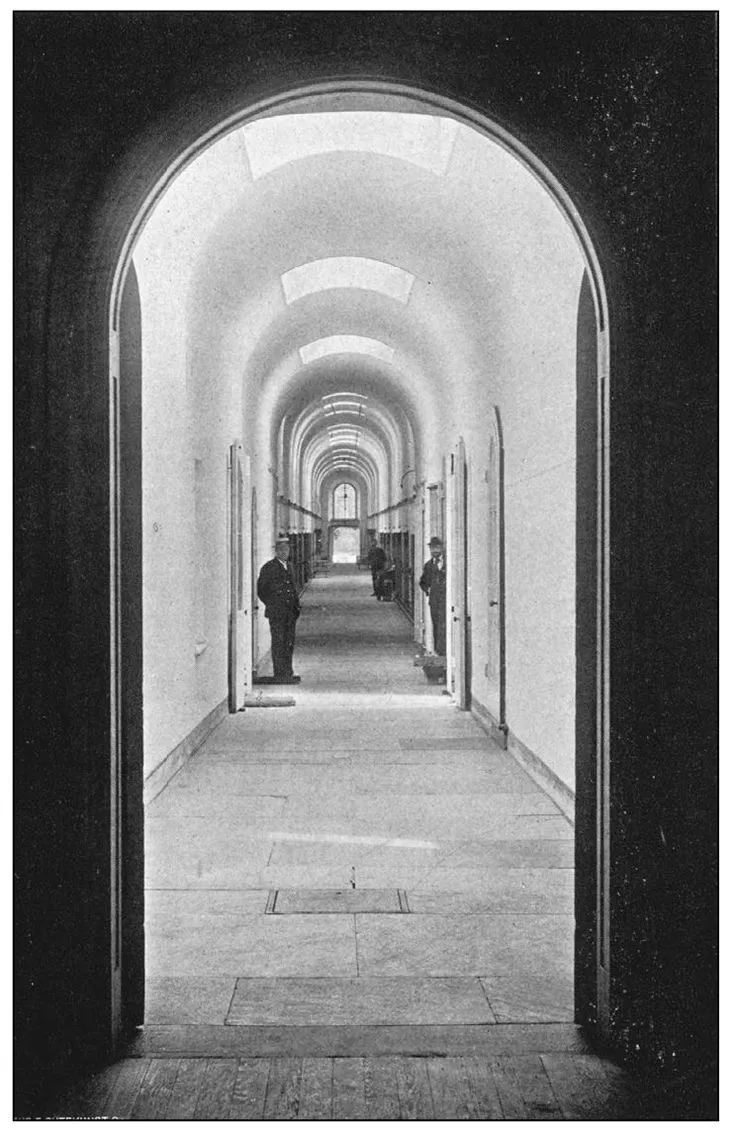
The original one-story cell blocks at Eastern State Penitentiary, cell blocks one through three, were the most luxurious prison facilities in the world. The interior of the prison was designed to resemble a cathedral to inspire penitence, or true regret, in the men and women housed there. Hence the new term, penitentiary. Large barrel-vaulted ceilings and skylights were the norm throughout the facility. This image is from the book Warden Cassidy on Prisons and Convicts by Michael J. Cassidy.

John Haviland’s original design called for seven one-story cell blocks to house inmates. Unfortunately this design only created 256 cells, far short of what the state envisioned. As a result, cell blocks four through seven were constructed with a second floor, called a gallery. The result was that inmates on the gallery were left without exercise yards and those on the first floor had poorly functioning skylights. Compromise was a regular part of Eastern State Penitentiary from the very beginning. This photograph was donated by the John D. Shearer family. (Courtesy of the Eastern State Penitentiary Historic Site Archives.)
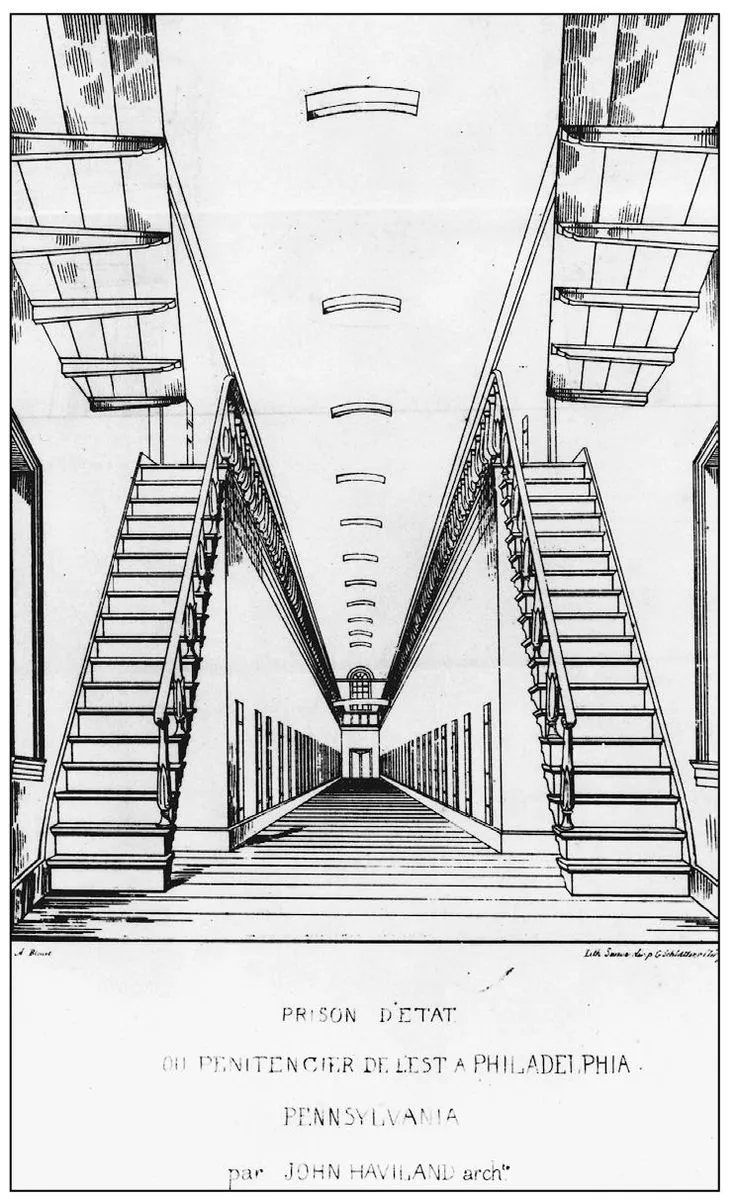
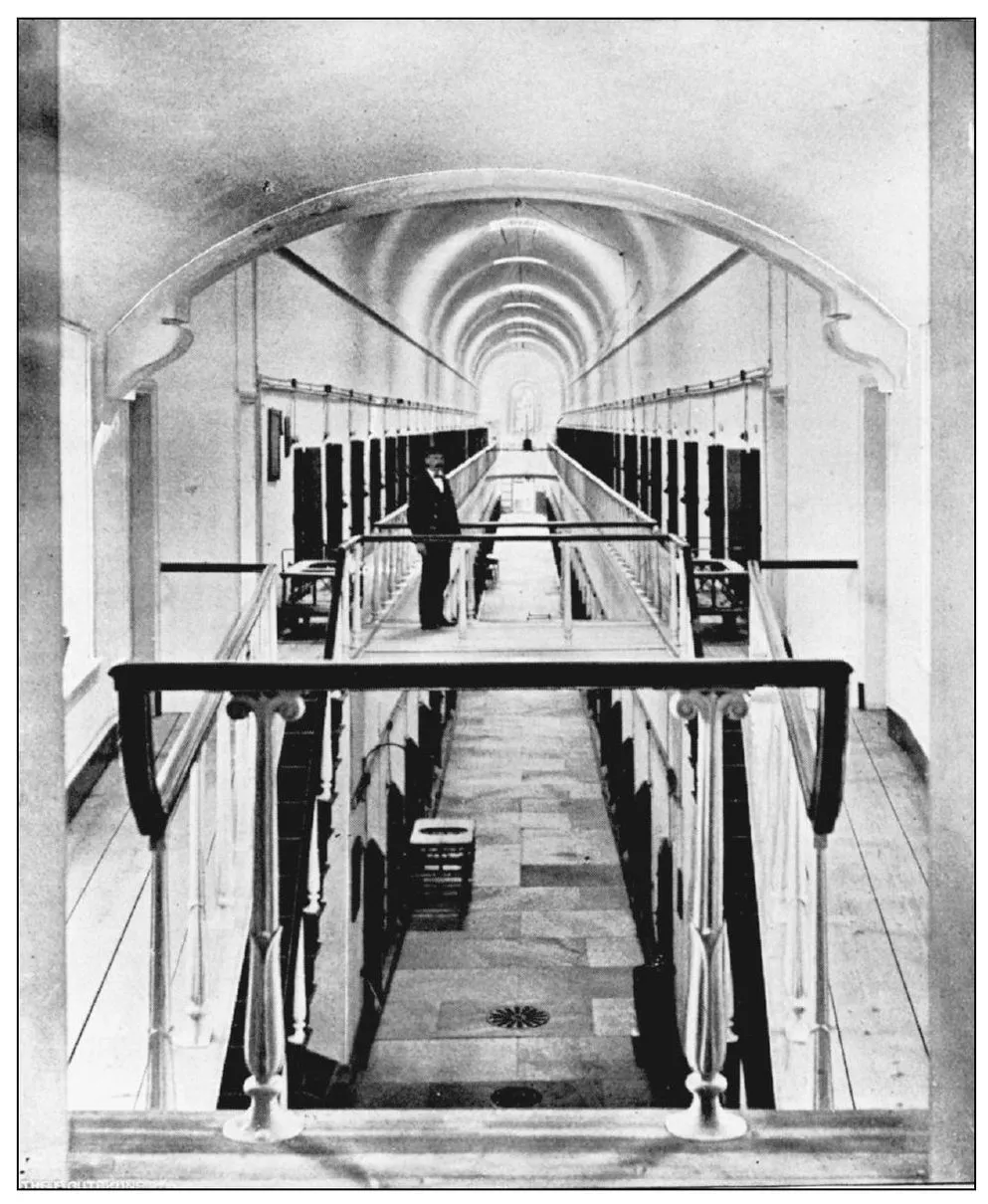
Completed in 1836, cell block seven was the largest and grandest of all the cell blocks in Eastern State Penitentiary. Confronted with the problem of overcrowding due to limited cells, architect John Haviland was forced to compromise his design of single story cell blocks, resulting in the two-tiered cell blocks of four through seven. Cell block seven contained 136 cells, 68 on each of its two levels. This image is from the book Rapports sur les penitenciers des Etats-Unis by Frederic-Auguste Demetz and Giollaume-Abel Blouet.
With the completion of cell block seven...
Table of contents
- Title Page
- Copyright Page
- Table of Contents
- ACKNOWLEDGMENTS
- INTRODUCTION
- One - A CITY WITHIN A CITY
- Two - THE FACES OF EASTERN STATE PENITENTIARY
- Three - ALL WORK AND SOME PLAY
- Four - ESCAPES AND RIOTS
- Five - RUIN AND REBIRTH
Frequently asked questions
Yes, you can cancel anytime from the Subscription tab in your account settings on the Perlego website. Your subscription will stay active until the end of your current billing period. Learn how to cancel your subscription
No, books cannot be downloaded as external files, such as PDFs, for use outside of Perlego. However, you can download books within the Perlego app for offline reading on mobile or tablet. Learn how to download books offline
Perlego offers two plans: Essential and Complete
- Essential is ideal for learners and professionals who enjoy exploring a wide range of subjects. Access the Essential Library with 800,000+ trusted titles and best-sellers across business, personal growth, and the humanities. Includes unlimited reading time and Standard Read Aloud voice.
- Complete: Perfect for advanced learners and researchers needing full, unrestricted access. Unlock 1.5M+ books across hundreds of subjects, including academic and specialized titles. The Complete Plan also includes advanced features like Premium Read Aloud and Research Assistant.
We are an online textbook subscription service, where you can get access to an entire online library for less than the price of a single book per month. With over 1.5 million books across 990+ topics, we’ve got you covered! Learn about our mission
Look out for the read-aloud symbol on your next book to see if you can listen to it. The read-aloud tool reads text aloud for you, highlighting the text as it is being read. You can pause it, speed it up and slow it down. Learn more about Read Aloud
Yes! You can use the Perlego app on both iOS and Android devices to read anytime, anywhere — even offline. Perfect for commutes or when you’re on the go.
Please note we cannot support devices running on iOS 13 and Android 7 or earlier. Learn more about using the app
Please note we cannot support devices running on iOS 13 and Android 7 or earlier. Learn more about using the app
Yes, you can access Eastern State Penitentiary by Francis X. Dolan in PDF and/or ePUB format, as well as other popular books in History & North American History. We have over 1.5 million books available in our catalogue for you to explore.