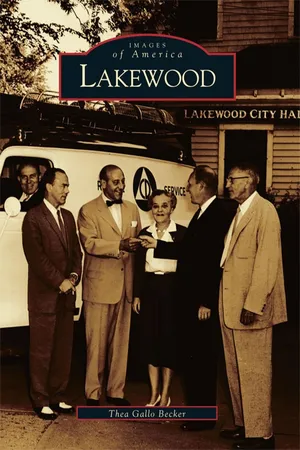
Named for its natural setting on the south shore of Lake Erie, Lakewood, Ohio was one of Cleveland's original suburbs. Incorporated as a city in 1911, Lakewood experienced tremendous growth during the early 20th century, and became known as "Cleveland's Fashionable Suburb, " and a "City of Beautiful Homes, " as it boasted some of the finest Victorian residences in the area. Using a wonderful collection of historic photographs, many from the Lakewood Historical Society, the pages of this book take you on a tour of Lakewood's history, chronicling the people, places, and events that have made the suburb one of the area's best places to live.
- 128 pages
- English
- ePUB (mobile friendly)
- Available on iOS & Android
eBook - ePub
Lakewood
About this book
Trusted by 375,005 students
Access to over 1.5 million titles for a fair monthly price.
Study more efficiently using our study tools.
Information
One
FARMING, BUSINESS, AND INDUSTRY

THE JAMES NICHOLSON HOUSE. The oldest wooden frame house in Lakewood was built in 1835 by James Nicholson, the area’s first permanent settler. Located at 13335 Detroit Avenue, this simple two-story white colonial is typical of the New England architectural style to which Nicholson was accustomed before he came to Rockport Township from Massachusetts in 1818. In 1979 the Nicholson house was placed on the National Register of Historic Places. (LHS.)

THE MAILE BRICKYARD. This 1910 photograph shows the brickyard of Christopher Maile, son of William R. Maile, Lakewood’s earliest and most successful brickmaker and Hamlet trustee. Christopher Maile opened this brickyard on Hilliard Boulevard and Warren Road. The richness of the soil made brickmaking one of the earliest industries in Lakewood. Early settlers turned away from log cabins and used the sturdier brick or sandstone for building homes. (LHS.)

THE FIRST BRICK HOUSE IN LAKEWOOD. Price French, an early settler who came to Rockport Township in 1828, built the first brick house in Lakewood on the southwest corner of Detroit and Wyandotte Avenue. The two-story mustard-colored home used bricks made from clay, an abundant natural resource in Lakewood. The home featured an open front porch. Like many other historic homes on Detroit Avenue, it was razed for commercial use. (LHS.)

THE HONAM-HOTCHKISS HOUSE. In 1838 John Honam, a Scottish weaver, built a stone house on the northwest corner of Detroit and St. Charles Avenues. He used Berea sandstone dug from a nearby quarry. His daughter Isabelle resided in it with her husband, Orville Hotchkiss, until 1870. Margaret Manor Butler, standing in the doorway, curator of the Lakewood Historical Society, led a campaign to save Lakewood’s oldest stone house. (LHS.)

CONSTRUCTION OF BELLE AVENUE. Many of Lakewood’s early settlers purchased large tracts of land extending from Detroit Avenue down to Lake Erie. As land values appreciated from an original purchase price of about $10/acre to as much as $2,000/acre, landholders like Nicholson and Honam sold their interests. In this photograph workers are cutting a new road, Belle Avenue, named for Isabelle Honam-Hotchkiss whose family had owned the land. (LHS.)

THE JOHN C. HALL HOUSE. John Hall, the youngest child of Joseph and Sarah Hall, built this home at 16913 Detroit Avenue in 1875. The Hall family, prosperous fruit farmers, owned large tracts of land along Detroit Avenue on which they built magnificent homes. This Victorian mansion featured ceiling-high windows, large rooms, and marble fireplaces. After it was razed the site was used for a park before becoming home of the YMCA/YWCA. (LHS.)

THE HALL FRUIT FARM. John C. Hall was perhaps the wealthiest and most successful member of the Hall family, building up one of the largest and most productive fruit farms in the area. Here is an open field on the Hall farm, which extended north from Detroit Avenue to Lake Erie. Workers are busily picking fruit with small straw baskets tied to their sides. (LHS.)

THE BERRY PICKERS. Early settlers discovered that Lakewood’s rich soil was ideal for growing fruit. Soon fruit farming became a thriving business. Grapes, strawberries, blueberries, apples, peaches, and pears grew in abundance as Lakewood became a major supplier of produce for Cleveland. Growers owned large estates on which workers, including entire families, tended the orchards and vineyards. Here a group of hearty children are toting their fruit baskets to harvest the day’s yield. (LHS.)

THE ANDREWS FAMILY HOME. One of the most prosperous fruit-growing families not only in Lakewood but all of Ohio was the Andrews family. They owned 80 acres of the richest land extending from Detroit Avenue north t...
Table of contents
- Dedication
- Title Page
- Copyright Page
- Table of Contents
- ACKNOWLEDGMENTS
- INTRODUCTION
- One - FARMING, BUSINESS, AND INDUSTRY
- Two - MUNICIPAL LAKEWOOD
- Three - TRANSPORTATION
- Four - LIBRARIES, SCHOOLS, AND CHURCHES
- Five - CLIFTON PARK
- Six - THE GOLD COAST
- Seven - ENTERTAINMENT AND RECREATION
Frequently asked questions
Yes, you can cancel anytime from the Subscription tab in your account settings on the Perlego website. Your subscription will stay active until the end of your current billing period. Learn how to cancel your subscription
No, books cannot be downloaded as external files, such as PDFs, for use outside of Perlego. However, you can download books within the Perlego app for offline reading on mobile or tablet. Learn how to download books offline
Perlego offers two plans: Essential and Complete
- Essential is ideal for learners and professionals who enjoy exploring a wide range of subjects. Access the Essential Library with 800,000+ trusted titles and best-sellers across business, personal growth, and the humanities. Includes unlimited reading time and Standard Read Aloud voice.
- Complete: Perfect for advanced learners and researchers needing full, unrestricted access. Unlock 1.5M+ books across hundreds of subjects, including academic and specialized titles. The Complete Plan also includes advanced features like Premium Read Aloud and Research Assistant.
We are an online textbook subscription service, where you can get access to an entire online library for less than the price of a single book per month. With over 1.5 million books across 990+ topics, we’ve got you covered! Learn about our mission
Look out for the read-aloud symbol on your next book to see if you can listen to it. The read-aloud tool reads text aloud for you, highlighting the text as it is being read. You can pause it, speed it up and slow it down. Learn more about Read Aloud
Yes! You can use the Perlego app on both iOS and Android devices to read anytime, anywhere — even offline. Perfect for commutes or when you’re on the go.
Please note we cannot support devices running on iOS 13 and Android 7 or earlier. Learn more about using the app
Please note we cannot support devices running on iOS 13 and Android 7 or earlier. Learn more about using the app
Yes, you can access Lakewood by Thea Gallo Becker in PDF and/or ePUB format, as well as other popular books in History & North American History. We have over 1.5 million books available in our catalogue for you to explore.