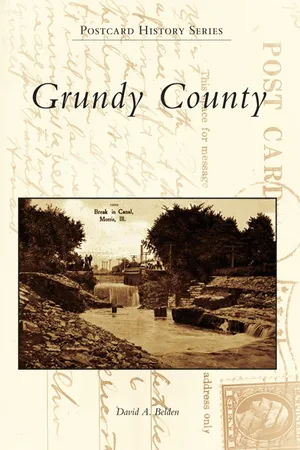
In 1673, Louis Jolliet and Fr. Jacques Marquette were the first Europeans to explore the Mississippi River and the Illinois River valleys. With their canoes loaded with furs, pelts, and other goods on their return trip to Montreal, their explorations through much of the interior of Illinois included encounters with Native American tribes and took them through what is now Grundy County. Over 150 years later, the first permanent residents, including William Marquis, began settling and farming in the area. While the chief occupation of the residents is agriculture, the county also has the Illinois River and the Illinois and Michigan Canal that pass through its northern sections, as well as the Rock Island and the Chicago and Alton Railways. With communities rich in history and small-town charm, Grundy County continues to draw visitors and residents to its towns, parks, museums, rivers, and lakes. Grundy County attempts to reveal this unique county and its sense of community and pride.
- 128 pages
- English
- ePUB (mobile friendly)
- Available on iOS & Android
eBook - ePub
Grundy County
About this book
Trusted by 375,005 students
Access to over 1.5 million titles for a fair monthly price.
Study more efficiently using our study tools.
Information
Three
DIVIDED-BACK POSTCARDS 1907–1914

Liberty Street, looking north from Main Street, is the scene of this divided-back postcard from 1913. Many of the original buildings along Liberty Street are still standing today. The three-story building on the northwest corner of Liberty and Main Streets is the old Gebhard Brewery that was built in the late 1880s, the three-story 1905 Collins Building (former Farmers and Merchants National Bank) is a block north on the northwest corner of Jackson and Liberty Streets, and the building on the northeast corner of Liberty and Main Streets (lower right) houses the Fabric Center today.

In 1904, citizens and farmers of Mazon came together and held a colt show on the main street of the town. This colt show proved to be such a success that, the next year, this same group of people bought a plot of land northwest of town and incorporated the Grundy County Agricultural Fair. Over the past 100 years, the Grundy County fair has grown because of the hard work and dedication of many people. This divided-back postcard, postmarked in 1913, shows citizens attending the annual event. Notice the large sign that advertises, “Your Photo Postcard While You Wait.”

Morris has several arch bridges constructed from area limestone. This divided-era postcard shows the arch bridge under the Rock Island railroad tracks in Goold Park directly south of the community swimming pool. Mailed March 26, 1910, and sent to Miss Helen Strasburg of Baltimore, Maryland, the correspondence reads, “Easter Greeting, to Helen from Margaret, very busy here. Hope all are well.”

The growth of Grundy County can be directly traced to the building of the Illinois and Michigan Canal. Completed in 1848 and nearly 100 miles long, the canal was the final link in a national plan to connect different regions of North American via waterways. With the help of many foreign-born immigrants, the six-foot-deep canal was dug through the northern part of Grundy County and connected the cities of Channahon and Morris to the east and west sections of the canal. In this divided-back postcard, three people can be seen standing on the footbridge of Lock 6 in Channahon. To the left, and lost in the trees, is the locktender’s house, which is still standing today.
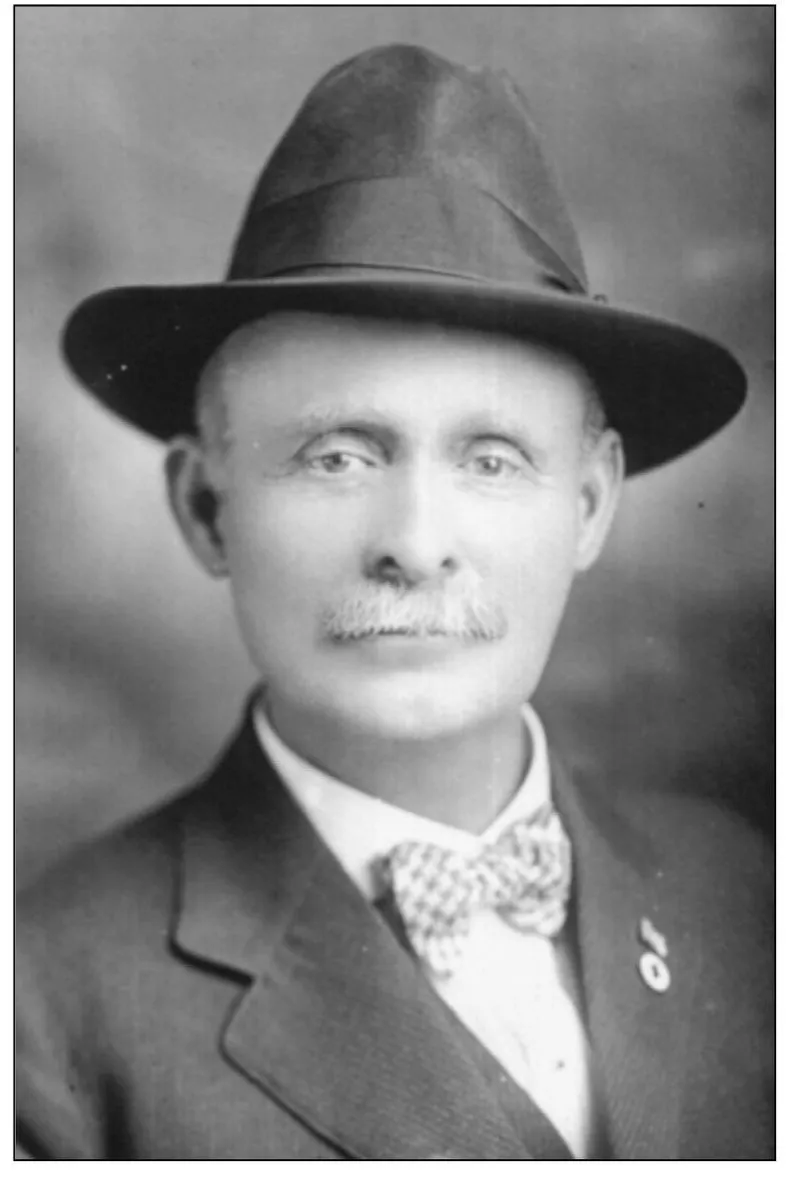
George Bedford was a successful Republican candidate for county judge in Grundy County. In addition to being a county judge, Bedford was also an amateur photographer from Morris who took many pictures around various Grundy County communities. He was known to take people’s pictures and send the photographs to them as a postcards. This divided-back-era postcard was used by Bedford as a campaign greeting card. Judge Bedford, who died in 1949, was a bachelor and lived in a very small house at 418 Fulton Street behind the old Masonic temple.

The town of Minooka was laid out as a village in 1852 by Ransom Gardner, who owned nearly 500 acres in the area and was eager to have the Rock Island Railroad come through the town. “Greetings from Minooka, Ill” is a 1910 postmarked postcard that depicts eight scenes from the area, including the DuPage River, Main Street, the concrete bridge, the railroad station depot, Truby’s grain elevator, St. Mary’s Church, Aux Sable Creek, and the farmer’s elevator.

Scottish-born William Somerville arrived in Coal City in 1895. An aviation pioneer, civic and business leader, and inventor, Somerville organized the Illinois Aero Construction Company in Coal City in 1911. Earl Dougherty was one of his best pilots. A fire at the factory in 1912 resulted in the loss of all planes, and Somerville quit the business in 1914. In this divided-back postcard that was never mailed, Somerville is standing at the propeller, and Dougherty is in the back on the left. The date on the front of the postcard is October 25, 1912.

Postmarked in Morris on July 25, 1910, this divided-back postcard reads, “Dear ‘Okey,’ I sent the collar in the same mail as this. As the mail was only two cts. I sent the other t...
Table of contents
- Title Page
- Copyright Page
- Table of Contents
- ACKNOWLEDGMENTS
- INTRODUCTION
- One - EARLY PRIVATE MAILING CARDS 1880–1901
- Two - UNDIVIDED-BACK POSTCARDS 1901–1907
- Three - DIVIDED-BACK POSTCARDS 1907–1914
- Four - WHITE-BORDER AND DIVIDED-BACK POSTCARDS 1915-1930
- Five - LINEN AND PHOTOCHROME POSTCARDS 1930–2007
Frequently asked questions
Yes, you can cancel anytime from the Subscription tab in your account settings on the Perlego website. Your subscription will stay active until the end of your current billing period. Learn how to cancel your subscription
No, books cannot be downloaded as external files, such as PDFs, for use outside of Perlego. However, you can download books within the Perlego app for offline reading on mobile or tablet. Learn how to download books offline
Perlego offers two plans: Essential and Complete
- Essential is ideal for learners and professionals who enjoy exploring a wide range of subjects. Access the Essential Library with 800,000+ trusted titles and best-sellers across business, personal growth, and the humanities. Includes unlimited reading time and Standard Read Aloud voice.
- Complete: Perfect for advanced learners and researchers needing full, unrestricted access. Unlock 1.5M+ books across hundreds of subjects, including academic and specialized titles. The Complete Plan also includes advanced features like Premium Read Aloud and Research Assistant.
We are an online textbook subscription service, where you can get access to an entire online library for less than the price of a single book per month. With over 1.5 million books across 990+ topics, we’ve got you covered! Learn about our mission
Look out for the read-aloud symbol on your next book to see if you can listen to it. The read-aloud tool reads text aloud for you, highlighting the text as it is being read. You can pause it, speed it up and slow it down. Learn more about Read Aloud
Yes! You can use the Perlego app on both iOS and Android devices to read anytime, anywhere — even offline. Perfect for commutes or when you’re on the go.
Please note we cannot support devices running on iOS 13 and Android 7 or earlier. Learn more about using the app
Please note we cannot support devices running on iOS 13 and Android 7 or earlier. Learn more about using the app
Yes, you can access Grundy County by David A. Belden in PDF and/or ePUB format, as well as other popular books in History & North American History. We have over 1.5 million books available in our catalogue for you to explore.