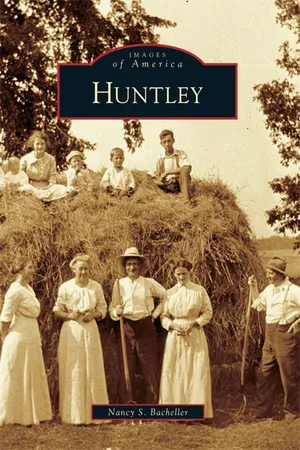
Huntley was founded in 1851. Its first boom yearsthe 1850s to 1920ssaw the town prosper thanks to the local dairy industry. Prolific dairy farmers provided milk for the many local condensing plants and cheese factories and sent huge surpluses into Chicago by train each day. It was said that the Huntley area produced more milk per square mile than anywhere else in the world. Businesses, homes, and churches all grew with the population. Village founders, movers and shakers of a century and more ago, as well as everyday workers and village residents are captured here in vintage images, showing what life was like in Huntley in years gone by.
- 128 pages
- English
- ePUB (mobile friendly)
- Available on iOS & Android
eBook - ePub
Huntley
About this book
Trusted by 375,005 students
Access to over 1.5 million titles for a fair monthly price.
Study more efficiently using our study tools.
Information
Two
MILK AND FARMING

Huntley began in the 1840s primarily as a farming community. Families worked the land for their own subsistence. Good times made a surplus of farm products available, and farmers were able to produce enough milk to supply local creameries and to send to other milk plants in Chicago. The numerous milk cans waiting on the platform to be loaded on to the train show just how much excess milk Huntley farmers could supply each day. The large building in the background is one of the major local milk factories, owned by the Cornell brothers. This photograph, taken in March 1907, likely was one of the last of the factory at that location. The building burned to the ground on May 7, 1907. (Courtesy of Tom and Barb Conley.)

The bounteous output of local dairy herds, the proliferation of milk processing factories in the area, and the extension of the train line into town all made for prosperity for Huntley. Here the Chicago and North Western Railway train reaches the Huntley depot. To the left is the Jelke milk factory. The smokestack showing above the train is from the Wood and Weltzien (later Cornell) milk plant. The barn and windmill on the right belong to Edward Keating, a cattle dealer. (Courtesy of Huntley Area Public Library.)

Chicago milk dealers visited Huntley early each spring to meet with farmers and bargain for a year’s supply of milk. Farmers and dealers met on contract day to sign agreements for future milk delivery. The practice began soon after the railroad came through Huntley in the 1850s, allowing for easy transport of fresh milk into the city. Each morning, farmers loaded cans of milk onto their wagons, hitched the wagon to a team of horses, and drove into Huntley to meet the 8:00 a.m. milk train bound for Chicago. (Courtesy of Huntley Area Public Library.)

John G. Weltzien (1847–1916) came to Huntley in 1860. He farmed for many years and later moved to town where he was in business with D. E. Wood in the manufacture of cheese and butter. Their factory had the latest technology, including a refrigeration plant, the first without using ice. When Wood retired, Weltzien went into business with the Cornell brothers. An article in the July 21, 1894, Huntley News reported, “The Huntley cheese factory owned by Messrs. Weltzien and Cornell is the largest in capacity and output of any in existence.” The article stated, “The average receipts of the creamery are not less than ten tons of milk for every day of the year.” Weltzien was a prominent political figure, serving as president of the Huntley Village Board for many years. (Courtesy of Tom and Barb Conley.)

The Cornell Brothers factory, which produced butter and cheese, was located along the railroad tracks between Main and Mill Streets. Milk was purchased from farmers on a contract basis, ranging from 55¢ for 100 pounds in the spring to $1.20 in October. This factory burned to the ground on May 7, 1907. Cornell Brothers subsequently moved its operation to what recently was the Catty Corporation on Church Street. (Photograph by Ed Cook; courtesy of Tom and Barb Conley.)

This building at Church and Mill Streets, near the Chicago and North Western Railway tracks, served as home to the Cornell milk factory then the Jelke Condensed Milk factory. After prohibition ended, it was a brewery (see chapter 9). During World War II, it was the William Fencil Gasket Company (see chapter 5). It most recently served as the Catty Corporation, a manufacturer of foil papers for food packaging. (Courtesy of Tom and Barb Conley.)
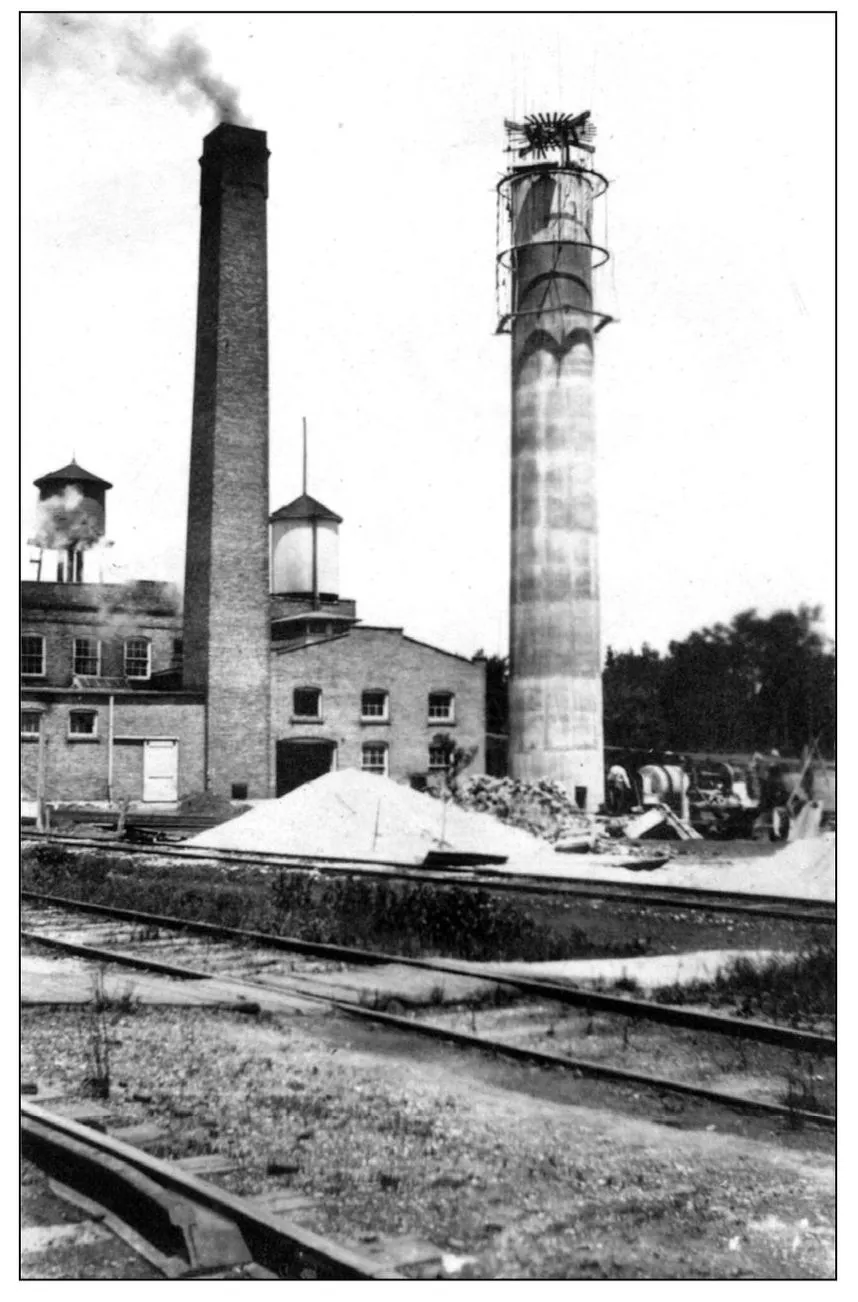
The large towers on the Cornell Brothers milk factory were under construction in this undated photograph. The Cornells moved to this l...
Table of contents
- Title Page
- Copyright Page
- Dedication
- Table of Contents
- ACKNOWLEDGMENTS
- INTRODUCTION
- One - BEGINNINGS
- Two - MILK AND FARMING
- Three - CHURCHES
- Four - SCHOOL DAYS
- Five - A MARK IN THE WORLD
- Six - HISTORIC SQUARE AND AERIALS
- Seven - HAVING FUN
- Eight - LIFE IN HUNTLEY
- Nine - DOING BUSINESS
Frequently asked questions
Yes, you can cancel anytime from the Subscription tab in your account settings on the Perlego website. Your subscription will stay active until the end of your current billing period. Learn how to cancel your subscription
No, books cannot be downloaded as external files, such as PDFs, for use outside of Perlego. However, you can download books within the Perlego app for offline reading on mobile or tablet. Learn how to download books offline
Perlego offers two plans: Essential and Complete
- Essential is ideal for learners and professionals who enjoy exploring a wide range of subjects. Access the Essential Library with 800,000+ trusted titles and best-sellers across business, personal growth, and the humanities. Includes unlimited reading time and Standard Read Aloud voice.
- Complete: Perfect for advanced learners and researchers needing full, unrestricted access. Unlock 1.5M+ books across hundreds of subjects, including academic and specialized titles. The Complete Plan also includes advanced features like Premium Read Aloud and Research Assistant.
We are an online textbook subscription service, where you can get access to an entire online library for less than the price of a single book per month. With over 1.5 million books across 990+ topics, we’ve got you covered! Learn about our mission
Look out for the read-aloud symbol on your next book to see if you can listen to it. The read-aloud tool reads text aloud for you, highlighting the text as it is being read. You can pause it, speed it up and slow it down. Learn more about Read Aloud
Yes! You can use the Perlego app on both iOS and Android devices to read anytime, anywhere — even offline. Perfect for commutes or when you’re on the go.
Please note we cannot support devices running on iOS 13 and Android 7 or earlier. Learn more about using the app
Please note we cannot support devices running on iOS 13 and Android 7 or earlier. Learn more about using the app
Yes, you can access Huntley by Nancy S. Bacheller in PDF and/or ePUB format, as well as other popular books in History & North American History. We have over 1.5 million books available in our catalogue for you to explore.