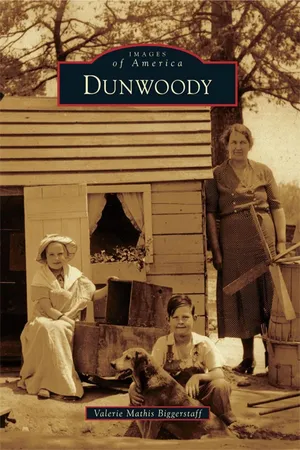
The name Dunwoody developed from a spelling error. Soon after the Civil War ended, Maj. Charles Dunwody left nearby Roswell to settle in a new community and decided to start a post office. The post office added one o to his name, and from that moment, the area was known as Dunwoody. Beginning as a humble farming community, Dunwoody grew into a popular suburb of Atlanta. Careful growth control, under the supervision of the Dunwoody Homeowners Association, kept Dunwoody from becoming too developed. The Dunwoody Preservation Trust works to identify and save Dunwoodys historical landmarks. The Dunwoody Farmhouse, located at the central crossroads of the community, is one of the trusts success stories and is enjoyed by many.
- 128 pages
- English
- ePUB (mobile friendly)
- Available on iOS & Android
eBook - ePub
Dunwoody
About this book
Trusted by 375,005 students
Access to over 1.5 million titles for a fair monthly price.
Study more efficiently using our study tools.
Information
Two
1900S HOMES AND PEOPLE

Glenn Greer Austin and Nettie Southern Austin posed for this marriage photograph in 1906. Their marriage took place on December 25 and was the first held in the newly organized Dunwoody Methodist Church. The couple first lived in a home on Austin family land in Sandy Springs near the Chattahoochee River. Their first child, Gladys, was born there. Daughter Nettie Mae Austin Kelley remembers her mother talking about being frightened that the baby carriage would roll into the Chattahoochee River. (Courtesy of the Austin family.)

This young member of the Carpenter family is Harvey Carpenter, son of Cicero and Matt Carpenter. In the mid-1940s, Harvey and his wife, Dorothy, owned the store and post office at the intersection of Mount Vernon Road and Chamblee Dunwoody Road. (Courtesy of the Anderson family.)

The Austin family home was built in 1924 on land on the north side of Mount Vernon Road. Glenn G. and Nettie Southern Austin built it to accommodate their family of six children. Timber was cut from their own land for the home. The address of the home was 1200 Mount Vernon Road, but all that was needed for mail delivery was a name and “Dunwoody, Georgia.” (Courtesy of the Austin family.)

This 1915 map of Dunwoody shows who the property owners were in the center of the community. Today’s Mount Vernon Road was then called Lawrenceville Road. The Dunwoody Depot and the path of the railroad (here identified as the “Southern Railroad Roswell Branch”) are both shown. The area labeled “Southern Railroad” is where the railroad section houses were located. Dr. Pucket owned land behind these. The Dunwoody Baptist Church was located next to the section houses, and New Hope Presbyterian Church is shown farther north. Dunwoody Methodist Church is at the bottom of the map. (Courtesy of Jim Perkins.)

Nettie Southern Austin poses in 1920 in front of the family home with five of her children. She and Glenn Greer Austin eventually had six children. Clockwise from center are baby Glenn with mother Nettie, Sarah, Nettie Mae, John, and Gladys. (Courtesy of the Austin family.)

This photograph of Gladys Ruth Austin was taken around 1922 in front of the well at the family home place. Gladys was born in 1907, attended Agnes Scott College, and was a teacher in Atlanta schools. (Courtesy of the Austin family.)

This 1920s photograph of John and Sally Southern features the family Studebaker. John W. Southern (1848–1924) was born in South Carolina. Sarah E. Jenkins Southern (1841–1924) grew up in Atlanta with many close relatives whom she cherished going to visit. Nettie Mae Austin Kelley, granddaughter of John and Sally Southern, recalls the family history that “one night during the Civil War a shell exploded in the living room where her [Sally’s] family sat. They left Atlanta at night in an open wagon with few possessions and fled to Macon.” (Courtesy of the Austin family.)

The woman at the bottom left of this photograph is Mary Jane Copeland, and she is holding her gran...
Table of contents
- Title Page
- Copyright Page
- Dedication
- Table of Contents
- FOREWORD
- ACKNOWLEDGMENTS
- INTRODUCTION
- One - CHEROKEE TRAILS AND EARLY SETTLERS
- Two - 1900S HOMES AND PEOPLE
- Three - THE ROSWELL RAILROAD
- Four - SCHOOLS
- Five - WARTIME IN DUNWOODY
- Six - CHURCHES
- Seven - BUSINESS AND COMMUNITY
- BIBLIOGRAPHY
Frequently asked questions
Yes, you can cancel anytime from the Subscription tab in your account settings on the Perlego website. Your subscription will stay active until the end of your current billing period. Learn how to cancel your subscription
No, books cannot be downloaded as external files, such as PDFs, for use outside of Perlego. However, you can download books within the Perlego app for offline reading on mobile or tablet. Learn how to download books offline
Perlego offers two plans: Essential and Complete
- Essential is ideal for learners and professionals who enjoy exploring a wide range of subjects. Access the Essential Library with 800,000+ trusted titles and best-sellers across business, personal growth, and the humanities. Includes unlimited reading time and Standard Read Aloud voice.
- Complete: Perfect for advanced learners and researchers needing full, unrestricted access. Unlock 1.5M+ books across hundreds of subjects, including academic and specialized titles. The Complete Plan also includes advanced features like Premium Read Aloud and Research Assistant.
We are an online textbook subscription service, where you can get access to an entire online library for less than the price of a single book per month. With over 1.5 million books across 990+ topics, we’ve got you covered! Learn about our mission
Look out for the read-aloud symbol on your next book to see if you can listen to it. The read-aloud tool reads text aloud for you, highlighting the text as it is being read. You can pause it, speed it up and slow it down. Learn more about Read Aloud
Yes! You can use the Perlego app on both iOS and Android devices to read anytime, anywhere — even offline. Perfect for commutes or when you’re on the go.
Please note we cannot support devices running on iOS 13 and Android 7 or earlier. Learn more about using the app
Please note we cannot support devices running on iOS 13 and Android 7 or earlier. Learn more about using the app
Yes, you can access Dunwoody by Valerie M. Biggerstaff in PDF and/or ePUB format, as well as other popular books in History & North American History. We have over 1.5 million books available in our catalogue for you to explore.