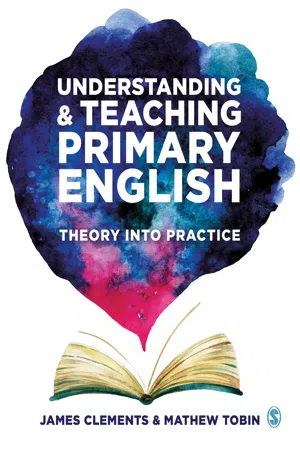
Understanding and Teaching Primary English
eBook - ePub

Understanding and Teaching Primary English

Theory Into Practice

  1. 344 pages
  2. English
  3. ePUB (mobile friendly)
  4. Available on iOS & Android
eBook - ePub

Understanding and Teaching Primary English

Theory Into Practice

About this book

Inspiring and supporting you to become an insightful, creative and professional teacher of primary English.

Teaching children English is an opportunity to give them skills that will enrich their entire lives and is a crucial part of their intellectual development.Covering all major aspects of primary English and following the foundations set in the early years, this booktakes you throughyour teacher training andinto yourearly career in the classroom.

Each topic explores what we know from theory and the latest research, and then demonstrates how you can use this understanding in practice. Drawing on the authors' own knowledge and experiences in the classroom, the book is full of practical advice and strategies to support your own teaching, while also helping you develop your subject knowledge.

Key topics include:

·Reading and writing in the early years

·Curriculum design and planning

·Promotive reading for pleasure and teachers as readers

·Teaching writing and its role as a form of communication

·Vocabulary development and word knowledge

·Assessment for formative and summative purposes

·Oracy and spoken language development

Frequently asked questions

Yes, you can cancel anytime from the Subscription tab in your account settings on the Perlego website. Your subscription will stay active until the end of your current billing period. Learn how to cancel your subscription.
At the moment all of our mobile-responsive ePub books are available to download via the app. Most of our PDFs are also available to download and we're working on making the final remaining ones downloadable now. Learn more here.
Perlego offers two plans: Essential and Complete
  • Essential is ideal for learners and professionals who enjoy exploring a wide range of subjects. Access the Essential Library with 800,000+ trusted titles and best-sellers across business, personal growth, and the humanities. Includes unlimited reading time and Standard Read Aloud voice.
  • Complete: Perfect for advanced learners and researchers needing full, unrestricted access. Unlock 1.4M+ books across hundreds of subjects, including academic and specialized titles. The Complete Plan also includes advanced features like Premium Read Aloud and Research Assistant.
Both plans are available with monthly, semester, or annual billing cycles.
We are an online textbook subscription service, where you can get access to an entire online library for less than the price of a single book per month. With over 1 million books across 1000+ topics, we’ve got you covered! Learn more here.
Look out for the read-aloud symbol on your next book to see if you can listen to it. The read-aloud tool reads text aloud for you, highlighting the text as it is being read. You can pause it, speed it up and slow it down. Learn more here.
Yes! You can use the Perlego app on both iOS or Android devices to read anytime, anywhere — even offline. Perfect for commutes or when you’re on the go.
Please note we cannot support devices running on iOS 13 and Android 7 or earlier. Learn more about using the app.
Yes, you can access Understanding and Teaching Primary English by James Clements,Mathew Tobin in PDF and/or ePUB format, as well as other popular books in Education & Elementary Education. We have over one million books available in our catalogue for you to explore.

Information

Part 1 English in the Early Years

  • 1 Reading in the Early Years: Theory 3
  • 2 Reading in the Early Years: Practice 17
  • 3 Writing in the Early Years: Theory 32
  • 4 Writing in the Early Years: Practice 46

1 Reading in the Early Years: Theory

THIS CHAPTER WILL
  • Introduce the concept of emergent readers
  • Explore the impact that early reading experiences have on later reading
  • Consider the theoretical underpinnings of different precursors to reading

Introduction

As primary practitioners, understanding the gradual journey children take in becoming literate is imperative. These initial chapters on reading and writing in the Early Years have been included so that practice and pedagogy is informed by these developmental foundations (it is referred to as ‘Early Years Foundation Stage’ for good reason). All teachers benefit from understanding good Early Years practice.
It is important to note that the Early Years phase of education, in England, stretches from birth to the age of five. In England, the Early Years Foundation Stage (EYFS):
…sets the standards that all early years providers must meet to ensure that children learn and develop well and are kept healthy and safe. It promotes teaching and learning to ensure children’s ‘school readiness’ and gives children the broad range of knowledge and skills that provide the right foundation for good future progress through school and life.
(DfE, 2017)
These four chapters will explore the key landmarks on a child’s journey to becoming literate. This chapter benefits from being read alongside Chapters 7 and 8, which are concerned with theory and practice in learning to read itself, including approaches to word reading.

An overview of the emergent reader

When children enter formal schooling, they will have already begun those initial steps to becoming a reader in their home and surrounding environments (McLachlan and Arrow, 2017). Yet, research has shown that the quality and quantity of these experiences will vary greatly (Goodman, 1986) with the greatest differences being connected to ‘phonological awareness, vocabulary and oral language’ (Buckingham et al., 2013). These, along with several other factors, will affect the child’s reading readiness (see Tables 1.1 and 1.2).
With there being a direct correlation between early reading success and later academic success, it is our role to ensure that we give every child the chance to succeed (Langston, 2014; Court, 2017).
As emergent readers, each child will enter the Early Years setting – Nursery or Reception – at different developmental stages and, in relation to providing a supportive and engaging environment, we must provide developmentally appropriate activities, conversations and observations to assess and address them (Godwin and Perkins, 2002). Practitioners must keep in mind that a child’s reading journey is a personal one and that a balance between a skills-based scaffolded approach and the enjoyment of books provides holistic, contextualised and meaningful reading experiences which convince children of the purpose and pleasure behind reading. This is imperative for future reading success.
Table 1.1 illustrates that the journey to independent reading is an individual one, which is affected by social and cultural factors often outside of a teacher’s control. These begin from birth and continue throughout a child’s entire schooling.
Table 1.1
Discovering children’s identities as readers is imperative in the Early Years setting and supporting them in seeing themselves as readers should be central to any pedagogical approach. Whatever their background or experience, a strong, supportive relationship between child, carer and setting ensures that all children have the best chance of success in the literate world.
Stop and Reflect
Gee (2004) refers to literacy as being ‘linked into ways of talking, thinking, believing, knowing, acting, interacting, valuing and feeling’.
How are we being asked to see the teaching of English here and how might it affect our pedagogy in the primary classroom?
Read Table 1.1 again, thinking closely about the different strands of early reading experience.
  • What might the implications be for a child starting school who has not had the rich early-reading experiences outlined?
  • How might a teacher or a school mitigate for this?
  • What might be the implications for curriculum design?
  • What might be the implications for classroom teaching?

Facilitative parents and conventional parents

For some children entering the Early Years setting, reading will already be associated with fun, pleasure and meaning making. Stories, information, songs, rhymes, jokes and forms of language play would have been shared throughout the day and be an integral part of bedtime routines. These shared, intimate experiences in which the adult is modelling the act of reading as something worth investing in will have a positive effect on the child’s in-school attitudes and reading readiness (Langston, 2014; Dobbs-Oates et al., 2015). They will also provide opportunities to extend alphabetic knowledge, show how print and picture both carry meaning by ‘pointing out words’ and pictures and understand a book’s format and story structure (Sawyer et al., 2014; Hume et al., 2015). Booktalk around picturebooks has especially been associated with improving language development, ‘vocabulary and narrative skills’ and reading fluency (Leech and Rowe, 2014).
In a US study which explored the relation between reading attitudes of parents and children in early childhood, Dobbs-Oates et al. (2015) placed the former in one of two categories: facilitative parents and conventional parents.
Table 1.2
There is extensive research that shows the impact of parental attitudes to reading on their child’s emergent literacies (Barker et al., 2011). This is known to ...

Table of contents

  1. Cover
  2. Half Title
  3. Acknowledgements
  4. Title Page
  5. Copyright Page
  6. Contents
  7. About the Authors
  8. Introduction
  9. Part 1 English in the Early Years
  10. 1 Reading in the Early Years: Theory
  11. 2 Reading in the Early Years: Practice
  12. 3 Writing in the Early Years: Theory
  13. 4 Writing in the Early Years: Practice
  14. Part 2 Oracy and Spoken Language
  15. 5 Talk, Oracy and Spoken Language: Theory
  16. 6 Talk, Oracy and Spoken Language: Practice
  17. Part 3 Reading
  18. 7 The Simple View of Reading: Theory
  19. 8 The Simple View of Reading: Practice
  20. 9 Becoming a Reader: Theory and Practice in Reading for Pleasure
  21. 10 Teachers as Readers – Understanding the Importance of Children’s Literature: Theory and Practice
  22. Part 4 Writing
  23. 11 The Teaching and Learning of Writing: Theory
  24. 12 The Teaching and Learning of Writing: Practice
  25. 13 Teaching Grammar and Punctuation in Context: Theory and Practice
  26. Part 5 Vocabulary and Word knowledge
  27. 14 Building Vocabulary and Word Knowledge: Theory and Practice
  28. Part 6 Curriculum, Planning and Assessment
  29. 15 Curriculum and Planning in Primary English: Theory
  30. 16 Curriculum and Planning in Primary English: Practice
  31. 17 Assessment in English: Theory
  32. 18 Assessment in English: Practice
  33. Index