In the heart of the Blackstone River Valley, Woonsocket is a thriving industrial community with a rich history founded on seventeenth-century saw and grist mills. Its nineteenth-century textile mills were a major force in the industrial revolution, and today its businesses meet the challenges of new ideas and new technology.
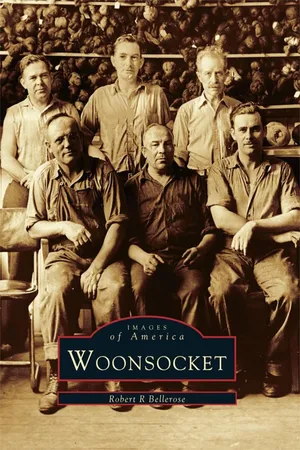
- 128 pages
- English
- ePUB (mobile friendly)
- Available on iOS & Android
eBook - ePub
Woonsocket
About this book
Trusted by 375,005 students
Access to over 1.5 million titles for a fair monthly price.
Study more efficiently using our study tools.
Information
Five
The Butcher, the Baker, and the Candlestick . . . Worker

Market Square as sketched in 1886. This is the intersection of Arnold and Main Streets. Many buildings shown have either had their facades altered or demolished. On the extreme right of the scene is the former Lippitt Mill, later the Hanora Building, constructed in 1865. (Woonsocket Harris Public Library.)

The Rathbun Block, which was located on Main Street, from an advertisement in The Woonsocket Patriot in 1848. Tenants who occupied storefronts in this building included Glackin and Mason, dealers in foreign and domestic dry goods, and William Hisbee, who operated a hat and shoe store. (Woonsocket Harris Public Library.)

The offices of The Woonsocket Patriot and The Evening Reporter on Main Street, as photographed shortly after the assassination of President McKinley in 1901. Both newspapers were owned and published by Leroy B. Pease. (Woonsocket Harris Public Library.)

The crew of The Evening Reporter, captured on film c. 1890 on Main Street. Owned and published by Leroy B. Pease, the newspaper had a daily circulation in 1892 of 5,700 copies. In 1908, The Call, its rival, purchased The Evening Reporter. (Woonsocket Harris Public Library.)

A c. 1890 view of Main Street including the Cook Block (in the center). The Central Block is to the left. The district between Market Square and Monument Square developed during the years 1870 to 1920 as the city’s urban core. Here, the commercial institutions, including stores, banks, offices, and theaters, would reflect the aspirations of a community that was growing in affluence and self-confidence. (Woonsocket Harris Public Library.)

The original home of the Woonsocket Institution for Savings, c. 1860. Chartered in 1845, the bank, originally located in this building, was at the corner of Main and Bernon Streets. It would later relocate to Cook’s Block on Main Street in 1867. (Woonsocket Harris Public Library.)

The Woonsocket Institution for Savings, on Main Street, c. 1930. Organized in 1845 at Market Square, the bank moved to the Cook Block on Main Street in 1867. Later it moved across the street to the ground level of the Harris Institute Building. In the late 1920s, under Aram J. Pothier’s presidency, the bank constructed the building shown here at 144 Main Street. (Woonsocket Harris Public Library.)

The Woonsocket Hotel, a Market Square landmark, c. 1900. In 1893, the city leaders rejected an offer to purchase the structure, for use as a city hall, for the sum of $55,000. (Woonsocket Harris Public Library.)

The main lobby of the Saint James Hotel, on Main Street, 1907. Constructed in 1892 by A.C. Brooks, it was the leading hostelry in Woonsocket for years. Fire destroyed this Main Street landmark in November 1986. (Woonsocket Harris Public Library.)
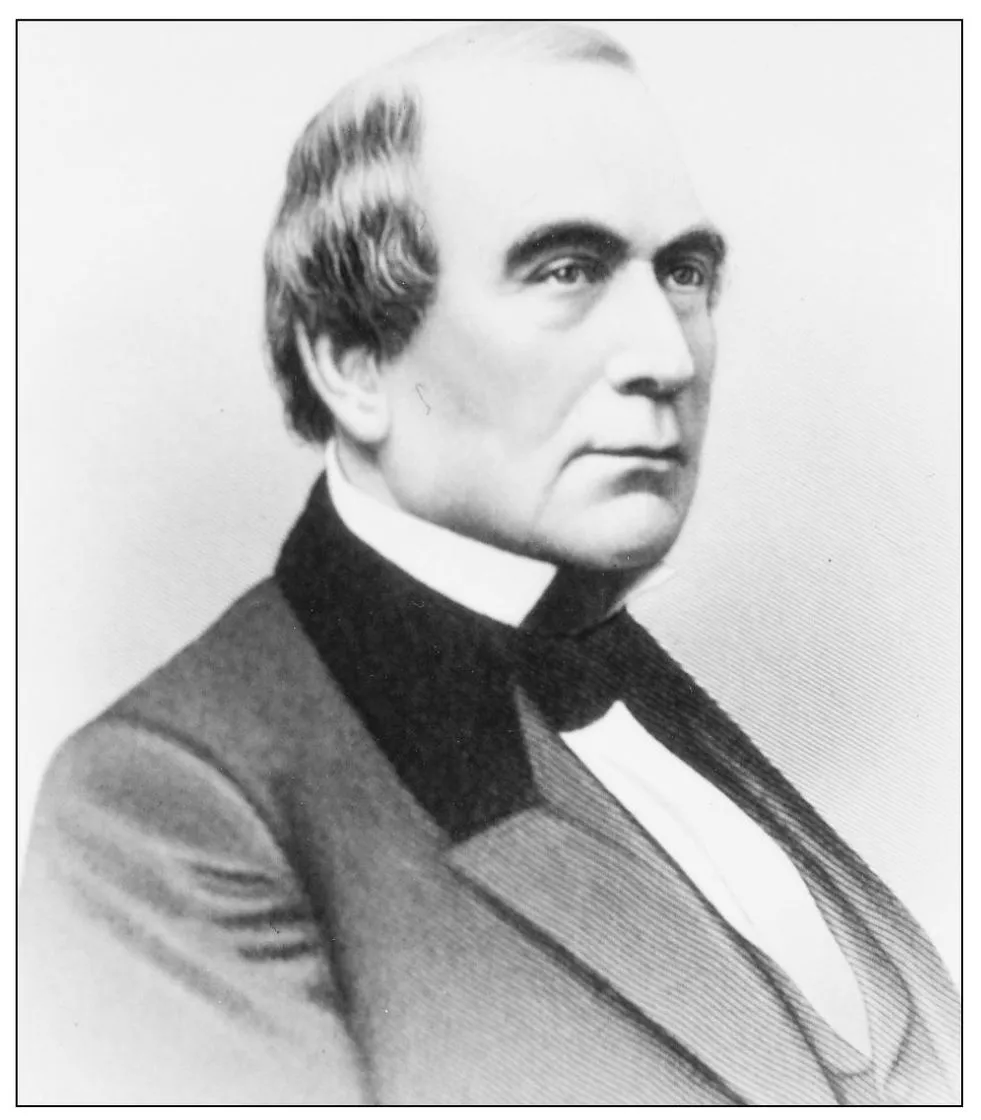
A portrait of Edward Harris (1801–1872,), Woonsocket’s most prominent citizen in the nineteenth century. Born in the village of Limerock in Lincoln, Rhode Island, Harris entered the te...
Table of contents
- Title Page
- Copyright Page
- Dedication
- Table of Contents
- Introduction
- Prologue
- One - A Working River Is Harnessed
- Two - The Backbone of the Industry: The Worker
- Three - A Working City Grows
- Four - Bridge over Working Waters
- Five - The Butcher, the Baker, and the Candlestick . . . Worker
- Six - We Gather Together . . . Workers and Mill Owners
- Seven - Workers on the Move
- Eight - When Working Waters Rage
- Nine - Working on the Railroad
- Ten - Workers Escape
Frequently asked questions
Yes, you can cancel anytime from the Subscription tab in your account settings on the Perlego website. Your subscription will stay active until the end of your current billing period. Learn how to cancel your subscription
No, books cannot be downloaded as external files, such as PDFs, for use outside of Perlego. However, you can download books within the Perlego app for offline reading on mobile or tablet. Learn how to download books offline
Perlego offers two plans: Essential and Complete
- Essential is ideal for learners and professionals who enjoy exploring a wide range of subjects. Access the Essential Library with 800,000+ trusted titles and best-sellers across business, personal growth, and the humanities. Includes unlimited reading time and Standard Read Aloud voice.
- Complete: Perfect for advanced learners and researchers needing full, unrestricted access. Unlock 1.5M+ books across hundreds of subjects, including academic and specialized titles. The Complete Plan also includes advanced features like Premium Read Aloud and Research Assistant.
We are an online textbook subscription service, where you can get access to an entire online library for less than the price of a single book per month. With over 1.5 million books across 990+ topics, we’ve got you covered! Learn about our mission
Look out for the read-aloud symbol on your next book to see if you can listen to it. The read-aloud tool reads text aloud for you, highlighting the text as it is being read. You can pause it, speed it up and slow it down. Learn more about Read Aloud
Yes! You can use the Perlego app on both iOS and Android devices to read anytime, anywhere — even offline. Perfect for commutes or when you’re on the go.
Please note we cannot support devices running on iOS 13 and Android 7 or earlier. Learn more about using the app
Please note we cannot support devices running on iOS 13 and Android 7 or earlier. Learn more about using the app
Yes, you can access Woonsocket by Robert R Bellerose in PDF and/or ePUB format, as well as other popular books in History & North American History. We have over 1.5 million books available in our catalogue for you to explore.