- 128 pages
- English
- ePUB (mobile friendly)
- Available on iOS & Android
eBook - ePub
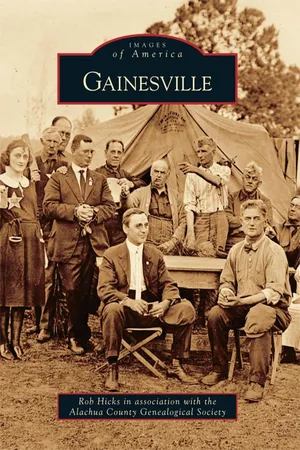
Gainesville
About this book
From a small agricultural community in northern Florida into a thriving city, many people have helped transform Gainesville into what it is today.
After befriending the Timucuan Indians who originally inhabited the region, Spanish colonizers began recruiting other settlers to move to the area. Despite the early foundations set, the people who brought the railroad to Gainesville deserve the most credit for giving the town its start. Soon after tracks were laid throughout the city, small businesses sprouted and opportunities for new industries arose. The city's population expanded along with its economic growth, and more people began to witness the unique potential of Gainesville. In 1905, the city became home to the University of Florida, and a rich educational heritage began. The university brought great attention to the town and subsequently made Gainesville not only one of the most important cities in Florida, but one of the most prominent educational epicenters in the South.
Trusted by 375,005 students
Access to over 1.5 million titles for a fair monthly price.
Study more efficiently using our study tools.
Information
Four
EDUCATION

Today Gainesville is best known as an educational epicenter. The University of Florida is the leading factor in this reputation. However, the school did not form overnight, and the town has a rich educational history beyond the university. This is an early sketch of the university’s grounds. (Courtesy University Archives, Department of Special and Area Studies Collections, George A. Smathers Libraries, University of Florida.)

The city’s education industry actually began in Ocala in 1853. That year, the state legislature agreed to support two public schools on either side of the Suwannee River. In 1853, an existing school in Ocala known as the East Florida Seminary was granted a portion of these funds as the designated school on the east side of the river. Three years later, James Henry Roper established Gainesville Academy. With the Ocala school facing financial turmoil, Roper convinced the state to merge the two schools, and the East Florida Seminary moved to Gainesville in 1866. The school later constructed Epworth Hall, seen in this 1883 etching. (Courtesy Florida State Archives.)

This building replaced the original East Florida Seminary structure in Gainesville that burned in the early 1880s. It was the school’s primary building and held classrooms, a library, and offices. It is now owned by First Methodist Church, who named it Epworth Hall. (Courtesy Florida State Archives.)

This building served as the dormitory for students at the East Florida Seminary. It was 197 feet long by 90 feet wide and featured beds, bathrooms, a kitchen, and an infirmary. The building burned in the early 1910s, and the property is now home to Roper Park. (Courtesy Florida State Archives.)

The East Florida Seminary had a strong military tradition. It required male students to dress in uniform and held a full arsenal of cadet rifles in addition to some artillery. A group of cadets poses here. Pictured from left to right are (first row) Ted Carroll, James Blanding, and three unidentified; (second row) James Fennell, two unidentified, Harry Knight, and Tom Campbell. (Courtesy Florida State Archives.)

After the war, many private institutions opened in Gainesville either by clergy or other individuals looking to profit while providing area youth with a needed education. One such school was Chateau-Briant. This large, three-story building was located on Northwest Ninth Avenue. The school boarded female students upstairs but also served boys during the day. (Courtesy P. K. Yonge Library of Florida History, Department of Special and Area Studies Collections, George A. Smathers Libraries, University of Florida.)

Perhaps the most popular of the smaller schools that opened in Gainesville was Miss Maggie Tebeau’s Boarding and Day School. It opened in 1873 near Courthouse Square but soon moved to the building seen here, once located at the southwest corner of South Main Street and Southwest Second Avenue. The school was highly regarded around town and remained in operation until 1936. (Courtesy Florida State Archives.)
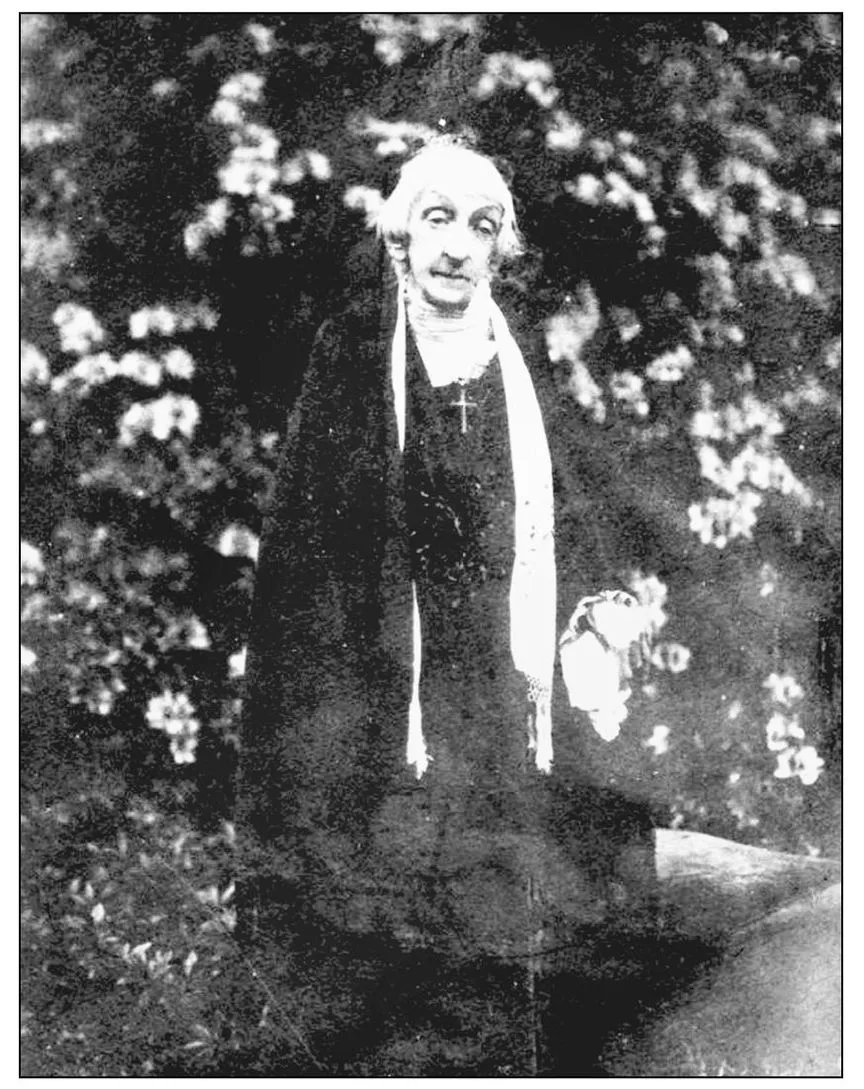
Miss Maggie, as she was known, was so impressive as an educator that the Episcopal Church declared the school the Diocesan School for Girls of the Florida Diocese of the Protestant Episcopal Church in 1909. Miss Maggie died in 1924 and was laid to rest in Evergreen Cemetery. Her niece, Alice Thomas, took over operations of the school. (Courtesy Florida State Archives.)

The school typically boarded 10 to 15 young ladies at a time but also educated young men during the day. A group of graduates from the school are seen here. Kate Clyatt Trenton is pictured on the left. Annie Pound is on the right. The other girls are not identified. (Courtesy Florida State Archives.)

Prior to 1885, students of almost any means attended the several private schools. The town’s very poorest students either received no education at all or were educated publicly under the most deplorable conditions. William Sheets, superintendent of public schools, began to campaign vigorously for funds to construct a sound public schoolhouse in the early 1880s. While many were against Sheets, his efforts met success in 1885 when the building on the left of this photograph was constructed at East University Avenue and Southeast Fourth Street. The 1897 version of the First Baptist Church, complet...
Table of contents
- Title Page
- Copyright Page
- Table of Contents
- ACKNOWLEDGMENTS
- INTRODUCTION
- One - ANTEBELLUM
- Two - GAINESVILLE EMERGES
- Three - THE EARLY GAINESVILLE COMMUNITY
- Four - EDUCATION
- BIBLIOGRAPHY
Frequently asked questions
Yes, you can cancel anytime from the Subscription tab in your account settings on the Perlego website. Your subscription will stay active until the end of your current billing period. Learn how to cancel your subscription
No, books cannot be downloaded as external files, such as PDFs, for use outside of Perlego. However, you can download books within the Perlego app for offline reading on mobile or tablet. Learn how to download books offline
Perlego offers two plans: Essential and Complete
- Essential is ideal for learners and professionals who enjoy exploring a wide range of subjects. Access the Essential Library with 800,000+ trusted titles and best-sellers across business, personal growth, and the humanities. Includes unlimited reading time and Standard Read Aloud voice.
- Complete: Perfect for advanced learners and researchers needing full, unrestricted access. Unlock 1.5M+ books across hundreds of subjects, including academic and specialized titles. The Complete Plan also includes advanced features like Premium Read Aloud and Research Assistant.
We are an online textbook subscription service, where you can get access to an entire online library for less than the price of a single book per month. With over 1.5 million books across 990+ topics, we’ve got you covered! Learn about our mission
Look out for the read-aloud symbol on your next book to see if you can listen to it. The read-aloud tool reads text aloud for you, highlighting the text as it is being read. You can pause it, speed it up and slow it down. Learn more about Read Aloud
Yes! You can use the Perlego app on both iOS and Android devices to read anytime, anywhere — even offline. Perfect for commutes or when you’re on the go.
Please note we cannot support devices running on iOS 13 and Android 7 or earlier. Learn more about using the app
Please note we cannot support devices running on iOS 13 and Android 7 or earlier. Learn more about using the app
Yes, you can access Gainesville by Rob Hicks,Alachua County Genealogical Society in PDF and/or ePUB format, as well as other popular books in History & North American History. We have over 1.5 million books available in our catalogue for you to explore.