- 128 pages
- English
- ePUB (mobile friendly)
- Available on iOS & Android
eBook - ePub
About this book
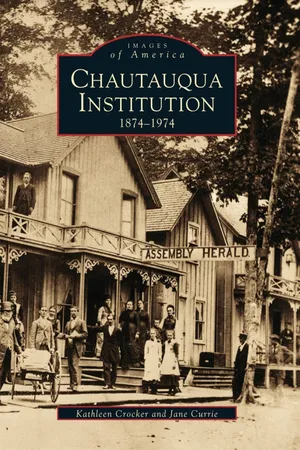
Explore the history of the education in this cloistered community, both spiritual and cultural, offered at the Chautauqua Institution in NY State for over 125 years.
The Chautauqua Institution, located on Chautauqua Lake in southwestern New York State, is both a cloistered community and a world-renowned educational establishment. Founded in 1874 as a summer camp for Methodist Sunday school teachers, Chautauqua is synonymous with the ideas of spiritual growth, educational study, and intellectual stimulation in conjunction with recreation in an outdoor setting. For over 125 years, Chautauqua has remained an educational and cultural mecca for the common man. Chautauqua Institution, 1874-1974 is a compendium of Chautauqua's growth from its inception at Fair Point to its centennial celebrations. Each chapter's brief introduction acquaints the reader with historic highlights followed by pages of fascinating facts and intriguing images, ranging from rudimentary tents to the grande dame of hotels, from Victorian cottages to Greek-pillared halls. This array of architecture forms the backdrop for countless individuals who were responsible for bringing the founders' vision to fruition and who were the backbone of the Chautauqua Movement.
Trusted by 375,005 students
Access to over 1.5 million titles for a fair monthly price.
Study more efficiently using our study tools.
Information
Three
RELIGION, EDUCATION, AND RECREATION
Founded as a camp meeting for Sunday school teachers, religion and a religious spirit are fundamental to the Chautauqua concept. Despite its Protestant heritage, the Chautauqua Institution takes pride in its ecumenical programs that minister to the needs of all visitors. The major denominations have houses or headquarters at Chautauqua that serve as hospitality centers and places of worship.
During the second Chautauqua Assembly in 1875, religious classes expanded to include the study of Hebrew. In 1882, the chaplain-of-the-week program began; daily devotional exercises continue to be led by clergy who not only preach on the Sabbath but often lecture or teach religion during their week’s stay. Moreover, after the formation of the School of Theology, religious training was available for candidates for the ministry and enrichment study for clergy. According to former historian Alfreda L. Irwin, Chautauqua’s religious program was “both inspirational and educational and consistent with Dr. Vincent’s goals,” as indicated by the motto of the Chautauqua Literary and Scientific Circle: “We study the Word and Works of God.”
In his book The Chautauqua Movement, John Heyl Vincent stated: “Education, once the peculiar privilege of the few, must . . . become a valued possession of the many.” Since both Miller and Lewis agreed that all learning was sacred, the emphasis on Bible study and religion was expanded to include classes in languages, sciences, and normal school studies.
In 1876, special interest groups, including a church congress, a scientific conference, and a temperance conference, convened on the grounds. In addition, the Chautauqua Schools of Languages and Music took root, and a Teacher’s Retreat of distinguished scholars from all over the country was founded. The very first summer school program in the United States is reputed to have originated at Chautauqua in 1879.
To consolidate the rapidly growing academic programs, a central organization was needed; as a result, the New York State legislature granted the newly created Chautauqua University the right to confer degrees. Lewis Miller assumed the role of university president, and John Heyl Vincent became university chancellor.
In 1902, when Chautauqua University was renamed the Chautauqua Institution under a new state charter, the name Chautauqua Assembly was retained when referring to the summer season. The educational institution’s stated purpose was “to promote the intellectual, social, physical, moral, and religious welfare of the people.”
Chautauqua’s growth continued and, by 1924, its summer school catalog boasted 18 departments of instruction with more than 120 faculty members and some 2,000 registered students, young and old. Affiliated at one time with New York State University and Syracuse University, Chautauqua provided the opportunity to earn course credits, and offerings adapted to the changing times. In 1945, after World War II, students could enroll in classes as diverse as lip reading, narcotics education, and “The Veteran on the Home Front.”
Religious and academic course offerings were complemented by the establishment of the Physical Education Department c. 1886 to promote healthful exercise to develop strong bodies along with intellect. A skating rink, tennis courts, a track, a baseball diamond, and a lakefront bathhouse were available for boys and girls. The Chautauqua Boys’ and Girls’ Clubs are thought to be the oldest continuous day camps in the United States. Although they usually met separately, both genders had experienced instructors and well-equipped facilities in a relaxed and safe environment.
In its more recent brochures, Chautauqua advertises its vacations as “an extraordinary blend of arts, programming, and recreational activities for personal enrichment and renewal.” Yet, recreation is more than mere relaxation. In 1918, an article in the RoundTable stated that Chautauqua’s setting and programs enabled a participant to become “fit for the work of the year” so that he might leave stronger and be “re-created in all his forces.” And, a vacation, as John Heyl Vincent so aptly noted, “need not imply vacuity of mind.”

The Gadf ly II was brought to Chautauqua Lake and, beginning in 1947, it left the Chautauqua Institution dock for scheduled passenger service. (Courtesy of the Post-Journal, Jamestown, N.Y.)
In 1916, a contemporary remarked that “Bishop Vincent and Dr. Hurlbut were often seen together at Chautauqua strolling arm in arm over the grounds so dear to both of them.” Jesse L. Hurlbut began as John Heyl Vincent’s associate in the...
Table of contents
- Title Page
- Copyright Page
- Dedication
- Table of Contents
- Acknowledgments
- INTRODUCTION
- One - THE ASSEMBLY AN D ITS COFOUNDERS
- Two - EXPANSION
- Three - RELIGION, EDUCATION, AND RECREATION
- Four - COMMUNITY AND CIVIC PRIDE
- Five - THE PLATFORM AND PERFORMING ARTS
- Six - CENTENNIAL
- BIBLIOGRAPHY
Frequently asked questions
Yes, you can cancel anytime from the Subscription tab in your account settings on the Perlego website. Your subscription will stay active until the end of your current billing period. Learn how to cancel your subscription
No, books cannot be downloaded as external files, such as PDFs, for use outside of Perlego. However, you can download books within the Perlego app for offline reading on mobile or tablet. Learn how to download books offline
Perlego offers two plans: Essential and Complete
- Essential is ideal for learners and professionals who enjoy exploring a wide range of subjects. Access the Essential Library with 800,000+ trusted titles and best-sellers across business, personal growth, and the humanities. Includes unlimited reading time and Standard Read Aloud voice.
- Complete: Perfect for advanced learners and researchers needing full, unrestricted access. Unlock 1.5M+ books across hundreds of subjects, including academic and specialized titles. The Complete Plan also includes advanced features like Premium Read Aloud and Research Assistant.
We are an online textbook subscription service, where you can get access to an entire online library for less than the price of a single book per month. With over 1.5 million books across 990+ topics, we’ve got you covered! Learn about our mission
Look out for the read-aloud symbol on your next book to see if you can listen to it. The read-aloud tool reads text aloud for you, highlighting the text as it is being read. You can pause it, speed it up and slow it down. Learn more about Read Aloud
Yes! You can use the Perlego app on both iOS and Android devices to read anytime, anywhere — even offline. Perfect for commutes or when you’re on the go.
Please note we cannot support devices running on iOS 13 and Android 7 or earlier. Learn more about using the app
Please note we cannot support devices running on iOS 13 and Android 7 or earlier. Learn more about using the app
Yes, you can access Chautauqua Institution by Kathleen Crocker,Jane Currie in PDF and/or ePUB format, as well as other popular books in History & Education General. We have over 1.5 million books available in our catalogue for you to explore.