- 128 pages
- English
- ePUB (mobile friendly)
- Available on iOS & Android
eBook - ePub
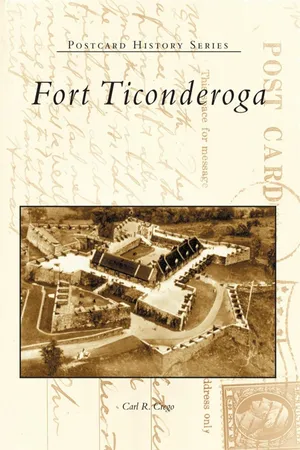
Fort Ticonderoga
About this book
A fascinating history of Fort Ticonderoga, which played an important role in both the French and Indian War as well as the American Revolution.Called "the Key to the Continent" and "the Gibraltar of the North," Fort Ticonderoga controlled the strategically critical portage between Lakes George and Champlain in the eighteenth century and played an important role in both the French and Indian War and the American Revolution. French troops began construction of the fort in 1755, calling it Fort Carillon. The British captured the fort in 1759 and renamed it Fort Ticonderoga. The storming of the fort on May 10, 1775, by Benedict Arnold, Ethan Allen, and the Green Mountain Boys was America's first victory of the Revolutionary War.
Trusted by 375,005 students
Access to over 1.5 million titles for a fair monthly price.
Study more efficiently using our study tools.
Information
Eight
THE RESTORATION CONTINUES
We have been criticized in some of the newspapers for undertaking the restoration at all; but when I saw the ruins as they stood in 1908 and as I remembered them in 1883, I was impressed with the fact that in another quarter of a century there would be little left to show.
—Stephen H. P Pell, 1912
The restoration of the West Barracks was only the first phase of the Pell family’s Fort Ticonderoga project. The reconstruction of the South Barracks began in early 1914, but it was stopped temporarily on Friday July 31, 1914. On that day, Stephen Pell’s brokerage firm was forced into receivership when cotton prices collapsed due to market uncertainties regarding the outbreak of war in Europe (World War I began on July 28). Pell had made a large fortune by betting on ever increasing cotton prices. However, when the price of cotton collapsed on that black Friday, his company had net liabilities of more than $1.5 million (about $27.6 million today). By the time his firm’s financial affairs were resolved, America had entered World War I, and building materials not required for the war effort were very expensive.
After Pell’s return from World War I in 1919, the restoration of the fort resumed. By 1922, the financial burden of maintaining the Garrison Grounds, adding to the fort’s collection, and accommodating increasing numbers of tourists became such that Pell initiated an admission charge of 50¢ (about $5.60 today) to defray these costs.
To ensure the continued restoration and preservation of the fort, the Pell family formed a not-for-profit educational institution, the Fort Ticonderoga Association, in 1931. Today, the association cares for more than 2,000 acres of historically significant land in New York and Vermont, as well as a world-class collection of 18th-century military objects and archives.

In 1909, Bossom designed a summer home for Howland Pell that was constructed north of the Pavilion inside the Germain Redoubt. Completed in 1910, Pell’s home was built on the foundation of a blockhouse built by the French in 1758, and it was informally known by that name. In the late 1920s and again in the 1940s, it served as a temporary location for the fort’s library. The Blockhouse is not open to the public.

The Gatehouse, also designed by Bossom, replicates, on a smaller scale, the exterior of the restored West Barracks. Constructed between 1909 and 1910, its exterior walls are constructed of the same type of stone that was used to build the fort’s barracks and demilunes. The Gatehouse has been a private residence since its construction and is not open to the public.

Although its official opening day was July 6, 1909, work on the West Barracks continued over the next three years. In the c. 1911 postcard above, the roof is still only partially tiled and there are no dormers. By 1912, as shown below, the roof had been completely tiled and the dormers had been constructed. The only significant change made to the exterior of the West Barracks was made in the late 1920s, when multiple staircases replaced the external single staircase and the long porch outside the second floor.


Until the second floor of the West Barracks was completed in 1910, the fort’s collection of artifacts was on display in the restored ground floor. The triangular cases on top of the long tables contained artifacts collected during the barracks’ restoration. Hanging on the wall to the left in the background are ax heads found at the fort.

Around 1951, the fort’s collection of weaponry, consisting of more than 100 muskets, rifles, swords, and other weapons dating from 1650 to 1820, was moved to the ground floor of the West Barracks. The fort has one of the largest and most comprehensive collections of British, French, German, and American 18th-century military firearms used in the colonial wars.

From 1910...
Table of contents
- Title Page
- Copyright Page
- Dedication
- Table of Contents
- ACKNOWLEDGMENTS
- FOREWORD
- One - CHAMPLAIN’S LAKE
- Two - THE WILDERNESS BASTION
- Three - THE BATTLE OF CARILLON
- Four - AMERICA’S FIRST VICTORY
- Five - THE WAR IN THE NORTHERN DEPARTMENT
- Six - THE NORTHERN TOUR
- Seven - THE RESTORATION BEGINS
- Eight - THE RESTORATION CONTINUES
Frequently asked questions
Yes, you can cancel anytime from the Subscription tab in your account settings on the Perlego website. Your subscription will stay active until the end of your current billing period. Learn how to cancel your subscription
No, books cannot be downloaded as external files, such as PDFs, for use outside of Perlego. However, you can download books within the Perlego app for offline reading on mobile or tablet. Learn how to download books offline
Perlego offers two plans: Essential and Complete
- Essential is ideal for learners and professionals who enjoy exploring a wide range of subjects. Access the Essential Library with 800,000+ trusted titles and best-sellers across business, personal growth, and the humanities. Includes unlimited reading time and Standard Read Aloud voice.
- Complete: Perfect for advanced learners and researchers needing full, unrestricted access. Unlock 1.5M+ books across hundreds of subjects, including academic and specialized titles. The Complete Plan also includes advanced features like Premium Read Aloud and Research Assistant.
We are an online textbook subscription service, where you can get access to an entire online library for less than the price of a single book per month. With over 1.5 million books across 990+ topics, we’ve got you covered! Learn about our mission
Look out for the read-aloud symbol on your next book to see if you can listen to it. The read-aloud tool reads text aloud for you, highlighting the text as it is being read. You can pause it, speed it up and slow it down. Learn more about Read Aloud
Yes! You can use the Perlego app on both iOS and Android devices to read anytime, anywhere — even offline. Perfect for commutes or when you’re on the go.
Please note we cannot support devices running on iOS 13 and Android 7 or earlier. Learn more about using the app
Please note we cannot support devices running on iOS 13 and Android 7 or earlier. Learn more about using the app
Yes, you can access Fort Ticonderoga by Carl R. Crego in PDF and/or ePUB format, as well as other popular books in History & Military & Maritime History. We have over 1.5 million books available in our catalogue for you to explore.