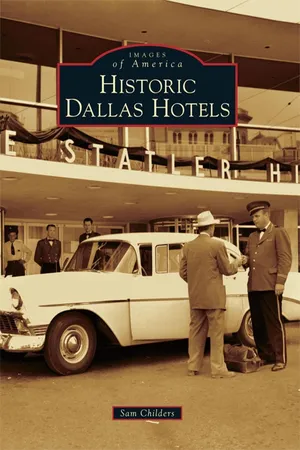
In Dallas's infancy, accommodations for the traveler arriving by stage or horseback consisted of boardinghouses or unfurnished rooms, but within 10 years of the city's founding, Dallas could boast about what is considered to be its first hotel: Thomas Crutchfield's log cabin and livery stable. As the village evolved from town to city, these early facilities were replaced with elegantly appointed hotels that rivaled those in New York or Chicago and established Dallas as a modern city. As the 20th century progressed, many older hotels were replaced with up-to-date facilities, and the rise of the automobile following World War II saw the establishment of dozens of motels and motor courts. There were accommodations for every type of traveler, and Dallas had established itself as a hotel town.
- 128 pages
- English
- ePUB (mobile friendly)
- Available on iOS & Android
eBook - ePub
Historic Dallas Hotels
About this book
Trusted by 375,005 students
Access to over 1.5 million titles for a fair monthly price.
Study more efficiently using our study tools.
Information
Three
MEET ME IN THE LOBBY
Nothing more accurately indicates the stages of growth of a city than its hotels.
—D. C. McCord, Dallas building inspector, February 27, 1926
Just how many of the 15,000 people that have represented Dallas’s population gain annually for several years may be traced to our excellent hotels cannot be ascertained.
—Dallas, official publication of the Dallas Chamber of Commerce, February 1925
The half-century between the opening of the Adolphus and the debut of the Statler saw the hotels’ function remain essentially the same, but rapid advances in technology provided guests with a great variety of safer, cleaner, and more comfortable accommodations.
Many hotels led local efforts for civic responsibility and even social change. During World War I, hotels sponsored “meatless” and “wheatless” days to conserve food for the war effort. Hotel workers had been trying for many years to organize during the Progressive Era and were finally successful in 1922. Despite these noble causes, hotel operators were in the business to make money and sometimes flaunted the law. During Prohibition, it was generally known that a downtown hotel was an easy place to obtain illicit whiskey, and hotel management defiantly resisted public officials’ efforts to ban the sale of “set-ups” (essentially cracked ice and ginger ale).
The development of good roads and the affordability of the automobile saw establishments such as the Melrose and the Stoneleigh open as “apartment hotels” that blended the amenities of home with the convenience and prestige of a “big city” hotel.
The most significant year of this period was 1925, which saw yet another major expansion of the Adolphus, the openings of the Hotel Scott and of the fondly remembered Baker, and the origins of an enterprise that would become practically synonymous with the word “hotel.”

The hotel business was highly competitive, but owners and operators realized that an organization to promote their properties and lobby for common interests was needed. In 1903, the Texas Hotel Keepers Association was founded at the Oriental Hotel. In 1922, the Dallas Hotel Men’s Association was organized to “co-operate with other business organizations in the upbuilding of Dallas and to take an active part in all civic activities.” Otto Herrold of the Adolphus was elected its first president. By 1936, when this advertisement ran, the group had changed its name to the Dallas Hotel Association and claimed 20 member hotels. (The Adolphus Archives.)

Ohioan Charles Mangold moved to Dallas in 1885 where he established a wholesale and retail liquor business. An enthusiastic Oak Cliff booster, Mangold promoted arts and culture, developed Lake Cliff Park, led the establishment of the Oak Cliff Little Theater, and promoted the construction of the first permanent viaduct between Oak Cliff and Dallas, in addition to building the Jefferson Hotel. He is shown here with Jefferson bartenders in 1933. (Dallas Public Library.)

Constructed with Texas materials and opened in October 1917, the Hotel Jefferson was state of the art for its time. One floor was reserved for “the exclusive use of women unattended, no men being quartered on that floor.” Mangold related that on opening day, a woman arriving in Dallas said she had been told the city was uncouth, but her first impression, “through the Jefferson, was an agreeable surprise.” (Author’s collection.)

Dallas’s Union Station was completed in 1916 and consolidated the five depots and nine railroads serving the city into a single Beaux Arts terminal. The Jefferson was strategically situated across from the depot so that the traveler crossed Ferris Plaza, George Kessler’s “front door to Dallas,” to reach the hotel. Named for Royal Ferris, who served on the committee that lobbied for the construction of the terminal, the park was completed in 1921. (Author’s collection.)
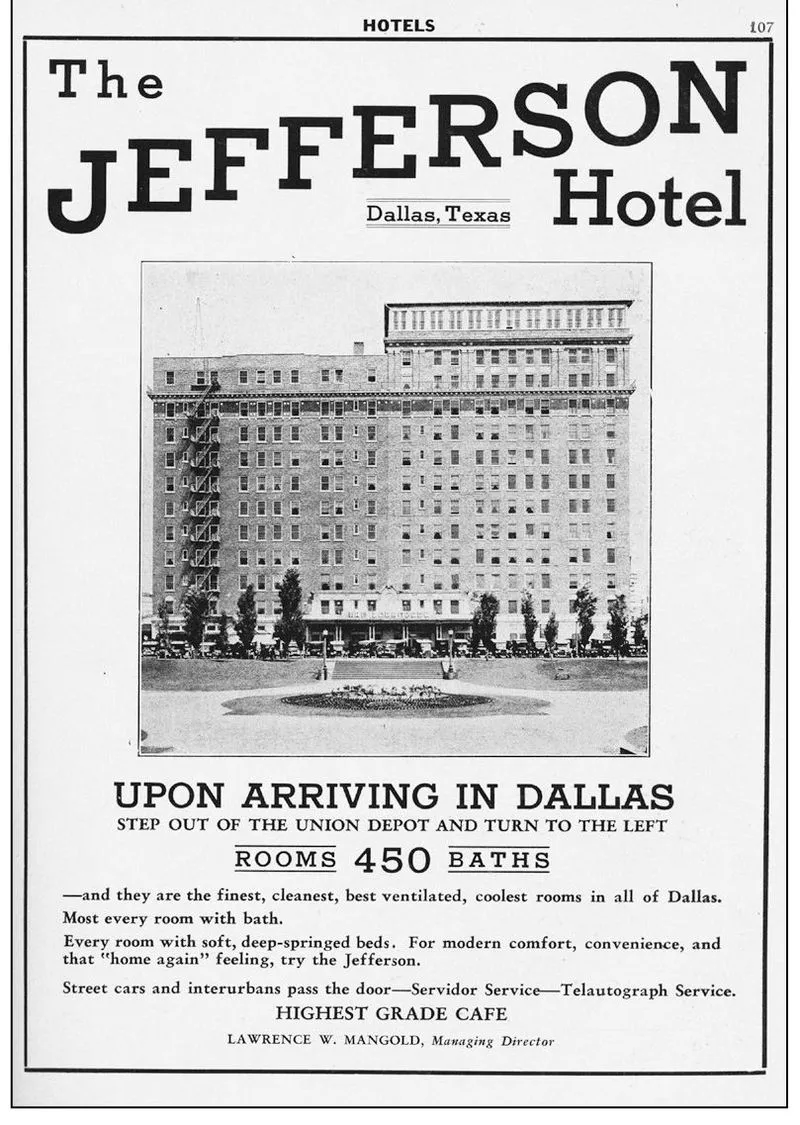
Travelers arriving at Union Station needed only to cross Houston Street to find clean, comfortable accommodations. The location was ideal for transient visitors such as traveling salesmen and was particularly busy during the annual State Fair of Texas. Efforts were made to create a home-like atmosphere, and each room was equipped with glass-topped bureaus and dressing tables and “Brussels and Axminster rugs covering the floors.” (Author’s collection.)

The Jefferson proved so profitable that an extensive addition was begun in 1919. Completed in 1921, the expansion tripled the size of the hotel and boasted “the largest hotel lobby in Dallas.” By the 1940s, a massive Dr. Pepper advertising sign with its prewar “Good For Life” slogan had been added to the roof. Dr. Pepper, although invented in Waco, was based in Dallas for many years. Dr. Pepper’s annual stockholders’ meeting was often held at the Jefferson, which perhaps explains the sign’s prominent perch. The Dr. Pepper and Hotel Jeff...
Table of contents
- Title Page
- Copyright Page
- Dedication
- Table of Contents
- ACKNOWLEDGMENTS
- INTRODUCTION
- One - CHECKING IN
- Two - FIVE STAR
- Three - MEET ME IN THE LOBBY
- Four - ROADSIDE ATTRACTION
- Five - WAKE-UP CALL
- Six - RISE AND SHINE
- BIBLIOGRAPHY
Frequently asked questions
Yes, you can cancel anytime from the Subscription tab in your account settings on the Perlego website. Your subscription will stay active until the end of your current billing period. Learn how to cancel your subscription
No, books cannot be downloaded as external files, such as PDFs, for use outside of Perlego. However, you can download books within the Perlego app for offline reading on mobile or tablet. Learn how to download books offline
Perlego offers two plans: Essential and Complete
- Essential is ideal for learners and professionals who enjoy exploring a wide range of subjects. Access the Essential Library with 800,000+ trusted titles and best-sellers across business, personal growth, and the humanities. Includes unlimited reading time and Standard Read Aloud voice.
- Complete: Perfect for advanced learners and researchers needing full, unrestricted access. Unlock 1.5M+ books across hundreds of subjects, including academic and specialized titles. The Complete Plan also includes advanced features like Premium Read Aloud and Research Assistant.
We are an online textbook subscription service, where you can get access to an entire online library for less than the price of a single book per month. With over 1.5 million books across 990+ topics, we’ve got you covered! Learn about our mission
Look out for the read-aloud symbol on your next book to see if you can listen to it. The read-aloud tool reads text aloud for you, highlighting the text as it is being read. You can pause it, speed it up and slow it down. Learn more about Read Aloud
Yes! You can use the Perlego app on both iOS and Android devices to read anytime, anywhere — even offline. Perfect for commutes or when you’re on the go.
Please note we cannot support devices running on iOS 13 and Android 7 or earlier. Learn more about using the app
Please note we cannot support devices running on iOS 13 and Android 7 or earlier. Learn more about using the app
Yes, you can access Historic Dallas Hotels by Sam Childers in PDF and/or ePUB format, as well as other popular books in History & Architecture General. We have over 1.5 million books available in our catalogue for you to explore.