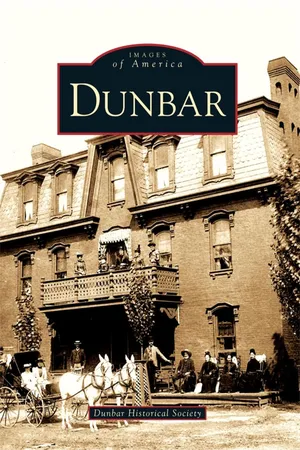
Settled in the 1790s and incorporated in 1883, Dunbar was named for Col. Thomas Dunbar, who along with Gen. Edward Braddock and George Washington came to the area in 1755 to take back Fort Duquesne. In 1791, Isaac Meason started the Union Furnace, marking the beginning of the industrial growth that became Dunbars lifeblood for more than a century. Vintage photographs in Dunbar capture the towns industry, tragedies such as the Hill Farm Mine disaster, faith, weddings, pastimes that entertained young and old alike, intriguing people, and beautiful buildings that stand as a testament to a more prosperous age. Today tourism opportunities such as the Sheepskin Trail, the Fayette Central Railroad Tourist Train, and the coke oven project at the Dunbar Historical Societys park are helping the community reinvent itself and provide a new future for the little town.
eBook - ePub
About this book
Trusted by 375,005 students
Access to over 1.5 million titles for a fair monthly price.
Study more efficiently using our study tools.
Information
One
BUSINESS AND INDUSTRY

Donated to the Dunbar Historical Society by artist William (Bill) Rockwell, this drawing shows the 1854 Dunbar Furnace. Built by Isaac Meason, the Union Furnace name was changed in 1844 to Dunbar Furnace under the management of Jones and Miller. In 1854, Baldwin and Cheney discontinued the use of charcoal as fuel and began using coke. One of Dunbar’s leading citizens, Thomas W. Watt, was general superintendent for Baldwin and Cheney.

These four panoramic views from about 1915 show the industry in the valley between Hardy Hill and Furnace Hill just outside Dunbar Borough. From top to bottom are the Pennsylvania Wire Glass Company and three views of the Semet-Solvay Company and the Dunbar Furnace Company. (Courtesy of George R. and Donna R. Myers.)

In 1895, the first contract to build a block of Semet-Solvay by-product coke ovens, outside the home plant in New York, was made with the Dunbar Furnace Company. The 50 ovens were to supply the furnaces with coke, and the by-products—coal tar, ammonia, gas, and light oil—were used for other industries. The gas was used by the Pennsylvania Wire Glass Company.

In 1791, Isaac Meason started a small furnace on Dunbar Creek, and in 1793, Meason and Dillon built a larger furnace and foundry at the same site. In 1844, Jones and Miller changed the name from Union to Dunbar Furnace and used water from Dunbar Creek as the motive power. In 1852, Watt and Larmer installed the first steam boiler and hot blast stove at the furnace. Baldwin and Cheney were the first to use coke as fuel in 1854. The Youghiogheny Coal and Iron Company assumed operations at the furnace in 1860 and moved it about 300 yards downstream. The Dunbar Iron Company, with Edmund Pechin as superintendent, became the owner in 1866. The furnace was compelled to close down in 1873, and in 1874, the Dunbar Iron Company sold out. In 1876, the Dunbar Furnace Company was formed. It took over the holdings of the Dunbar Iron Company. Pechin remained superintendent. By 1880, the company purchased the Ferguson ovens and built 98 beehive ovens at Hill Farm Mine.

This photograph shows a rare glimpse into the inside of the Dunbar Furnace Company. The furnace workers included many boys who were put to work at a young age to help supplement the family income. Changes in the physical structure of the plant are evident where the wall was simply torn out to make way for modernization and changes in the plant.

Dunbar Furnace Company employees are, from left to right, James McVey, George Gilroy, John McVey, James Martin, Joseph O’Neal, George Frye, Michael Flynn, Archie Reid, Jacob Breakiron, and Doc Smitley. Work at the furnace was dirty, and employees put in many hours since labor laws had not yet been passed. Many of the furnace pictures were donated to the Dunbar Historical Society by the Lawrence Harvey estate.

The photograph above shows the internal workings of the Dunbar Furnace Company. It appears that repairs are being made to the equipment. The date of the photograph and the men are unidentified. Hundreds of workers came from far and wide to work at the furnace, which was the largest employer at one time. As many immigrants flocked to the mines, most who came to work had little money. The company paid the miner with scrip redeemable only at the company store. The scrip (below) was issued by the Dunbar Furnace Company store. While providing for the workers and their families, the use of scrip and company housing was also a way of keeping the men from leaving the employ of the company. (Courtesy of George R. and Donna R. Myers.)


Cleaning mined coal was practiced little in Fayette County due to the purity of the coal from the Pittsburgh bed. According to the June 12, 1905, issue of Fuel magazine, the Link-Belt Machinery Company of Chicago installed the first coal washer in Dunbar at the Semet-Solvay Company for its by-product ovens. Coal from the Freeport mines was treated at the washer, which operated until 1924. (Courtesy of George R. and Donna R. Myers.)

One of Dunbar’s largest employers was the Penn...
Table of contents
- Title Page
- Copyright Page
- Dedication
- Table of Contents
- ACKNOWLEDGMENTS
- INTRODUCTION
- One - BUSINESS AND INDUSTRY
- Two - TOWN SCENES
- Three - TRAGEDIES
- Four - TRANSPORTATION
- Five - LOCAL FOLKS AND COLORFUL CHARACTERS
- Six - PATRIOTISM AND FAITH
- Seven - SCHOOLS AND ORGANIZATIONS
- Eight - PASTIMES AND COMMUNITY PRIDE
- Nine - DUNBAR TODAY
- BIBLIOGRAPHY
Frequently asked questions
Yes, you can cancel anytime from the Subscription tab in your account settings on the Perlego website. Your subscription will stay active until the end of your current billing period. Learn how to cancel your subscription
No, books cannot be downloaded as external files, such as PDFs, for use outside of Perlego. However, you can download books within the Perlego app for offline reading on mobile or tablet. Learn how to download books offline
Perlego offers two plans: Essential and Complete
- Essential is ideal for learners and professionals who enjoy exploring a wide range of subjects. Access the Essential Library with 800,000+ trusted titles and best-sellers across business, personal growth, and the humanities. Includes unlimited reading time and Standard Read Aloud voice.
- Complete: Perfect for advanced learners and researchers needing full, unrestricted access. Unlock 1.5M+ books across hundreds of subjects, including academic and specialized titles. The Complete Plan also includes advanced features like Premium Read Aloud and Research Assistant.
We are an online textbook subscription service, where you can get access to an entire online library for less than the price of a single book per month. With over 1.5 million books across 990+ topics, we’ve got you covered! Learn about our mission
Look out for the read-aloud symbol on your next book to see if you can listen to it. The read-aloud tool reads text aloud for you, highlighting the text as it is being read. You can pause it, speed it up and slow it down. Learn more about Read Aloud
Yes! You can use the Perlego app on both iOS and Android devices to read anytime, anywhere — even offline. Perfect for commutes or when you’re on the go.
Please note we cannot support devices running on iOS 13 and Android 7 or earlier. Learn more about using the app
Please note we cannot support devices running on iOS 13 and Android 7 or earlier. Learn more about using the app
Yes, you can access Dunbar by in PDF and/or ePUB format, as well as other popular books in History & North American History. We have over 1.5 million books available in our catalogue for you to explore.