- 128 pages
- English
- ePUB (mobile friendly)
- Available on iOS & Android
eBook - ePub
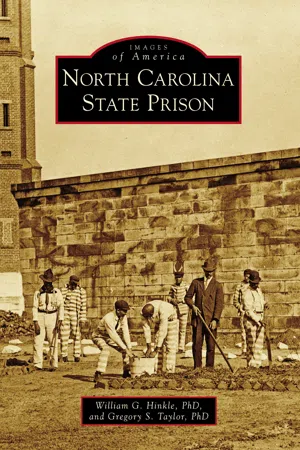
North Carolina State Prison
About this book
North Carolina's State Prison was typical of American prisons in the 19th century, but with an important difference. North Carolina put most of its inmates outside prison walls to work on road camps and prison farms for the purpose of getting useful work out of them. Opened in 1870, the prison in Raleigh housed only a fraction of the prisoners. Those inmates were for the most part too old, too sick, or too feeble to handle anything other than light institutional work details. This book explores all three components of North Carolina's early prison system, including its use of prison chain gangs, and clarifies how a penitentiary differs from a reformatory, correctional institution, or community-based facility.
Trusted by 375,005 students
Access to over 1 million titles for a fair monthly price.
Study more efficiently using our study tools.
Information
One
BUILDING A PENITENTIARY
Construction work on the North Carolina State Prison began on January 6, 1870, when 33 inmates joined a larger civilian crew at the worksite. A wooden-pole stockade went up first and gave the penitentiary its original nickname, “the Poles.” With the prisoners secure behind the wall, their numbers increased, and 12 temporary inmate quarters were built. The 19-square-foot buildings had a central hallway running down the middle and were covered by one continuous roof. The hallway, a walkway atop the stockade, and sentry boxes stationed around its exterior provided custody officers vantage points from which to watch the inmates, who worked alongside skilled craftsmen to construct the permanent structures.
As construction on the formal penitentiary buildings began, administrators revised their plans and called for a permanent structure with 450 cells, a 50 percent increase from the original blueprints. With that increase incorporated into the new design, work on the permanent structures proceeded. Making use of a neighboring quarry, which the prison purchased in 1873, and on-site brick kilns and tin shops, inmates and workers laid the foundations, slowly raised the first stone and masonry buildings, built the cell walls, and hung the cell doors. They also erected a permanent stone barrier to surround the penitentiary and, in 1872, laid tracks to connect the site to a nearby railroad.
In 1875, the first permanent cell buildings were occupied, the main administrative building was complete in 1880, and the entire eastern cell house of the penitentiary was populated in 1881. Final work was complete in 1884, when the main intake building and the western cell house were occupied. With the permanent buildings complete, the temporary quarters were converted into stables for horses and cattle. Construction took 14 years and cost $1.25 million, a figure that would have been higher without the savings resultant from the use of inmate labor. Although among the last of states to construct a penitentiary, North Carolina eventually had one of the most architecturally advanced penal facilities in the nation.

CELL-BLOCK CORRIDOR, NORTH CAROLINA STATE PENITENTIARY. A penitentiary is a public institution in which those convicted of crimes are confined for definite or indefinite terms. Confinement is regarded as more humane and effective than corporal or capital punishment, but it is administered to cause enough unpleasantness to affect both specific and general deterrence.

AERIAL VIEW FROM THE EAST, 1900S. On April 12, 1869, the North Carolina General Assembly passed “An Act to Provide for the Erection of a Penitentiary.” The act situated the new institution one mile west of the capitol on the extension of Morgan Street near Hillsboro Road in Raleigh. The railroad track in front of the prison, visible on the right of the image here, and the proximity of the stone quarry, evident in the lower left, were essential to the site choice.

VIEW OF EAST PAVILION, HOSPITAL, 1970S. The penitentiary commission created to oversee all elements of the new institution first addressed matters of judgment, taste, and economy as well as the management and discipline of the inmates. Since the state had never before undertaken a penal program, debates on these issues often proved contentious.

REAR VIEW OF WEST PAVILION, LOCATION OF DANGEROUS INSANE INMATES, 1970S. The commissioners, in keeping with the constitutional prerogative that the penitentiary be self-sustaining, eventually decided to employ inmates in as much of the original construction as possible. Doing so would achieve the punitive element of their punishment while saving the state the burden of additional construction crews.

WOODEN STOCKADE AROUND THE COMPLETED PRISON, 1900S. First constructed was the 2,965-footlong pine pole stockade, which rose 15 feet and had its base buried four feet deep. The stockade included two wagon gates, one railroad gate, and one small personnel gate. By November 1, 1870, the stockade and temporary buildings were complete.

WOODEN STOCKADE, TEMPORARY BUILDINGS, EAST PAVILION, 1900S. Next to rise were the temporary wooden buildings, including twelve prison cells, two hospital rooms, and two rooms for lockup. In addition, there was a 20-by-24-foot bathing room and a 20-foot-by-38-foot washroom, both supplied with tubs furnished with hot and cold water. A 20-by-38-foot kitchen and a 20-by-25foot bakery completed the inmates’ amenities.

QUARRY POND, TEMPORARY WOODEN BUILDINGS IN FOREGROUND, 1900S. A blacksmith shop, a carpentry shop, a toolhouse, and stables were built next. The inmates, of course, could not be left alone, so the site soon included a three-room guard office, a separate kitchen and dining facility for the custody officers, and 12 sentry boxes. Some of the temporary structures can be seen in the foreground of this photograph. Architect Levi T. Schofield, from Cleveland, Ohio, and Col. William J. Hicks, a Raleigh native who served as assistant architect and project superintendent, drafted blueprints for the permanent structures. The result was a plan for a magnificent brick structure enclosed by a 20-foot high granite wall. Rock for the buildings and wall came from the quarry pictured here, which was surrounded by an 870-foot plank stockade.

STOCKADE AROUND STONE QUARRY, 1880S. With the blueprints in hand, the commissioners put out bids. The construction process was divided into eight sections, and bids were accepted for each portion of the work, although bidders could put in offers for more than one section. The commissioners believed this system ensured better work would be done, it would be done cheaper, and it would be d...
Table of contents
- Cover Page
- Title Page
- Copyright Page
- Dedication
- Table of Contents
- Acknowledgements
- Introduction
- 1. Building the Penitentiary
- 2. The Walls
- 3. The Physical Plant
- 4. Convict Prison Labor
- 5. Prison Industries
- 6. Institutional Work Assignments
- 7. Inmate Classification
- 8. Offender Treatment
- 9. Executions in North Carolina
- 10. The New Central Prison
Frequently asked questions
Yes, you can cancel anytime from the Subscription tab in your account settings on the Perlego website. Your subscription will stay active until the end of your current billing period. Learn how to cancel your subscription
No, books cannot be downloaded as external files, such as PDFs, for use outside of Perlego. However, you can download books within the Perlego app for offline reading on mobile or tablet. Learn how to download books offline
Perlego offers two plans: Essential and Complete
- Essential is ideal for learners and professionals who enjoy exploring a wide range of subjects. Access the Essential Library with 800,000+ trusted titles and best-sellers across business, personal growth, and the humanities. Includes unlimited reading time and Standard Read Aloud voice.
- Complete: Perfect for advanced learners and researchers needing full, unrestricted access. Unlock 1.4M+ books across hundreds of subjects, including academic and specialized titles. The Complete Plan also includes advanced features like Premium Read Aloud and Research Assistant.
We are an online textbook subscription service, where you can get access to an entire online library for less than the price of a single book per month. With over 1 million books across 990+ topics, we’ve got you covered! Learn about our mission
Look out for the read-aloud symbol on your next book to see if you can listen to it. The read-aloud tool reads text aloud for you, highlighting the text as it is being read. You can pause it, speed it up and slow it down. Learn more about Read Aloud
Yes! You can use the Perlego app on both iOS and Android devices to read anytime, anywhere — even offline. Perfect for commutes or when you’re on the go.
Please note we cannot support devices running on iOS 13 and Android 7 or earlier. Learn more about using the app
Please note we cannot support devices running on iOS 13 and Android 7 or earlier. Learn more about using the app
Yes, you can access North Carolina State Prison by William G. Hinkle PhD,Gregory S. Taylor PhD in PDF and/or ePUB format, as well as other popular books in History & North American History. We have over one million books available in our catalogue for you to explore.