- 128 pages
- English
- ePUB (mobile friendly)
- Available on iOS & Android
eBook - ePub
Boone County
About this book
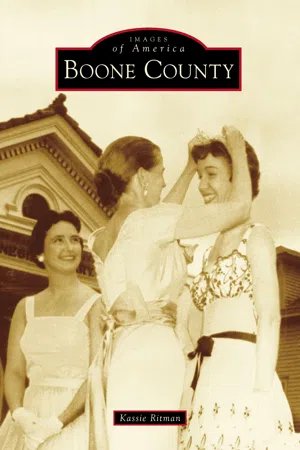
Boone County, founded on April Fools' Day in 1830, is situated in the center of the state, abutting Indiana's capital, Indianapolis. The first settlers found swampy land overgrown with ancient hardwoods, riddled with rattlesnakes, and teeming with wetland creatures--most famously, frogs. Although life was challenging for the area's first settlers, most persevered. Many chided that Boone was not fit to be included as a part of the fledgling state of Indiana. They dubbed the newly platted area as the "State of Boone" to set it aside from the superior farmland and living conditions found elsewhere in Indiana. Boone County's first census counted 621 persons in 1830. Today, many of the original surnames remain prevalent among a population that exceeds 60,000 residents.
Trusted by 375,005 students
Access to over 1 million titles for a fair monthly price.
Study more efficiently using our study tools.
Information
One
THE PIONEER YEARS

Around 1888, this enormous tulip poplar was felled and brought into town for milling into usable lumber. The Lebanon Pioneer reported in 1873 that a similar poplar tree, 33 feet in circumference, was taken down at the Jackson township farm of William Coombs. The Patriot newspaper told of another ancient tree—a sycamore from Chauncy Canine’s property in Washington Township—presented in 1902 at A.N. Holloway’s mill. These may have been the last few giant trees felled in the area.

Silvester and Elizabeth Robertson came to Harrison Township in 1858. There, he built a log cabin and eventually this fine house. While teaching in a nearby one-room schoolhouse, he acquired 100 acres, enabling him to both farm and establish a field tile factory. Drainage tiles were in high demand. Eventually, Silvester built the two-story home shown in this 1894 photograph of his family, likely taken after services at New Brunswick Church of Christ. Six generations later, the farm is still owned by Silvester’s family. (Rick Robertson.)

Despite the constant hardships of pioneer life, this 1909 photograph shows English immigrant and early settler Susan White Everett (second row, fourth from the left) at age 84. She is surrounded by more than 60 of her American-born descendants. (Everett family.)
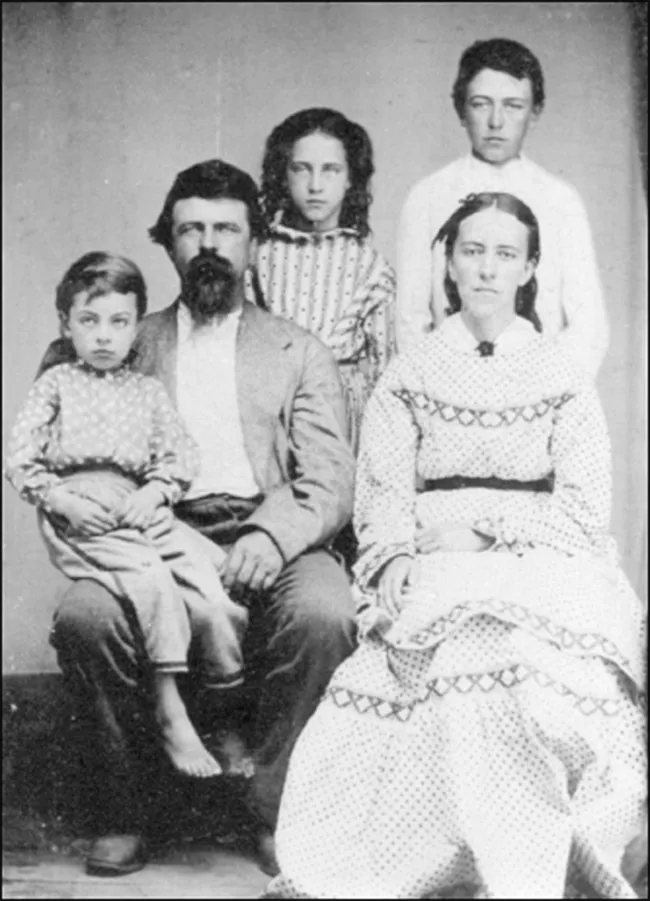
This 1870 photograph shows pioneers John and Jane Edwards with their young family. Listed among the first settlers in the Whitelick area, the Edwards family lived a life of ceaseless work, rarely seeing others in the early years except at church services provided by circuitriding preachers who led services about once per month, usually at a farmhouse. (Everett family)

Isaac Leap’s cabin was typical of those built in Boone County. Though his home seems quite modest, he owned 80 acres and also kept a store at nearby Rosston. He also served as a Baptist minister. Leap’s 1837 land grant title was signed by Pres. Martin Van Buren.

The Charles Schooler cabin (in use at the time of this 1966 photograph as a farmer’s outbuilding) was a sturdy log structure built about two miles south of Whitestown. The Schooler family settled here in the early 1830s. Part of their property contained three low spots used by bison as wallows. The buffalo would go to these swampy depressions to roll in mud to deter flies and other insects.

At the corner of the Schooler property, a 28-square-foot plot was reserved for family burials. Only three markers remain in the unfenced cemetery. The oldest one belongs to the Schoolers’ young son Andrew, who died in 1839 at eight months of age.

Although the town of Spicklepoint, located at the far south edge of Harrison Township, was only a cornfield and vague memory after about 1905, it once was home to a store, a schoolhouse, three residences, two doctors’ offices (Dr. Parrish and Dr. Stevens), and a sawmill and corngrinding operation. When the tiny town was “discontinued,” this one-room cabin—built in 1834 by James Logan, and which once housed the Acton family and their nine children for an entire winter)—was moved and used as part of a much larger home. When that home was razed in the 1970s, the cabin was rediscovered in a well preserved state. The Society for the Preservation of Our Indian Heritage carefully removed it and reassembled it on the grounds of Old Mill Run Park for display.

This substantially larger log cabin was built north of James Logan’s cabin by the Herr family in Perry Township. Many settlers from neighboring Hendricks County followed an old trail, known as Buzzard’s Trail, into Boone County. The path was used by Indians who traded with William Conner’s post along the White River in Hamilton County. Wildlife also used the path to travel through the heavily swamped and forested area. The cabin was gifted to the James Hill chapter of the Daughters of the American Revolution (DAR) in 1937 and moved to Memorial Park in Lebanon, where it is maintained as a historic site and rented out for private events.

This c. 1880 photograph shows Theodore (Dora) Caldwell working in the sugar camp he ran each spring. Caldwell collected sap from the many maple trees on his property along Sugar Creek, near Brown’s Wonder. He produced about 100 gallons of maple syrup each season. Another famous sugar camp, called Uncle Johnny’s, was near Whitestown at the current site of the Whitestown Lions Club Park.

In 1904, this large dredging sled attracted a daily crowd of onlookers at Lebanon’s Prairie Creek. Until the creek was dredged, rerouting much of the waterlogged drainage areas, “swamp rattlers” (Massasauga rattlesnakes) were a constant threat. The deadly reptiles found a safe haven and endless food supplies in the chicken houses and grain bins of the damp county’s farmland. Men baling hay to store for winter livestock feed were always on the lookout for “snake bales.” When the last of the drainage problem areas was remedied, the rattler population died off.

This c. 1890 photograph shows the early Lebanon City Building, which was constructed as a home in 1839. The city added a barn and additional rooms for the fire department. The simple, wood-frame structure served the county seat until it was replaced with a larger, brick building in 1903. Note the wooden sidewalk in the foreground.

John Gipson and James Matlock laid out a 16-lot town for a new settlement along the stagecoach route from Indianapolis to Crawfordsville. Gipson had purchased 80 acres in the area in 1828. The two flipped a coin to decide who would name the new town. Matlock, having won the toss, immediately pronounced it to be Jamestown. Locals often use the more familiar name of “Jimtown,” to the confusion of those new to the area. In the 1920s, banners lined Main Street commemorating the town’s not-to-be forgotten distinction: “Jamestown, Boone’s First County Seat.” (Tri-Area Library History Vault.)

The town originally named Osceola—but changed to Advance, perhaps due to great hopes of economic gains from the coming railroad station—was once home to a mineral spring. This scene shows the old downtown around 1918, when Red Harlis and Oty Walls used to drive sheep up and down Main Street to switch pastures on a regular schedule. Advance has hit hard times, but, true to its name, is struggling to go forward. The abandoned bank building at right is now a community library. The general store houses Boone County Uniques, a thriving antiques business....
Table of contents
- Cover Page
- Title Page
- Copyright Page
- Dedication
- Table of Contents
- Acknowledgements
- Introduction
- 1. The Pioneer Years
- 2. Out of the Swamp
- 3. At Rest in Boone
- 4. Newfangled Boone
- 5. Caring as a Community
- 6. Farming the Land, Dodging the Weather
- 7. School, Sports, and Stuff to Do
- 8. Something to Celebrate in Boone
- 9. Fondness and Fame in Boone County
Frequently asked questions
Yes, you can cancel anytime from the Subscription tab in your account settings on the Perlego website. Your subscription will stay active until the end of your current billing period. Learn how to cancel your subscription
No, books cannot be downloaded as external files, such as PDFs, for use outside of Perlego. However, you can download books within the Perlego app for offline reading on mobile or tablet. Learn how to download books offline
Perlego offers two plans: Essential and Complete
- Essential is ideal for learners and professionals who enjoy exploring a wide range of subjects. Access the Essential Library with 800,000+ trusted titles and best-sellers across business, personal growth, and the humanities. Includes unlimited reading time and Standard Read Aloud voice.
- Complete: Perfect for advanced learners and researchers needing full, unrestricted access. Unlock 1.4M+ books across hundreds of subjects, including academic and specialized titles. The Complete Plan also includes advanced features like Premium Read Aloud and Research Assistant.
We are an online textbook subscription service, where you can get access to an entire online library for less than the price of a single book per month. With over 1 million books across 990+ topics, we’ve got you covered! Learn about our mission
Look out for the read-aloud symbol on your next book to see if you can listen to it. The read-aloud tool reads text aloud for you, highlighting the text as it is being read. You can pause it, speed it up and slow it down. Learn more about Read Aloud
Yes! You can use the Perlego app on both iOS and Android devices to read anytime, anywhere — even offline. Perfect for commutes or when you’re on the go.
Please note we cannot support devices running on iOS 13 and Android 7 or earlier. Learn more about using the app
Please note we cannot support devices running on iOS 13 and Android 7 or earlier. Learn more about using the app
Yes, you can access Boone County by Kassie Ritman in PDF and/or ePUB format, as well as other popular books in History & North American History. We have over one million books available in our catalogue for you to explore.