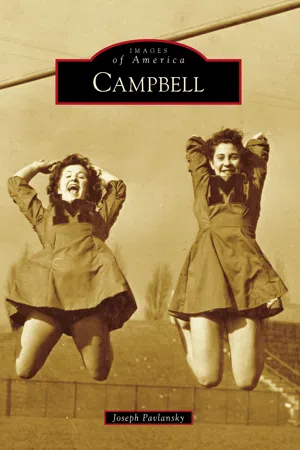
- 128 pages
- English
- ePUB (mobile friendly)
- Available on iOS & Android
eBook - ePub
Campbell
About this book
Shaped from the rough farmlands and hills of northeast Ohio and forged from the blood, sweat, and tears of the steel mill workers, the city of Campbell (formerly Coitsville Township and later East Youngstown) had a humble start. With the turn of the 20th century, it was thrust into an economic growth that rivaled the biggest cities in the United States. Measuring only 3.74 square miles, some said Campbell brought in enough revenue that the streets could be lined with gold. The Youngstown Sheet & Tube Company Campbell Works formed in 1900 and brought with it the need for more workers. As immigrants from the surrounding areas came for employment, their families joined them from Europe. Within a few years, Campbell became a culturally diverse city that fed on the revenue from the steel mill and its socioeconomic by-products.
Trusted by 375,005 students
Access to over 1.5 million titles for a fair monthly price.
Study more efficiently using our study tools.
Information
One
SOUP CITY

This is an undated photograph looking down Robinson Road toward Wilson Avenue showing the various taverns and markets available to mill workers as they crossed the Short Street Bridge. The buildings have been home to food markets, taverns, doctor’s offices, apartments, a movie theater, and more. The Youngstown Sheet and Tube Company plant can be seen in the background. Today, many of the buildings pictured are no longer standing. After the steel mills closed in 1977, small businesses began to decline as jobs and money became scarce. Buildings were abandoned and left vacant until demolished by a new owner or the city. Today, Mother Nature has reclaimed some lots, while private companies have purchased the others. (Courtesy of Florence Galida.)

This photograph of the Hodgekin’s Home Theater, located on Robinson Road and Short Street, was taken in 1919. Robinson Road and Short Street was a central location for many Campbell residents looking for entertainment after work and on the weekends. This area of the city was also filled with businesses to accommodate employees returning from work across the Short Street Bridge. (Courtesy of Mike Parise.)

The Hodgekin’s Home Theater, pictured here in July 1921, played movies and serial cliff-hangers for kids and adults. Various promotional war movie posters can be seen hanging in front of the building. Several multinational flags are hanging from the building and across Robinson Road in recognition of the many different immigrants in the city. The theater was the earliest to open in East Youngstown (Campbell) and closed down at an unknown date. (Courtesy of Mike Parise.)
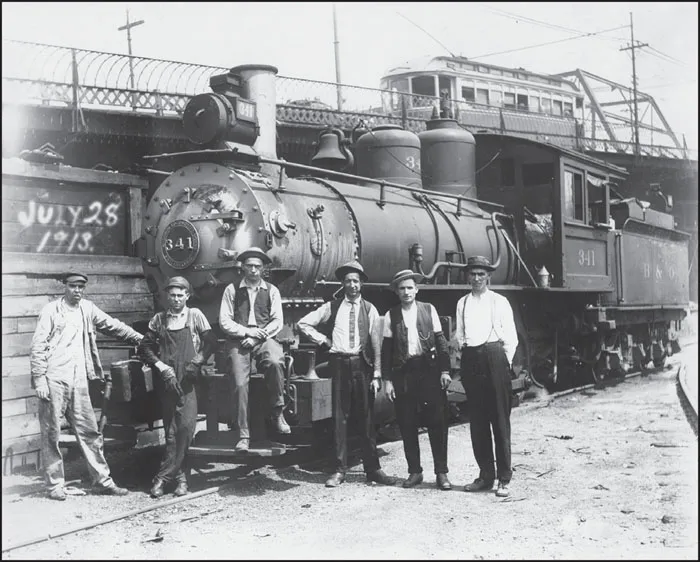
Not all immigrants found work at the steel mills; some took more desirable positions on the railroads. Shown in this photograph from July 28, 1913, are railroad workers with electric streetcars in the background. The streetcars and trolleys were housed at the Haselton Car Barns location along Wilson Avenue near Coitsville Road. The barns shut down in 1944 and later became the site for the Calex Corporation. (Courtesy of Florence Galida.)

In the early 1890s, electric streetcars ran from Youngstown to East Youngstown at Stop One (Wilson Avenue at Coitsville Road). By 1899, a single track had been established through East Youngstown to Struthers and later into Lowellville. Operated by the Mahoning Valley Electric Railroad Company, the tracks ran from Stop One to behind the homes on the south side of Wilson Avenue and then behind the residences on the riverbank before continuing north on Eighth Street, where they ran parallel to Wilson Avenue all the way into Lowellville. The electric streetcars operated until 1940, when they were replaced by the electric trolley buses. (Courtesy of Mike Parise.)

The Neighborhood House Campbell Christian Center on the corner of Gordon Avenue and Fifteenth Street is pictured as it appeared in 1980. After the closure of Hamrock Hall on Wilson Avenue at Washington Street in 1923, various Presbyterian churches in Youngstown became concerned with the drastic increase in the immigrant population. In 1927, these churches raised approximately $12,000 and constructed the Neighborhood House the same year. The Neighborhood House, along with the Bethal House, played a major role in assisting the citizens of Campbell during the Great Depression and throughout World War II. (Courtesy of Florence Galida.)

This 1943 photograph shows the children of the Bethal House, which was located on Murray Avenue at Washington Street. The origins of the Bethal House began in 1919 when Rev. Robert Hughes of the Hazeltine Baptist Church began a missionary Sunday school in a small storeroom located on Ninth Street. With the immigrant population of the area growing, Hughes moved to a hall on Reed Avenue before finally settling at the Bethal House. (Courtesy of Florence Galida.)

Built in 1950, the Campbell swimming pool occupied the site of the current community center. During its operation, the pool’s water supply was provided solely from well water and was more than likely the only city pool in the state that did so. Children and adults alike flocked from the city and from Youngstown to enjoy not only the refreshing pool water but also the beautiful scenery of Roosevelt Park. (Courtesy of Florence Galida.)

Here is an undated photograph of the Roosevelt Park pool house. The Campbell Community Center and gazebo currently occupy the land, and the pool has since been filled in with dirt.

This precinct map from 1966 shows the jurisdictional borders of the city and the region that each of the four wards encompassed. Each ward was broken into four to six smaller zones. City police officers used this map for an easier recognition of their area of responsibility during foot or car patrols. Many of the city churches, businesses, or other prominent establishments are also marked on the map. (Courtesy of Joseph Pavlansky.)

In 1937, under the recommendation of the Hazelton Slovak City Improvement Club, Mayor John Borak purchased the 64.5-acre Gluck farm for $6,250 in order to provide a large enough area for a city park. Most of the land at the time was swamp, and through the combined effort of extensive programs, it was drained and improved upon over the next several years. (Courtesy of F. Galida.)

Local immigrants established various social halls according to their nationality to provide a venue for sp...
Table of contents
- Cover Page
- Title Page
- Copyright Page
- Dedication
- Table of Contents
- Acknowledgments
- Introduction
- 1. Soup City
- 2. The Mills and Company Homes
- 3. City of Churches
- 4. School Days
- 5. Home of the Red Devils
- 6. The City’s Finest
- 7. The Bicentennial and Beyond
Frequently asked questions
Yes, you can cancel anytime from the Subscription tab in your account settings on the Perlego website. Your subscription will stay active until the end of your current billing period. Learn how to cancel your subscription
No, books cannot be downloaded as external files, such as PDFs, for use outside of Perlego. However, you can download books within the Perlego app for offline reading on mobile or tablet. Learn how to download books offline
Perlego offers two plans: Essential and Complete
- Essential is ideal for learners and professionals who enjoy exploring a wide range of subjects. Access the Essential Library with 800,000+ trusted titles and best-sellers across business, personal growth, and the humanities. Includes unlimited reading time and Standard Read Aloud voice.
- Complete: Perfect for advanced learners and researchers needing full, unrestricted access. Unlock 1.5M+ books across hundreds of subjects, including academic and specialized titles. The Complete Plan also includes advanced features like Premium Read Aloud and Research Assistant.
We are an online textbook subscription service, where you can get access to an entire online library for less than the price of a single book per month. With over 1.5 million books across 990+ topics, we’ve got you covered! Learn about our mission
Look out for the read-aloud symbol on your next book to see if you can listen to it. The read-aloud tool reads text aloud for you, highlighting the text as it is being read. You can pause it, speed it up and slow it down. Learn more about Read Aloud
Yes! You can use the Perlego app on both iOS and Android devices to read anytime, anywhere — even offline. Perfect for commutes or when you’re on the go.
Please note we cannot support devices running on iOS 13 and Android 7 or earlier. Learn more about using the app
Please note we cannot support devices running on iOS 13 and Android 7 or earlier. Learn more about using the app
Yes, you can access Campbell by Joseph Pavlansky in PDF and/or ePUB format, as well as other popular books in History & North American History. We have over 1.5 million books available in our catalogue for you to explore.