eBook - ePub
Navajo Weavers of the American Southwest
- 128 pages
- English
- ePUB (mobile friendly)
- Available on iOS & Android
eBook - ePub
Navajo Weavers of the American Southwest
About this book
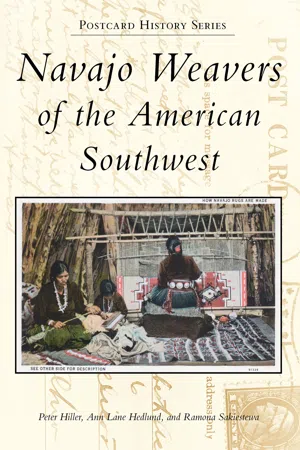
From the mid-17th century to the present day, herding sheep, carding wool, spinning yarn, dyeing with native plants, and weaving on iconic upright looms have all been steps in the intricate process of Navajo blanket and rug making in the American Southwest. Beginning in the late 1800s, amateur and professional photographers documented the Diné (Navajo) weavers and their artwork, and the images they captured tell the stories of the artists, their homes, and the materials, techniques, and designs they used. Many postcards illustrate popular interest surrounding weaving as an indigenous art form, even as economic, social, and political realities influenced the craft. These historical pictures illuminate perceived traditional weaving practices. The authors' accompanying narratives deepen the perspective and relate imagery to modern life.
Trusted by 375,005 students
Access to over 1.5 million titles for a fair monthly price.
Study more efficiently using our study tools.
Information
One
PUEBLO ANTECEDENTS
AND
EARLY NAVAJO WEAVERS
AND
EARLY NAVAJO WEAVERS

Puebloan ancestors lived in the Southwest long before Diné people migrated from the north. Prehistoric Pueblo weaving with local fibers served everyday and ceremonial uses. Navajo weavers adopted Pueblo methods by the 1650s but made distinctive two-paneled dresses (the biil worn here) and shawls (on the loom). This photogravure is Plate XXV in Washington Matthews’ 1881– 1882 report to the Bureau of American Ethnology.

Men from the Hopi pueblos demonstrated weaving in the Hopi House showroom at the Grand Canyon. This room replicates a Hopi household storeroom, where corn, chiles, and other foods were stowed. This weaver is making one panel of a fringed ceremonial dance sash with white cotton and colorful wool brocading. This card was mailed from the Grand Canyon in 1906. (DPC and FHC.)

A museum diorama reveals the interior and rooftop of a Hopi two-story home. Striped blankets hang over a “rug pole” on the back wall, while a male weaver makes a dress or manta (shawl) in blue and black wool. Pueblo manta-dresses are wrapped around the wearer and under one arm in the manner worn by the three women in the images on page 13. (Milwaukee Public Museum.)

Weavers from Hopi and Rio Grande Pueblos, including Isleta and Zuni, made narrow belts on backstrap- and foot-tensioned looms. In contrast, Navajos used an upright frame for weaving belts and blankets. Karl Moon made the original glass plate sometime between 1904 and 1907. Forthis postcard, the original background—a non-Indian floral carpet and bed with flounced coverlet— was removed, resulting in this starker scene. (US.)

Identified by her distinctive hairstyle, this unmarried Hopi woman works on a backstrap or “waist loom” flanked by fancy sashes. This novelty postcard, postmarked in 1947, was made from a thin sheet of yucca wood laminated to a paper backing. Its caption notes that Pueblo and Navajo weavers make many narrow belts, “all the way from garter and arm bands, to wide sashes and wider ceremonial girdles with long fringe.” (US.)

Wrapped in a trade blanket, this Hopi man works at a loom hung from the building’s exterior beams. The lower loom bar is fixed in place with hidden “loom blocks” or rag-and-stick bundles inserted into the ground. With four horizontal heddle and shed sticks extending across the dark wool warps (vertical foundation yarns), the weaver is ready to make a twill manta or dress. (DPC.)

Instead of using underground blocks to anchor his loom, this Hopi weaver used heavy stones. This typical manta has two diamond-twill borders—the first was woven from the bottom, then moved to the top by turning the woven and unwoven web upside down; the second was finished from the bottom up, with a diagonal-twill center panel beginning above a raised line of twining.(M. Reider.)
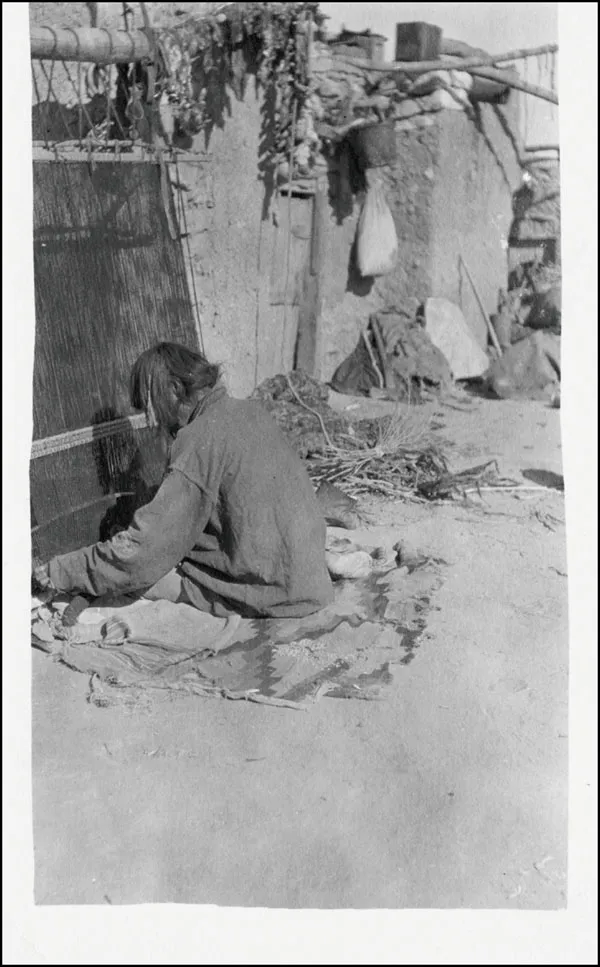
Although “Navajo weaving a blanket on his handmade loom” is penciled on this card’s reverse, the man is clearly Hopi, judging by his hairstyle, the twill weaving sticks, dark wool warps on the loom, and his Pueblo surroundings. He sits, however, on a nearly worn-out Navajo-style rug with a stepped design. Like many neighbors, Hopis and Navajos had friendly long-term trading relationships as well as disputes and rivalries. (US.)
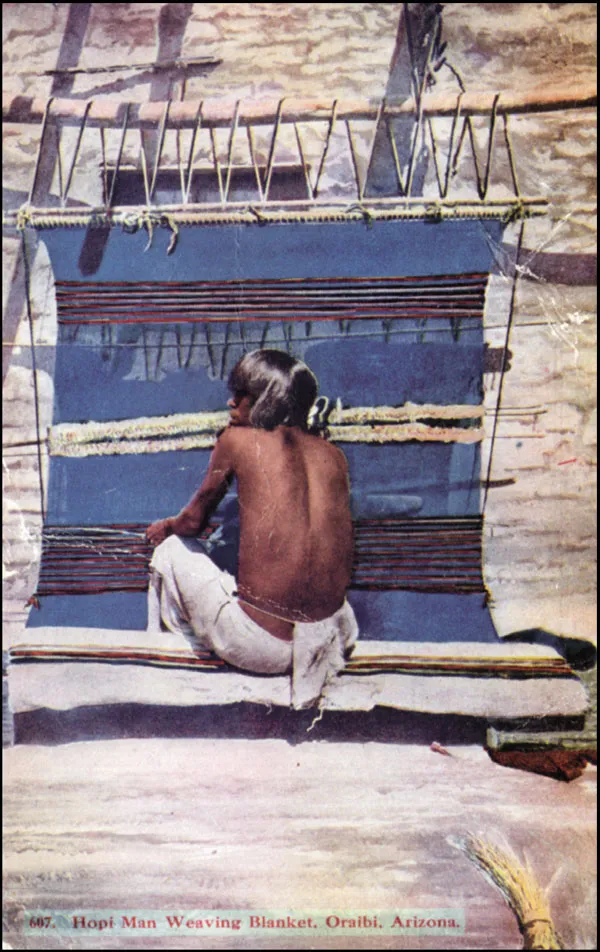
Pueblo weaving appears subtler than Navajo design work. The somber indigo blue and black yarns of a classic manta in the original black-and-white photograph were enlivened by someone who hand-tinted the red stripes and blue background. Oraibi, the site of this well-known 1901 photograph, is a Hopi village in northern Arizona. To publicize the West, the Santa Fe Railway and Fred Harvey Company hired William H. Simpson, the photographer who created this image.
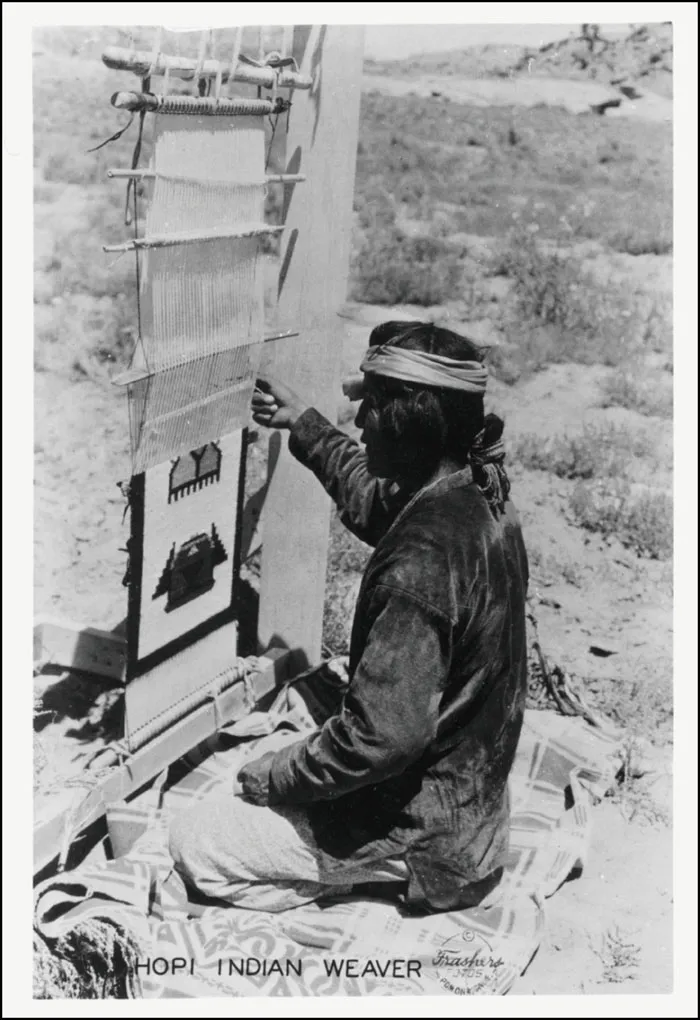
Although Hopi weavers focused on garments for tribal use, they occasionally created pictorial or geometric rugs for sale to outsiders. This Hopi man, pictured around 1932, is making a pictorial panel in tapestry weave, the main technique used by Navajos. In his simply bordered piece with a lower fringe, the visage of a “Crow Mother” kachina is surmounted by an emerging symbol of rain clouds. (FFS.)

Among Navajos, women are the predominant weavers, but a few men were known to weave as early as the 1880s. In Hopi society, men are the weavers of traditional garments and blankets. Surprisingly, this Hopi man is weaving a Navajo-style blanket with serrate diamonds. In the stereograph’s caption, his location is misspelled “Wolpi”—Walpi is an ancient Hopi village still occupied today. (UU and KVC.)

An elder Navajo weaver with bare feet works in her summer shade house of vertical logs. The card’s caption mistakes this for a hogan’s interior and calls her loom “primitive.” The reverse of the stereograph card shown on page 16, however, states that the Navajo heddle system is “a forerunner of the endlessly complicated machinery in modern looms… a step ahead of the mere back and forth darning with a needle.” (KVC.)

The legend on this stereograph, in which a Navajo weaver works on a geometric-patterned rug, repeats generalizations based in fact but not universally practiced—“The patterns are worked out on the loom and no two are alike. The weavers do not work from a drawing, but plan the design as they weave. The early Navaho [sic] blankets were so closely woven that water would not soak through them.” (KVC.)
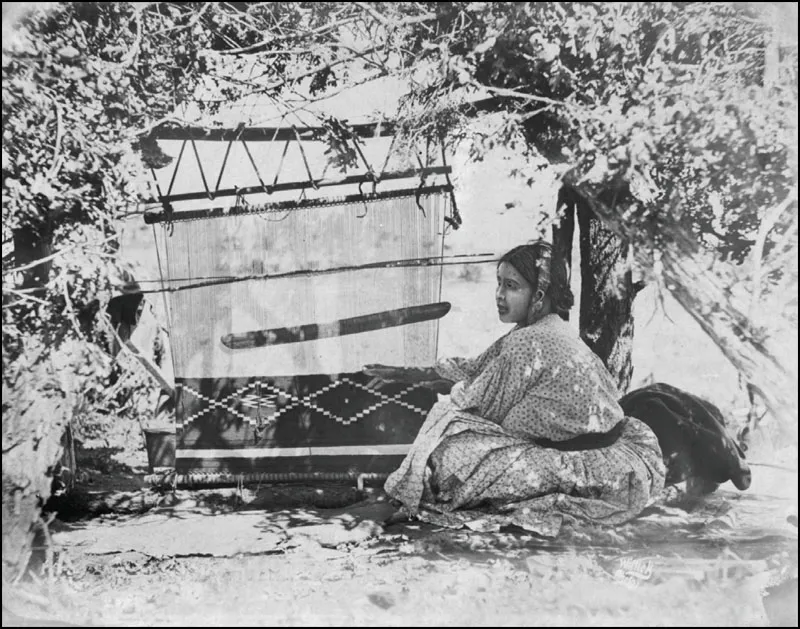
The blanket on this loom has a mix of stepped diamonds of the late classic period and zigzag motifs from the early transitional period. From th...
Table of contents
- Cover Page
- Title Page
- Copyright
- Dedication
- Contents
- Foreword
- Acknowledgements
- Introduction
- 1. Pueblo Antecedents and Early Navajo Weavers
- 2. Romance and Realities
- 3. Shepherding and Working the Wool
- 4. Weaving at Home
- 5. At the Loom
- 6. What’s on the Loom?
- 7. Card Sets and Curios
- Bibliography
- Index
Frequently asked questions
Yes, you can cancel anytime from the Subscription tab in your account settings on the Perlego website. Your subscription will stay active until the end of your current billing period. Learn how to cancel your subscription
No, books cannot be downloaded as external files, such as PDFs, for use outside of Perlego. However, you can download books within the Perlego app for offline reading on mobile or tablet. Learn how to download books offline
Perlego offers two plans: Essential and Complete
- Essential is ideal for learners and professionals who enjoy exploring a wide range of subjects. Access the Essential Library with 800,000+ trusted titles and best-sellers across business, personal growth, and the humanities. Includes unlimited reading time and Standard Read Aloud voice.
- Complete: Perfect for advanced learners and researchers needing full, unrestricted access. Unlock 1.5M+ books across hundreds of subjects, including academic and specialized titles. The Complete Plan also includes advanced features like Premium Read Aloud and Research Assistant.
We are an online textbook subscription service, where you can get access to an entire online library for less than the price of a single book per month. With over 1.5 million books across 990+ topics, we’ve got you covered! Learn about our mission
Look out for the read-aloud symbol on your next book to see if you can listen to it. The read-aloud tool reads text aloud for you, highlighting the text as it is being read. You can pause it, speed it up and slow it down. Learn more about Read Aloud
Yes! You can use the Perlego app on both iOS and Android devices to read anytime, anywhere — even offline. Perfect for commutes or when you’re on the go.
Please note we cannot support devices running on iOS 13 and Android 7 or earlier. Learn more about using the app
Please note we cannot support devices running on iOS 13 and Android 7 or earlier. Learn more about using the app
Yes, you can access Navajo Weavers of the American Southwest by Peter Hiller,Ann Lane Hedlund,Ramona Sakiestewa in PDF and/or ePUB format, as well as other popular books in History & Art General. We have over 1.5 million books available in our catalogue for you to explore.