- 128 pages
- English
- ePUB (mobile friendly)
- Available on iOS & Android
eBook - ePub
About this book
As he rode through mid-19th-century Lenox, Massachusetts, Dr. Oliver Wendell Holmes wrote, "Perfect almost to a miracle." Founded in 1767, Lenox had sent Gen. John Paterson riding to the Revolutionary War 75 years earlier. Named the Shire Town because of its central Berkshires location, Lenox was home to the county courts. In the east, the center of a bustling glassworks and ironworks industry was situated by the Housatonic River. In the west, rolling hills and sparkling waters drew the literary lights to the New England Lake District. When the county seat moved to Pittsfield, fears of a local economic decline were unfounded with the arrival of the Gilded Age millionaires, who built stately seasonal estates with the charmingly ironic nickname of cottage. The exodus of the millionaires saw Lenox reinvent itself as a cultural and educational center, with private schools and performing arts organizations, Tanglewood chief among them, located on former estates. Change may come to Lenox again, but one constant remains throughout these past 250 years: its scenic beauty.
Trusted by 375,005 students
Access to over 1 million titles for a fair monthly price.
Study more efficiently using our study tools.
Information
One
BIRTH AND REVOLUTION
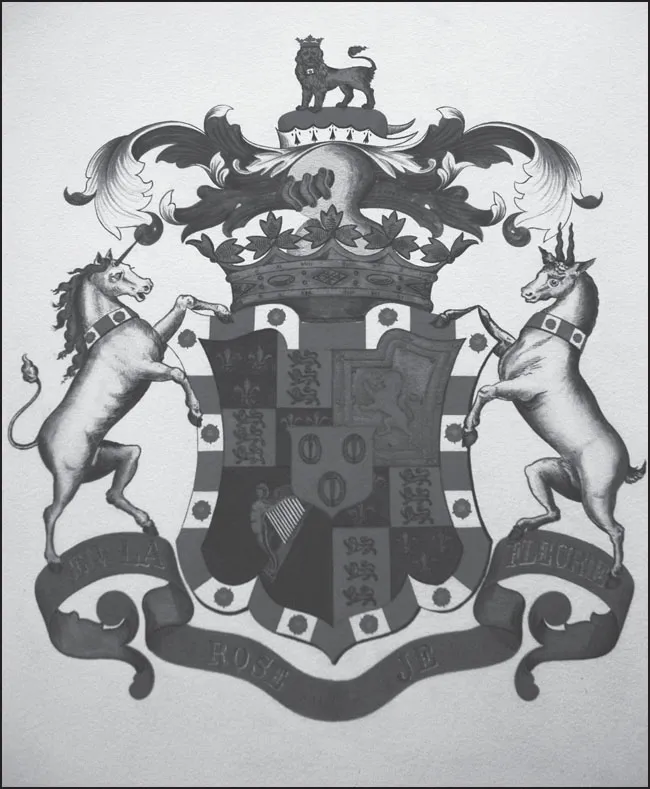
Lenox was named for Charles Lennox, the third Duke of Richmond. The second N was dropped as a casualty of the indifferent spelling practices of the 18th century. The first and fourth quarters of the coat of arms indicate royal blood (that of Charles II); the border indicates the bloodline through the king’s favorite mistress. As a member of Parliament, the duke was a champion of the American Colonies. The motto “En la rose, je fleurie” loosely translates to “like the rose, I flower.” This coat of arms would be adapted for the town named after the duke.

Far from the titled estate of the duke in Berkshire, England, the settlement in the province of Massachusetts Bay would have been primeval forest, touched only lightly by the Mahicans. Its name was originally Yokuntown, for the chief whose lands were purchased. Jonathan Hinsdale, the first settler, made his home in 1750 on what is now Old Stockbridge Road.

The first town meeting was held at the dwelling of Israel Dewey on March 11, 1767, at 9:00 a.m., where he was elected selectman. There are indications that the Birchwood Inn on this site still has vestiges of Dewey’s home.

On July 7, 1774, the Berkshire County Congress adopted the Non Consumption, Non Importation Act. The heads of 110 households signed this copy in Lenox, including those of Israel Dewey, Charles Mattoon, William Walker, and John Paterson, men who would soon take up arms in pursuit of liberty. It not only held the signers to promise not to import British goods, but also, in an act of solidarity, to “engage to avoid all unnecessary lawsuits whatever.” (Courtesy of Kevin Sprague.)
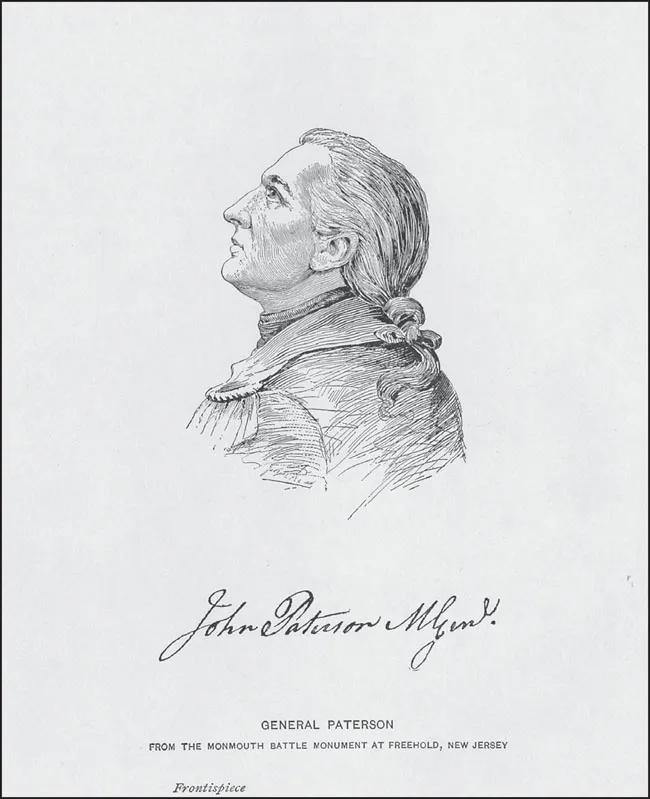
Lawyer John Paterson moved to Lenox from Farmington, Connecticut, in early 1774. Within months, this 30-year-old Yale graduate was the delegate in charge of obtaining those 110 signatures. He was elected to the First Provincial Congress in September 1774. By the time he returned to Lenox in December of the same year, he was moved to raise a regiment of men ready to go to war at a minute’s notice.

Built in 1783, the Paterson home, in the center of the village, spoke to the general’s status as a legislator and military officer.
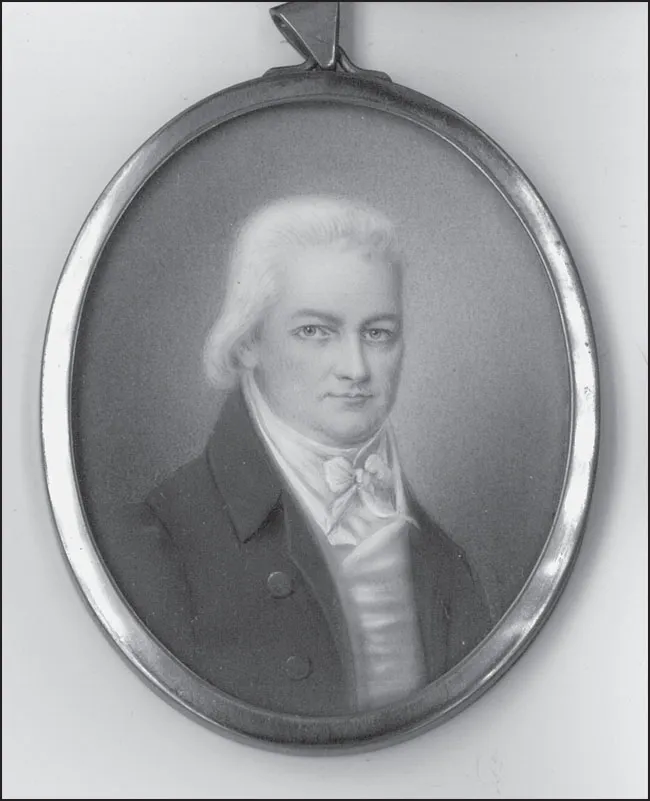
On April 22, 1775, Lt. (later Maj.) Azariah Egleston marched with Col. (later Gen.) John Paterson’s regiment to Cambridge hours after receiving word of the opening battle of the Revolutionary War at Lexington. He fought at Valley Forge and was paymaster for the 1st Massachusetts Regiment at West Point. In 1785, he married Paterson’s daughter Hannah.

The invitation reads, “General Washington presents his Compliments to Lieut Egleston & requests the Favor of his company at Dinner Tomorrow—3 o’clock. Friday, 24th July.”

On April 14, 1775, the town voted to “procure 40 muskets with bayonets and cartouch boxes.” Musket balls were produced locally; even this early in the town’s history, a rich vein of iron ore had been discovered threading through the village.

One hundred pounds of powder, 400 pounds of lead, and 600 flints were stored in the town powder house. After the war, it was taken down and the materials reused for a burial receiving vault.

The Village Inn was John Whitlock’s tavern, built in 1771. A Tory, Whitlock was accused in 1777 of being “inimically disposed and dangerous to remain in the States of America.” His land was subsequently confiscated, and he moved to Canada. (Courtesy of the Lenox Historical Society.)
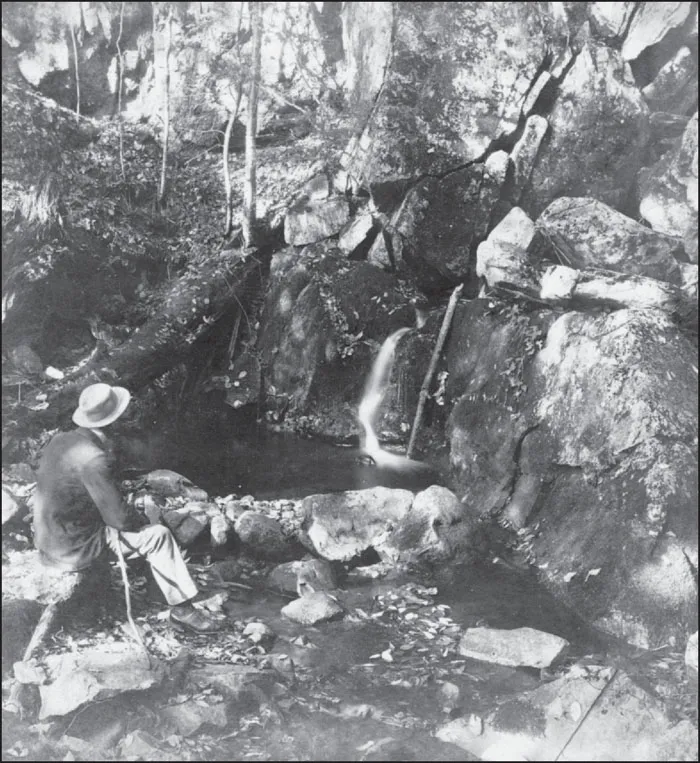
In 1776, Stockbridge Tory Gideon Smith, wanted for treason because he harbored an escaped British prisoner, took refuge in a cave (more like a cleft) in the hillside near Roaring Brook. Since then, the spot has been known as Tory Cave.
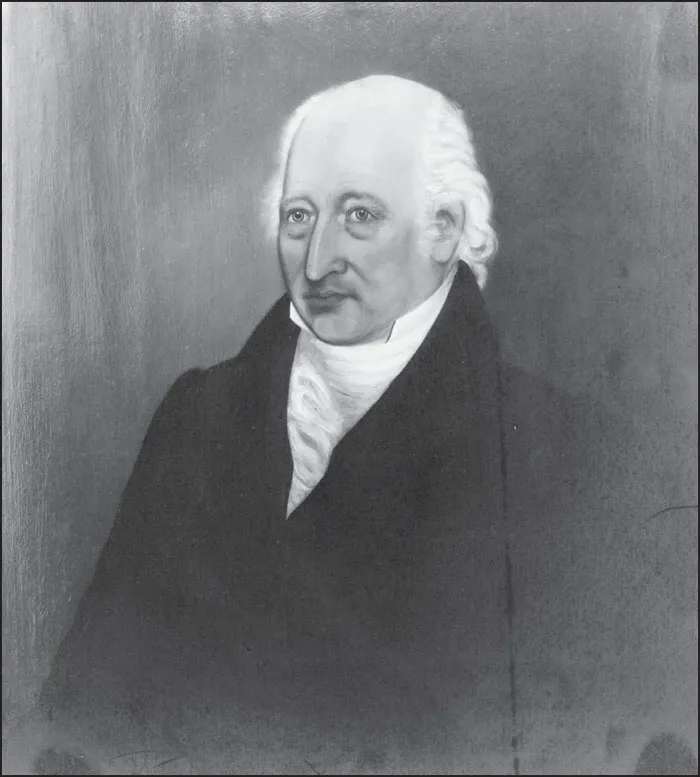
Capt. William Walker was born in Rehoboth, Massachusetts, in 1751 and moved to Lenox in 1770. One of the minutemen who left for war immediately upon the news of the Battle of Lexington, he was with Washington at the Battles of Trenton and Princeton. After serving as state senator, he became the presiding judge when Lenox was established as the county seat.
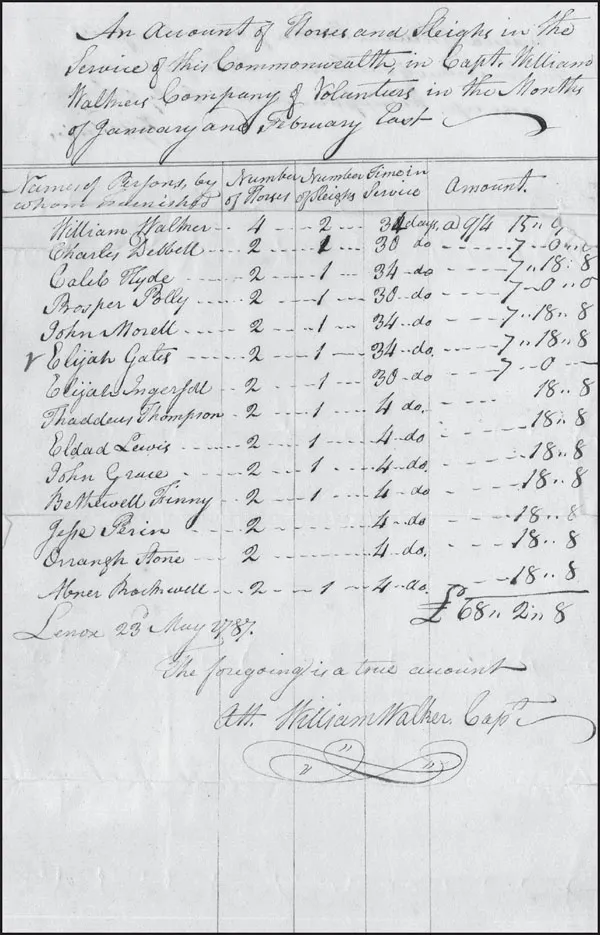
This appears to be a nondescript invoice for sleighs from February 1787. However, these sleighs from Lenox were ordered by Capt. William Walker and were used to transport more than 50 insurrectionists of Shays’ Rebellion to the county jail.

Another inn bearing the vestiges of an earlier dwelling was owned by Revolutionary War soldier– turned–Shays insurrectionist Pere...
Table of contents
- Cover Page
- Title Page
- Copyright Page
- Dedication
- Table of Contents
- Acknowledgments
- Introduction
- 1. Birth and Revolution
- 2. Shire Town Lenox
- 3. Civil War Times
- 4. Gilded Age Lenox
- 5. Lenox at Work
- 6. Cottages and “Cottages”
- 7. Lenox at Play
- 8. A Natural Delight
- Bibliography
- About the Lenox Library Association
Frequently asked questions
Yes, you can cancel anytime from the Subscription tab in your account settings on the Perlego website. Your subscription will stay active until the end of your current billing period. Learn how to cancel your subscription
No, books cannot be downloaded as external files, such as PDFs, for use outside of Perlego. However, you can download books within the Perlego app for offline reading on mobile or tablet. Learn how to download books offline
Perlego offers two plans: Essential and Complete
- Essential is ideal for learners and professionals who enjoy exploring a wide range of subjects. Access the Essential Library with 800,000+ trusted titles and best-sellers across business, personal growth, and the humanities. Includes unlimited reading time and Standard Read Aloud voice.
- Complete: Perfect for advanced learners and researchers needing full, unrestricted access. Unlock 1.4M+ books across hundreds of subjects, including academic and specialized titles. The Complete Plan also includes advanced features like Premium Read Aloud and Research Assistant.
We are an online textbook subscription service, where you can get access to an entire online library for less than the price of a single book per month. With over 1 million books across 990+ topics, we’ve got you covered! Learn about our mission
Look out for the read-aloud symbol on your next book to see if you can listen to it. The read-aloud tool reads text aloud for you, highlighting the text as it is being read. You can pause it, speed it up and slow it down. Learn more about Read Aloud
Yes! You can use the Perlego app on both iOS and Android devices to read anytime, anywhere — even offline. Perfect for commutes or when you’re on the go.
Please note we cannot support devices running on iOS 13 and Android 7 or earlier. Learn more about using the app
Please note we cannot support devices running on iOS 13 and Android 7 or earlier. Learn more about using the app
Yes, you can access Lenox by Lenox Library Association in PDF and/or ePUB format, as well as other popular books in History & North American History. We have over one million books available in our catalogue for you to explore.