- 128 pages
- English
- ePUB (mobile friendly)
- Available on iOS & Android
eBook - ePub
Freeport through the Years
About this book
Like other towns in coastal Maine, Freeport was settled in the 18th century by residents of the southern part of the state--Massachusetts, which it was a part of until 1820. The Harraseeket River provided mill power and transportation, enabling growth and separation from North Yarmouth in 1789. The arrival of the railroad in 1849 led to a late-century economic boom fueled by entrepreneur E.B. Mallet. Piggybacking on the established industrial infrastructure, L.L. Bean and other retailers prospered in the next century, forming the core of activity at the heart of Freeport Village today. South Freeport was sustained by shipbuilding that ebbed and flowed through the 20th century, and largely because of that industry, it remains a historic village to this day. Because of Freeport's rapid growth and a number of downtown fires, historic buildings have been lost, moved, or altered over time, though the historical society has advocated for preservation and maintains a broad collection of photographs that visually record these changes.
Trusted by 375,005 students
Access to over 1 million titles for a fair monthly price.
Study more efficiently using our study tools.
Information
One
VILLAGES

This home at Kendall’s Corner, built around 1820 by War of 1812 veteran Robert Kendall, had its original kitchen in the cellar. Known as Frost’s Corner two centuries ago for early settler Phineas Frost, this intersection marks the northern boundary of Freeport Village. Located at a crossroads of travel to Durham or Brunswick, Samuel Hyde had a hatter’s shop nearby from about 1810 to 1817. The Kendall family is seen playing croquet around 1880, before a second-story expansion was added to the house. (Courtesy of Lincoln Merrill Jr.)

Although Freeport’s four villages have experienced major transformations in their multi-century history, no area has seen more rapid and dramatic changes than Freeport Corner. A transportation crossroads that included the commerce road between Durham and Porter’s Landing, the original post road to Brunswick (Route 1), and the stagecoach route between Brunswick and Portland over Pleasant Hill—wagons, trolleys, and automobiles all converged at this location. Poignantly, everything in this view from near a century ago is now gone: from left to right, the Oxnard Block, Warren Block, and Smith (or Cates) Block, the trolley, a granite hitching post, and the town water hydrant. The Chinook husky drinking from the hydrant was named Semiluk; he was the lead dog in a sled team brought back from Greenland by famed Arctic explorer Donald MacMillan for local teenager Eddie Skillin. Cars passing this intersection became so numerous in the early 20th century that a stoplight was installed in 1937; it was removed after 1951 when the Freeport Bypass rerouted traffic. The Warren Block, L.L. Bean’s longtime home, was built in 1894 by Orren W. Smith, whose middle name may have been Warren. It was razed in 1977 for L.L. Bean’s expansion.

This building, shown in 1889, once sat on Main Street just north of Bow Street, an ideal commercial location for generations. Merchant Nathan Nye, who moved to Freeport in 1807, may have built the structure around 1820, since the store he owned with son-in-law Enoch Harrington was near this site. A variety of owners later kept stores here until the building was destroyed by fire in 1894, along with the adjacent Congregational church. It had previously been saved from burning when townspeople relayed buckets of water from a nearby well. Englishman Samuel Thing, an innholder in the 1840s, opened a store with Starrett Litchfield here in 1854. When Thing & Co. moved to the tavern across the square in 1860, merchants Creech & Means moved in until they sold to Jarvis A. Brewster, who owned the building when it burned. Before the fire, the block housed the post office, Golden Cross Hall, a barber, dentist, and dressmaker, as well as Brewster’s store, which sold hardware, stoves, crockery, paint, and oil. Brewster later founded Casco Bay Packing Co., which processed clams at Porter’s Landing.

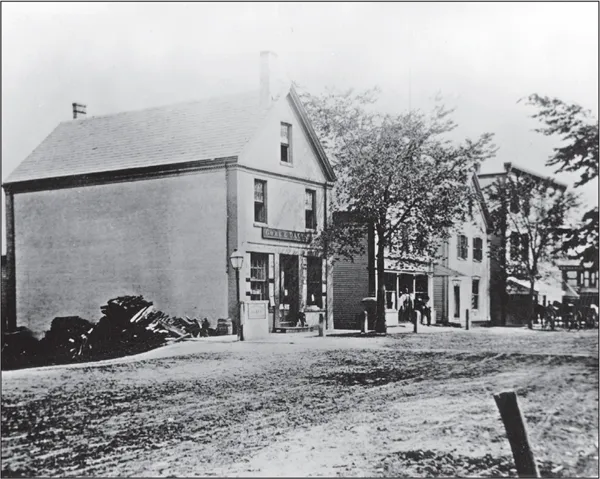
Built in 1790 for Freeport’s first minister, Thomas Means opened a tavern here around 1807, which was a stagecoach stop between Portland and Augusta. Samuel Holbrook used it as a store from 1815 until 1824, when Samuel Bliss again kept it as a tavern. Known as Holbrook Block by the 1870s, the structure housed many retail ventures until it was razed in the early 1970s. The building behind the stable may have been an early 19th-century store, and a shoe and cabinet-making shop around 1830. Holbrook and William Gore opened a store near the site of the building below at Main and Mechanic Streets in 1831, and the upstairs served as town meeting space. Although the structure was brick, it burned around 1844, destroying Masonic records. Gore & Holbrook rebuilt, and the new brick building shown below survived until the fire of 1909. Gore continued the store after Holbrook left in 1860, and from 1875 to 1889, partnered with William Davis to form Gore & Davis.

In 1888, Frederick Nichols built the Harraseeket House (above), a hotel with 25 rooms on the second and third floors, on a quarter acre of land he purchased in 1876 for $400. The block housed a hotel office, trolley waiting room, millinery, boot and shoe store, drugstore, and two grocery stores on the ground floor. A.W. Mitchell owned a stationery store and circulating library at the corner with 200 volumes of popular novels, magazines, and fashion books. Mallet constructed the adjacent block below in 1889. It housed a dry and fancy goods store and a general store, which was finished in polished whitewood and pine and had showcases and swinging stools advertised as “equal to those in any city.” The emergence of these retail and service blocks reflected rapid growth caused by the village’s industrial boom and foretold a surge of block building that would dramatically change the face of Freeport Village.


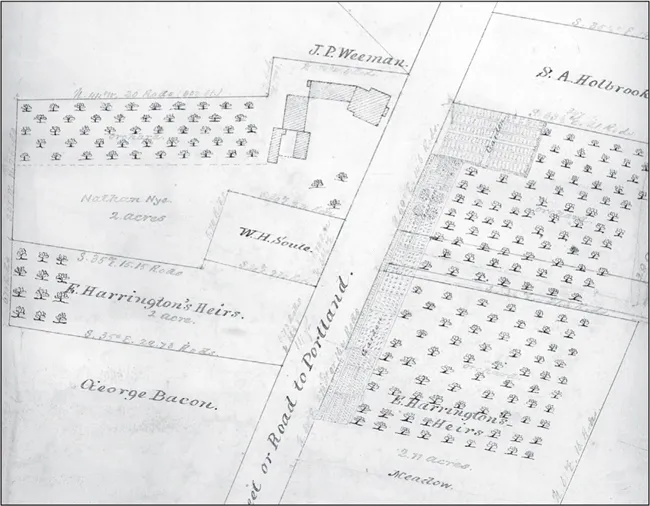
The home above was built around 1800 by mariner David Soule and was later owned by his son David B. Soule, a joiner. In 1857, merchant Robert S. Soule, son of prolific Porter’s Landing shipbuilder Rufus Soule, purchased it and hired architect George Randall for renovations. Robert ran a packet boat between Freeport and Portland that supplied his village store from the 1820s until 1862, when he passed the business to his son Edward. A traveler in 1859 wrote that Soule’s home was beautiful, “built in the imitation of a dark grey freestone and surrounded with an elegant iron fence,” seen in the 1880s view above. The traveler was struck by the home’s landscape, which had “an orchard with every tree pruned.” The 1860 map below shows that apple orchards were a prominent feature of Main Street 150 years ago. The house was razed in 1973, and Key Bank replaced it.

The connected buildings on Main Street at Mechanic Street above were the village’s first business block, built around 1867 by Edward Oxnard with partner Washington Soule. Oxnard had 12 employees manufacturing clothing there in 1876, and 80 more working at home. Oxnard bought the property from Samuel Appleton Holbrook, who had a hall/arcade on Mechanic Street around 1852 that may have become the corner store, shown occupied by Stephen Mitchell around 1910. Its second floor and single story weathered a fire in 1915. Repairs were made, but in 1946, the block burned again, forcing it to be totally rebuilt. An 1889 view of the other end (below) shows Derosier’s when it was a harness shop and housed surveyor E.C. Townsend’s office, first dentist J.E. Harvey (note carved tooth sign), and homeopath Dr. Gannett. The building may have been Seth Bailey’s store, adjacent to Gore’s store around 1841 and moved down when the block was built.


Samuel Appleton Holbrook’s home is shown with an e...
Table of contents
- Cover Page
- Title Page
- Copyright Page
- Dedication
- Table of Contents
- Acknowledgments
- Introduction
- 1. Villages
- 2. People and Homes
- 3. Industry and Businesses
- 4. Community
- 5. Pastimes and Traveling
Frequently asked questions
Yes, you can cancel anytime from the Subscription tab in your account settings on the Perlego website. Your subscription will stay active until the end of your current billing period. Learn how to cancel your subscription
No, books cannot be downloaded as external files, such as PDFs, for use outside of Perlego. However, you can download books within the Perlego app for offline reading on mobile or tablet. Learn how to download books offline
Perlego offers two plans: Essential and Complete
- Essential is ideal for learners and professionals who enjoy exploring a wide range of subjects. Access the Essential Library with 800,000+ trusted titles and best-sellers across business, personal growth, and the humanities. Includes unlimited reading time and Standard Read Aloud voice.
- Complete: Perfect for advanced learners and researchers needing full, unrestricted access. Unlock 1.4M+ books across hundreds of subjects, including academic and specialized titles. The Complete Plan also includes advanced features like Premium Read Aloud and Research Assistant.
We are an online textbook subscription service, where you can get access to an entire online library for less than the price of a single book per month. With over 1 million books across 990+ topics, we’ve got you covered! Learn about our mission
Look out for the read-aloud symbol on your next book to see if you can listen to it. The read-aloud tool reads text aloud for you, highlighting the text as it is being read. You can pause it, speed it up and slow it down. Learn more about Read Aloud
Yes! You can use the Perlego app on both iOS and Android devices to read anytime, anywhere — even offline. Perfect for commutes or when you’re on the go.
Please note we cannot support devices running on iOS 13 and Android 7 or earlier. Learn more about using the app
Please note we cannot support devices running on iOS 13 and Android 7 or earlier. Learn more about using the app
Yes, you can access Freeport through the Years by Holly K. Hurd with Freeport Historical Society in PDF and/or ePUB format, as well as other popular books in History & Business History. We have over one million books available in our catalogue for you to explore.