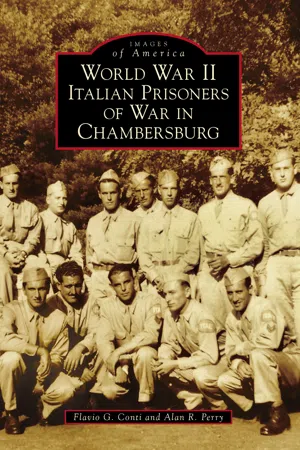
- 128 pages
- English
- ePUB (mobile friendly)
- Available on iOS & Android
eBook - ePub
World War II Italian Prisoners of War in Chambersburg
About this book
During World War II, the US government interned more than 1,200 captured Italian soldiers at the Letterkenny Army Ordnance Depot located near Chambersburg, Pennsylvania. These troops collaborated with the United States in a collective effort to defeat the Axis powers. They formed the 321st Italian Quartermaster Battalion, and their work consisted mainly of stocking and shipping materials--ammunition, military vehicles, weapons, and machinery parts--to the war fronts in the European and Pacific theaters of operation. For entertainment, the soldiers formed an orchestra and band and for sport, several different company soccer teams. As a sign of their faith, they built a chapel and bell tower, which are still used today. Many POWs forged deep friendships with Americans, and after the war, a few married their sweethearts and returned to live in the United States. Today, warm relations still continue between children and grandchildren of the POWs and the wider Chambersburg community.
Trusted by 375,005 students
Access to over 1.5 million titles for a fair monthly price.
Study more efficiently using our study tools.
Information
One
FROM WAR TO
IMPRISONMENT
IMPRISONMENT
Italian soldiers fought with great tenacity and courage during World War II, despite the fact that their equipment and arms were decisively inferior to weapons and machinery that their Allied foes employed. To prove this point, note a few photographs of Italian tanks. The troops called them “sardine cans,” and they stand in marked contrast to the size of American M4 Shermans and various models of German Panzers. Much of the equipment Italians used was also outdated. Indeed, many artillery pieces and transportation vehicles were first employed during World War I.
By mere chance, most likely because of circumstances and location of capture, numerous Letterkenny POWs belonged to a special infantry corps. The bersaglieri were elite foot soldiers easily identifiable in garrison by their large plumed hat and highly disciplined running regimen; bersaglieri never marched but jogged everywhere they went, and their esprit de corps was matchless. Fierce fighters, they often were called upon for special assault operations.
Several prisoners, before being sent to America, were first transported to England. Such is the case of Giovanni Serpe, whose submarine Galileo Ferraris was sunk in the Atlantic Ocean.
Once the POWs arrived in the United States, each had an identification card issued to him that consisted of his photograph along with annotations concerning his personal data, place of detention, and assigned unit. A soldier had to carry his ID with him wherever he went.
It was not uncommon for relatives and even brothers to be captured together, and these troops naturally did all they could to stay together during their term of imprisonment. At Letterkenny, there were two sets of brothers—Domenico and Luigi Sambrotta, who were originally from San Buono, a town in the province of Chieti; and Cirillo and Ismo Beggi, who came from Casalgrande in the province of Reggio Emilia. Two photographs in this chapter detail the information that Americans registered for the Sambrottas during administrative in-processing along with their assigned prisoner serial numbers. Finally, a few examples are provided of individual POW photographs that accompanied official US prisoner documentation.
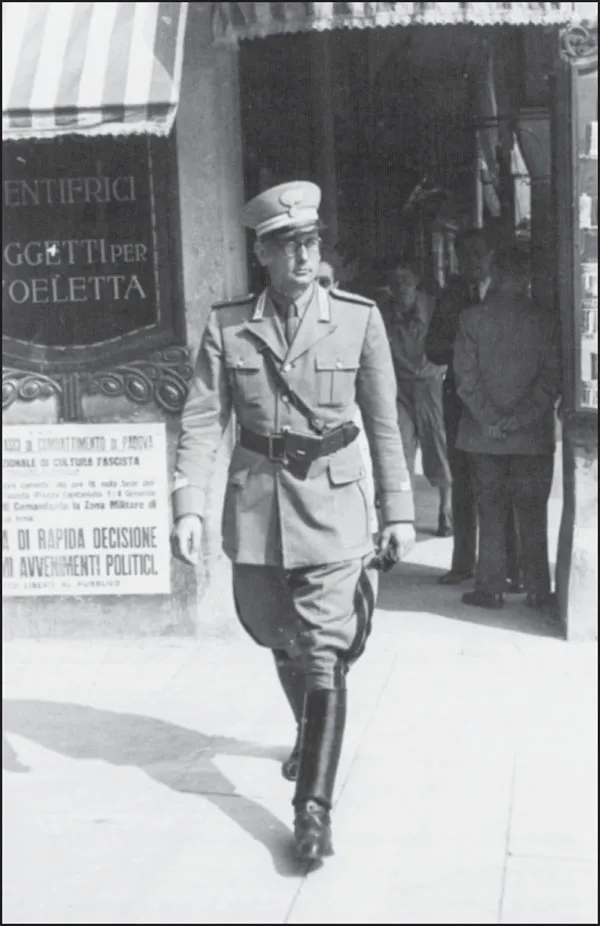
Lt. Roberto Cardinale, a carabiniere (member of the Italian national police force) is seen here in Florence in 1938. Together with the Italian army, navy, and air force, the carabinieri are Italy’s fourth armed service. During the war, they primarily undertook military policing. While at Letterkenny, Cardinale served as a captain and commanded the 85th ISU. Since he was a carabiniere, he was one of the first to be repatriated to Italy, where he arrived on March 13, 1945. (Courtesy of Giuseppe Grasso.)
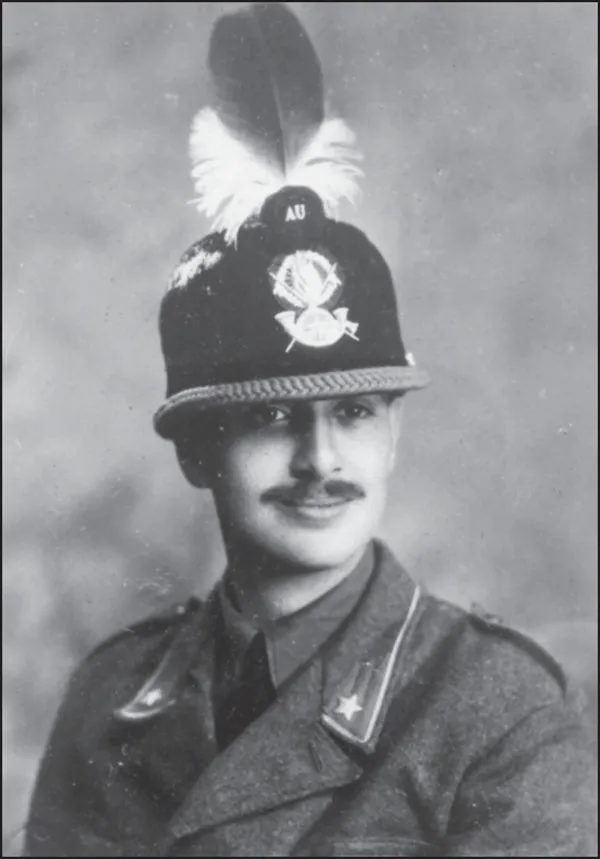
Massimo Jappelli is seen here in his officer candidate school photograph, dressed in his decorative hat with a large feather. At Letterkenny, Jappelli, as second lieutenant, served with the 83rd ISU, a unit later sent in July 1945 to the Sioux Ordnance Depot, Sidney, Nebraska. After the war, Jappelli lived in different countries for work, and in 2000 he emigrated to Brazil, where his daughter Deborah and her family still live today. (Courtesy of Deborah Jappelli.)
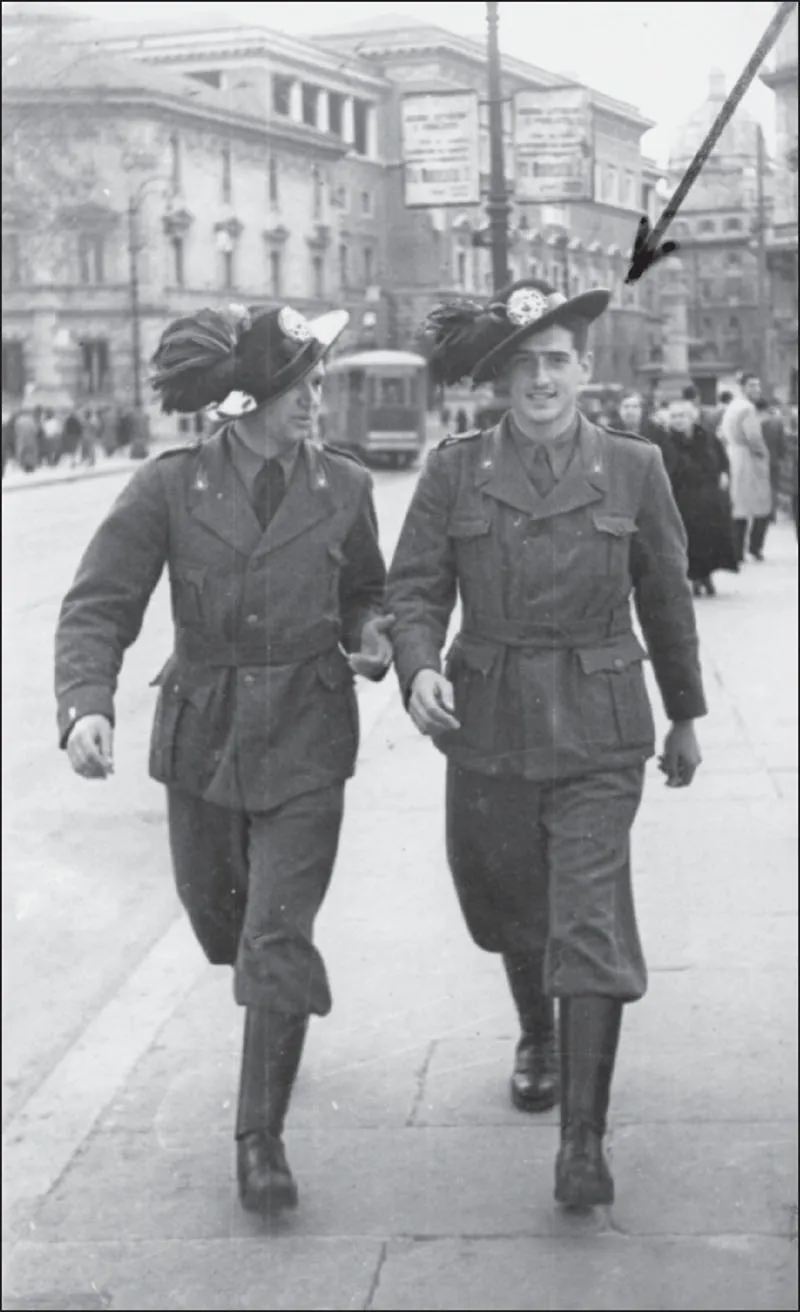
2nd Lt. Alfredo Tonolo, right, walks with a fellow bersagliere on Rome’s Via Arenula, most likely in 1941 or early 1942. The Bersaglieri are a special infantry unit of the Italian army and very beloved by the Italian public still today. Indeed, one of the corps’ distinguished traits is to parade at double time with unique bugle calls while donning special feathered hats. (Courtesy of Frances Tonolo MacAvoy.)
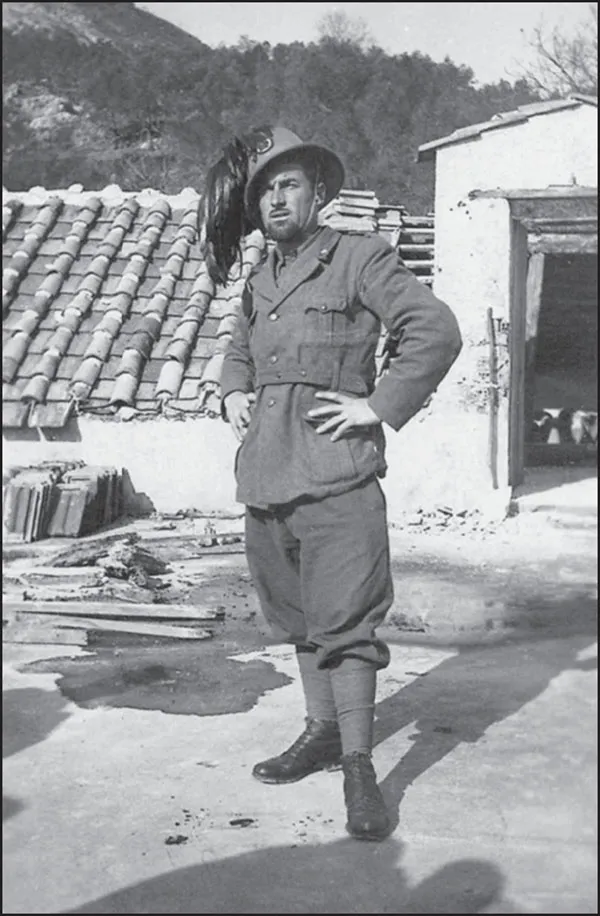
Aldo Lorenzi poses somewhat arrogantly in his bersagliere uniform for this photograph. Lorenzi, born on October 22, 1913, in Mozzecane, a town near Verona located in the Veneto region, served with the Italian army in the 8th Bersaglieri Regiment. He was captured on March 20, 1943, in North Africa when US tanks surrounded his unit. As a Letterkenny POW, he served with the 84th ISU. (Courtesy of Keti Melotto.)
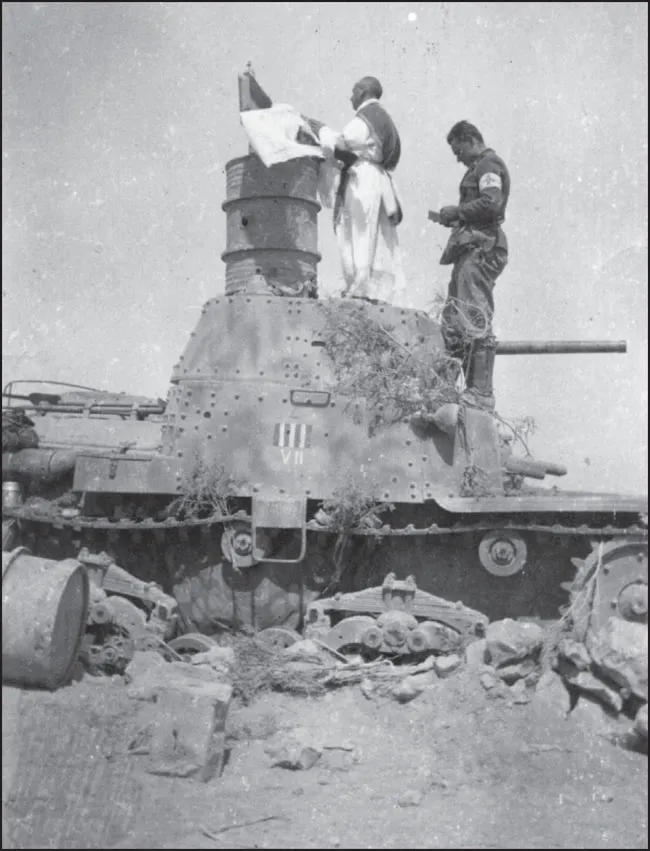
A military chaplain of the 8th Bersaglieri Regiment, assisted by another Italian soldier wearing a Red Cross band on his left arm, celebrates an improvised field Mass on the Tobruk front on May 2, 1941. Note that the priest is using the turret of a tank as an altar. (Courtesy of Vittoria Buffoni.)

Donato Pietra, seated second from the left, poses with a few military buddies at Tobruk (Libya) on July 17, 1942. English troops took him prisoner on May 11, 1943, in Tunisia. Born on October 22, 1921, Pietra still enjoys excellent health, and, as of April 2017 he lives with family members in Bergamo, a city in the Lombardy region. (Courtesy of Donato and Massimo Pietra.)

Innocente Salini stands, first on the right, with other bersaglieri troops. Besides the feathered hat, bersaglieri at times wore the fez. In the 19th century, during the first years after this branch formed in 1834, they also wore knickerbockers. Salini was born on August 20, 1922, in the province of Bergamo, in the Lombardy region. (Courtesy of Mariantonia Salini.)

Antonio Arganetto here shaves a fellow soldier under the shade of a tent in North Africa. English forces captured Arganetto shortly after the Battle of El Alamein, on November 3, 1942. Upon capture, his barber tools were confiscated, but in the United States Arganetto received a completely new set and continued to exercise his barber trade. (Courtesy of Michael Arganetto.)

Mario Luigini is first on the left standing with other bersaglieri and seen here during military maneuvers. Luigini was born in Pescara, and at Letterkenny he was the sergeant major of the 321st Italian Quartermaster Battalion. In 1945, for almost six months, he was hospital bound recovering from thromboangiitis (Buerger disease), first at Carlisle Barracks and then subsequently at the Ashorf General Hospital in West Virginia. (Courtesy of Mario Luigini [grandson].)

Leo Siligardi, far right, poses with other soldiers in front of a tank in Africa in 1942. Siligardi hailed from the Emilia Romagna region. The English captured him on May 10, 1943, in Tunisia and two weeks later turned ...
Table of contents
- Cover Page
- Title Page
- Copyright Page
- Dedication
- Table of Contents
- Acknowledgments
- Introduction
- 1. From War to Imprisonment
- 2. Correspondence
- 3. Prisoners Pose for Photographs
- 4. POWS, Italian Americans, and Women
- 5. Music and Entertainment
- 6. Faith Activities
- 7. Soccer as the Main Sporting Event
- 8. Camp Life
- 9. After the War
Frequently asked questions
Yes, you can cancel anytime from the Subscription tab in your account settings on the Perlego website. Your subscription will stay active until the end of your current billing period. Learn how to cancel your subscription
No, books cannot be downloaded as external files, such as PDFs, for use outside of Perlego. However, you can download books within the Perlego app for offline reading on mobile or tablet. Learn how to download books offline
Perlego offers two plans: Essential and Complete
- Essential is ideal for learners and professionals who enjoy exploring a wide range of subjects. Access the Essential Library with 800,000+ trusted titles and best-sellers across business, personal growth, and the humanities. Includes unlimited reading time and Standard Read Aloud voice.
- Complete: Perfect for advanced learners and researchers needing full, unrestricted access. Unlock 1.5M+ books across hundreds of subjects, including academic and specialized titles. The Complete Plan also includes advanced features like Premium Read Aloud and Research Assistant.
We are an online textbook subscription service, where you can get access to an entire online library for less than the price of a single book per month. With over 1.5 million books across 990+ topics, we’ve got you covered! Learn about our mission
Look out for the read-aloud symbol on your next book to see if you can listen to it. The read-aloud tool reads text aloud for you, highlighting the text as it is being read. You can pause it, speed it up and slow it down. Learn more about Read Aloud
Yes! You can use the Perlego app on both iOS and Android devices to read anytime, anywhere — even offline. Perfect for commutes or when you’re on the go.
Please note we cannot support devices running on iOS 13 and Android 7 or earlier. Learn more about using the app
Please note we cannot support devices running on iOS 13 and Android 7 or earlier. Learn more about using the app
Yes, you can access World War II Italian Prisoners of War in Chambersburg by Flavio G. Conti,Alan R. Perry in PDF and/or ePUB format, as well as other popular books in History & Military Biographies. We have over 1.5 million books available in our catalogue for you to explore.