- 128 pages
- English
- ePUB (mobile friendly)
- Available on iOS & Android
eBook - ePub
About this book
Kyle, Texas, was founded in 1880 when settlers from the nearby established communities of Blanco and Mountain City purchased lots in the 200-acre township deeded to the International-Great Northern Railroad by David E. Moore and Fergus Kyle, who gave his name to the new city. Beneath a live oak tree, which still stands, lots for both businesses and residences that had been laid out by surveyor Martin Groos were sold at auction in October 1880. Within two years, the town had 500 residents, although it would not be incorporated until 1928. Around the time Kyle was founded, Col. R.J. Sledge brought German workers to his Pecan Springs Valley plantation east of Kyle, generating new customers for his mercantile store in town. Kyle has been the home of some famous people, including author Katherine Anne Porter, Boston Red Sox pitcher Tex Hughson, Rhodes Scholar Terrell Sledge, and Dean Edwin J. Kyle, namesake of Kyle Field at Texas A&M University.
Trusted by 375,005 students
Access to over 1.5 million titles for a fair monthly price.
Study more efficiently using our study tools.
Information
One
FOUNDING AND
EARLY YEARS
EARLY YEARS
Following the auction under the oak tree in the fall of 1880, the new town created by the International–Great Northern Railroad grew quickly. In November 1880, just two months after the filing of the town map, Tom Martin opened Kyle’s first business—a combination saloon and meat market—in a frame building at the southwest corner of the public square. Martin was also a Deputy US Marshal. Soon after, three other saloons opened in competition. In its first year of existence, Kyle added a livery stable (operated by W.C. Weatherford), a dry goods store (owned by Otto Groos from New Braunfels), a grocery store (owned by D.A. Young), a general merchandise store (run by W.E. Roach, who also served as postmaster), a hotel called Hays House (owned by the Houstons), a gin (owned by Ezekiel Nance) and a lumberyard (run by H.C. Wallace). Within two years, the population of Kyle was estimated at 500. After 1883, however, development was slower than before. Nicholas Schlemmer of New Braunfels, who had declined the opportunity to be the first postmaster in Kyle in 1880, returned in 1884 and opened a general mercantile store, eventually constructing a stone building in 1890. Kyle remained unincorporated until 1895, when voters approved incorporation as a village, only to vote to reverse the decision in 1897. In 1906, another vote for incorporation passed.

Surveyor Martin Groos filed this town map in the office of the county clerk of Hays County on September 7, 1880, identifying lots in 18 blocks along the railroad right-of-way. The Texas Land Company deeded the land the town needed for streets and alleys. By the time the map was filed, the town was named Kyle in honor of Capt. Fergus Kyle. (Courtesy HFP.)

Under the branches of this live oak tree, residential and business lots for the new town of Kyle were sold at auction in the fall of 1880. The lots were sold by the Texas Land Company, a subsidiary of the International–Great Northern Railroad, to create a town on the new rail line between Austin and San Antonio. This tree still stands in Kyle in front of a private residence on Sledge Street. (Courtesy of Jill Lear.)

Built of limestone and cypress hand-split by Ezekiel Nance on his property near the Blanco River in 1865, the Blanco Chapel served as a school and church until 1881. The building was later used by the Mexican Presbyterian Church, and in 1885, the pews were given to the Kyle Seminary. Today, the chapel is on private property (McCoy Ranch) and is not open to the public. The Blanco Chapel was among the first buildings in Hays County to receive a recorded Texas Historical Landmark designation. (Courtesy HCCM.)
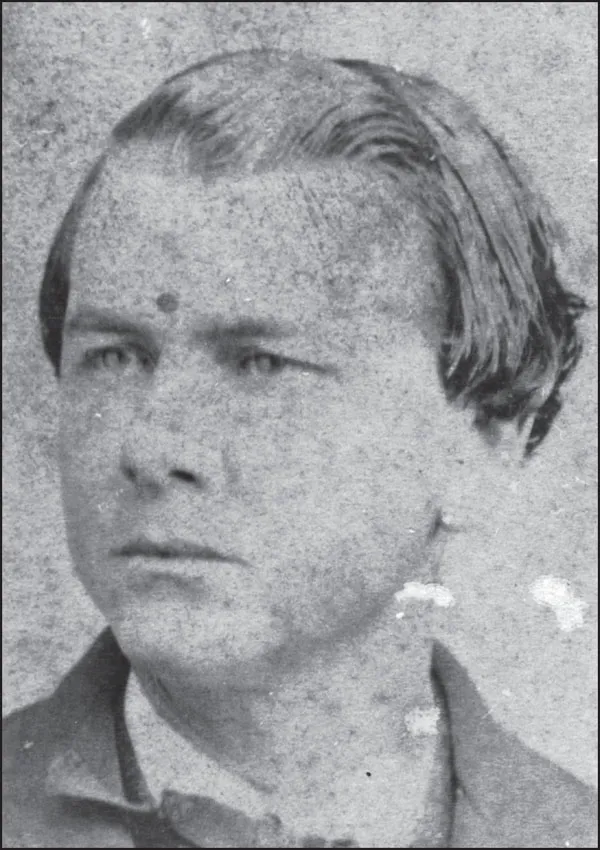
David A. Young, a Tennessee native and Civil War veteran, moved his mercantile business from Mountain City to Kyle when the lots were sold for the town. Young died of abdominal pain not long after the building was completed, leaving his widow with seven young children. (Courtesy of the Word family.)

This rock building was the first permanent structure in Kyle. It was constructed by owner David A. Young to house his mercantile store in 1881. The building, on the northwest corner of the town square, later served as a firehouse for the Kyle Volunteer Fire Department. The building was later acquired by Kyle rancher M.G. Michaelis Sr., who gave it to the town on May 13, 1936, in appreciation of the firemen’s efforts to fight a fire on his ranch. (Courtesy of the Word family.)
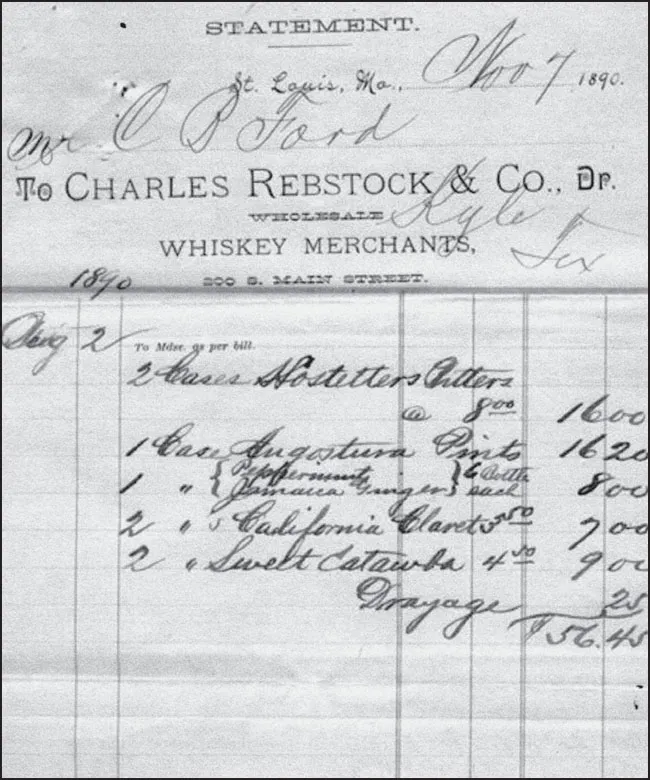
This invoice is from one of the saloons in Kyle, operated by C.B. Ford. Reports describe Kyle as a “wild and wooly” town, with saloons, horse racing, and gambling. Stories of men cutting each other with knives and shooting each other with six-shooters and Winchesters were common. The wild atmosphere did not last long, however, since saloons were voted out in 1898. (Courtesy of Jim Cullen.)

In 1884, possibly in response to the “wild” atmosphere in Kyle, the Hays County Commissioner’s Court appropriated $100 and gave Kyle one of the old cells from the county jail, which was moved to Kyle and located at the intersection of Center and Front Streets, near the present CVS store. Once Kyle became a quieter place, the unused jail was sold and moved in the 1960s to the Texana Village at San Marcos tourist attraction Aquarena Springs. In 1950, however, the citizens who opposed selling alcohol in Kyle used the jail as part of their campaign in a local election by attaching a sign to the jail that read “Kyle Jail in 1896, Not Used Since Kyle Voted Dry!” (Courtesy HFP.)

Kyle grew quickly during its first few years of existence. This view of Center Street shows the many businesses that were built by 1900, as well as the depot at the end of the street (Courtesy HFP.)

The depot was built by the International–Great Northern Railroad not long after the railroad created the town of Kyle, replacing the tent where it first conducted business. The wooden depot was destroyed by fire in 1916. (Courtesy HFP.)

Col. Robert John Sledge was the most prominent landowner east of the site selected for Kyle. He built the Pecan Springs plantation and later brought German immigrants to colonize the area. He donated property in town for a church for African American residents, and the church still bears his name today (Sledge Chapel). Sledge died in 1900. (Courtesy of the Word fa...
Table of contents
- Cover Page
- Title Page
- Copyright Page
- Dedication
- Table of Contents
- Acknowledgments
- Introduction
- 1. Founding and Early Years
- 2. Kyle Family Contributions
- 3. Kyle in the Early 20th Century
- 4. Notable Kyle Residents
- 5. Kyle during the Depression and World War II
- 6. Mid-Century Changes
- About the Organization
Frequently asked questions
Yes, you can cancel anytime from the Subscription tab in your account settings on the Perlego website. Your subscription will stay active until the end of your current billing period. Learn how to cancel your subscription
No, books cannot be downloaded as external files, such as PDFs, for use outside of Perlego. However, you can download books within the Perlego app for offline reading on mobile or tablet. Learn how to download books offline
Perlego offers two plans: Essential and Complete
- Essential is ideal for learners and professionals who enjoy exploring a wide range of subjects. Access the Essential Library with 800,000+ trusted titles and best-sellers across business, personal growth, and the humanities. Includes unlimited reading time and Standard Read Aloud voice.
- Complete: Perfect for advanced learners and researchers needing full, unrestricted access. Unlock 1.5M+ books across hundreds of subjects, including academic and specialized titles. The Complete Plan also includes advanced features like Premium Read Aloud and Research Assistant.
We are an online textbook subscription service, where you can get access to an entire online library for less than the price of a single book per month. With over 1.5 million books across 990+ topics, we’ve got you covered! Learn about our mission
Look out for the read-aloud symbol on your next book to see if you can listen to it. The read-aloud tool reads text aloud for you, highlighting the text as it is being read. You can pause it, speed it up and slow it down. Learn more about Read Aloud
Yes! You can use the Perlego app on both iOS and Android devices to read anytime, anywhere — even offline. Perfect for commutes or when you’re on the go.
Please note we cannot support devices running on iOS 13 and Android 7 or earlier. Learn more about using the app
Please note we cannot support devices running on iOS 13 and Android 7 or earlier. Learn more about using the app
Yes, you can access Kyle by Betty Harrison,Hays County Historical Commission in PDF and/or ePUB format, as well as other popular books in History & North American History. We have over 1.5 million books available in our catalogue for you to explore.