- 128 pages
- English
- ePUB (mobile friendly)
- Available on iOS & Android
eBook - ePub
About this book
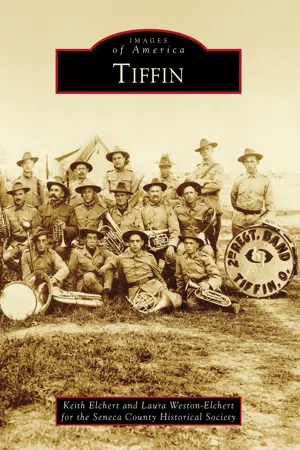
Tiffin, Ohio, may be most well-known for a devastating flood but it is defined by so much more than tragedy.
The flood of 1913 is likely the reason people are familiar with Tiffin, Ohio. It took the lives of 19 people in a disaster that literally reshaped the city. However, the city is much more than that. Tiffin--named after Ohio's first governor, Edward Tiffin--was first settled in 1817. The seat of Seneca County has been home to businesses of wide renown: Tiffin Glass, National Machinery, and Ballreich's Potato Chips, among others. Tiffin's institutions of higher learning, Heidelberg and Tiffin Universities, and its strong public and parochial school systems reflect a deep commitment to education among the city's residents. Historic figures like Charles Dickens and Thomas Edison, as well as local luminaries such as Josiah Hedges and Gen. William Harvey Gibson, have played a part in forging Tiffin's history.
Trusted by 375,005 students
Access to over 1.5 million titles for a fair monthly price.
Study more efficiently using our study tools.
Information
One
A TALE OF TWO CITIES

This building, constructed in 1822 by Josiah Hedges, was the settlement’s first frame structure and served as Seneca County’s first courthouse. It was originally situated on the north side of present-day Court Street, east of Washington Street, but was later moved to the riverbank at the end of Jefferson Street. The building was lost to the floodwaters of 1913.

This Indian Maiden statue stands on the grounds of Fort Ball along present-day Frost Parkway. The inscription on the statue reads, “This Indian maid keeps ceaseless watch where red men and sturdy pioneers drank from a spring whose sparkling waters flowed within the stockade of old Fort Ball / Presented to the City of Tiffin by Meshech Frost June 1926.” (Authors’ collection.)
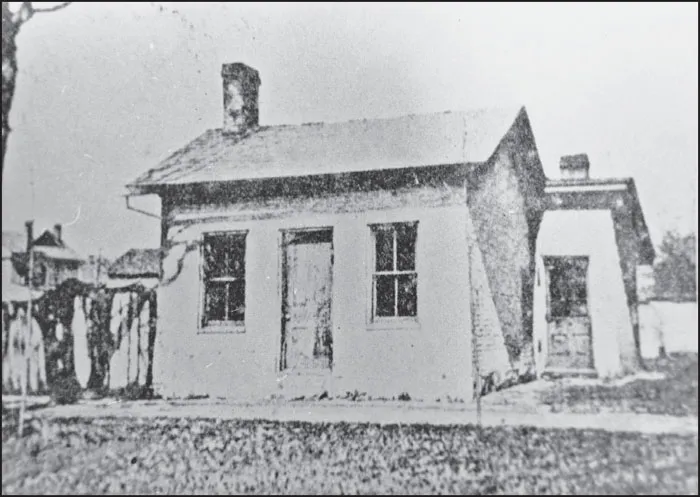
Dr. Eli Dresbach was the first physician in the territory that became Seneca County. He originally settled in Fort Ball but moved across the river after a few years. In 1824, Dresbach constructed this building at the northwest corner of present-day North Sandusky and Miami Streets. It was Seneca County’s first brick structure, but the building was razed in 1911.

The redbrick, tin-roof Erastus Bowe residence at 108 Franklin Street was built by Seneca County’s first white settler in 1837 (other sources say 1847), several decades after Bowe first arrived in Fort Ball. The home was restored in the early 2000s by Tiffin preservationists Phil and Rayella Engle. As part of their research, the Engles visited the birthplace of Thomas Edison in Milan, Ohio—the Edison house has the identical blueprint to the Bowe house. (Authors’ collection.)
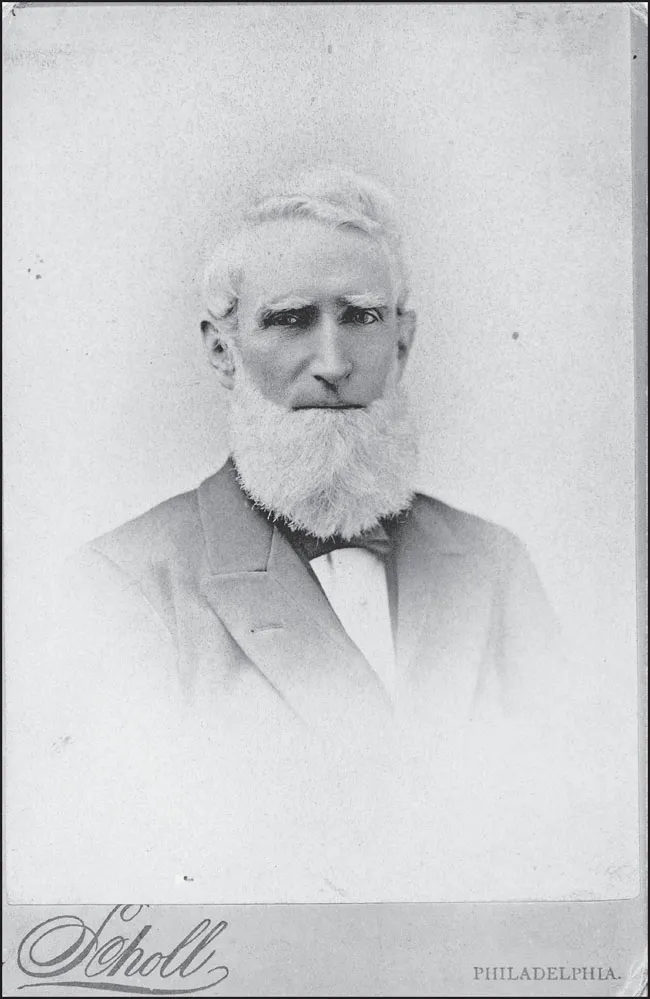
Rezin Shawhan is regarded as Tiffin’s first millionaire. He and his family arrived from Virginia in 1832. Shawhan’s success in the mercantile business allowed him to invest in the growing town and eventually to turn to real estate, banking, and hotel construction full-time. When Shawhan died in 1887, his will stipulated a $2,000 gift for a Tiffin library and $1,000 to every church in the city, as well as a bequest to Heidelberg College.

The Rezin Shawhan house, built in 1853, is now the Seneca County Museum. “It was a good example of late Greek Revival architecture,” wrote former museum director Myron Barnes, “and it had seventeen rooms plus a large two story carriage house. It easily housed the museum collection, and had room for further expansion.” Among its myriad displays is a collection of Tiffin glass and the contents of the demolished courthouse’s cornerstone.

Seneca County’s first freestanding jail, situated along Madison Street, was built in 1843, replacing a log structure that lent itself easily to jailbreaks by enterprising inmates. The original structure, which features particularly narrow windows, is to the rear of the photograph. A new jail, complete with a sheriff’s residence, took the place of this one in 1878.

The house at 260 Riverside Drive is considered one of Tiffin’s oldest, built by Josiah Hedges. For more than a century, the home was the property of the Bacon family. Frank Bacon could walk down the stone front walkway and across the road to his business at Bacon’s (now the Pioneer) Mill. Frank’s son Roger assisted in the conversion of the Pioneer Mill into the restaurant it is today. (Authors’ collection.)
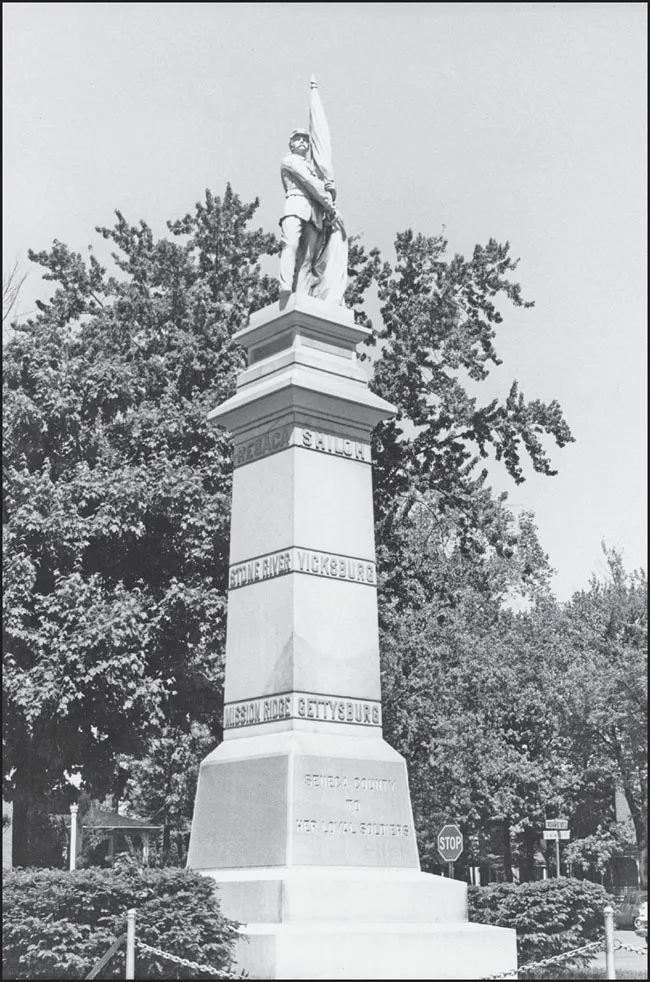
The Soldiers and Sailors Monument is the centerpiece of Tiffin’s Civil War memorial on Frost Parkway. Dedicated on July 3, 1885, the granite standard bearer monument, built at a cost of $8,000, is inscribed: “Seneca County / To her loyal soldiers / Resaca / Stone River / Mission Ridge / Shiloh / Vicksburg / Atlanta / Antietam / Appomattox / Nashville / Cedar Creek / Wilderness.” H.W. Yeager is credited as the monument’s sculptor.

Now wedged between a pair of modern businesses, the Jacob Oster residence, 259 South Washington Street, is a Greek Revival throwback. Inside, the house’s walls are a foot thick, with hand-forged nails still visible. Oster was a tinsmith who built his home in 1841, making it one of Tiffin’s oldest residences. (Authors’ collection.)
Two
A CITY OF
LAW AND ORDER
LAW AND ORDER
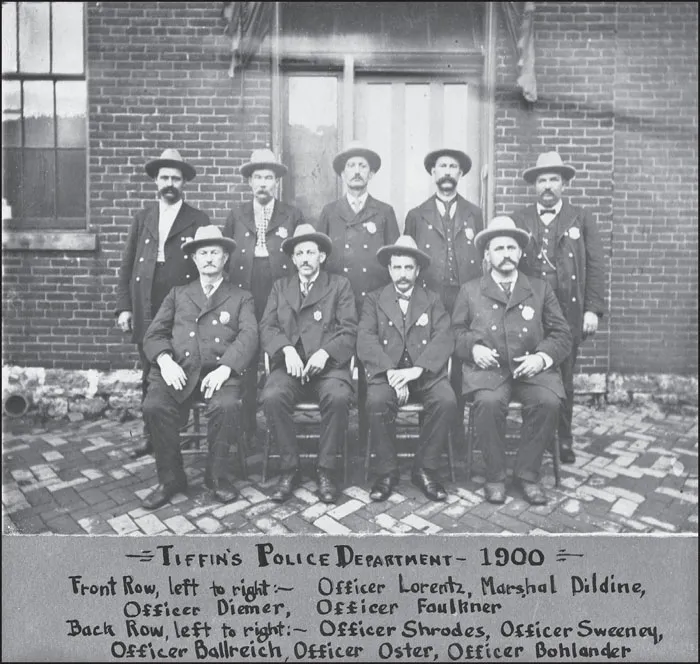
Tiffin’s police department in 1900 consisted of eight officers and their marshal, protecting the town’s nearly 11,000 residents. The slaying of Officer Sweeney (second row, second from left) by business robber Butch Hoffman led to the department’s reorganization into the structure familiar today. Hoffman hopped a train to Toledo and was never arrested. In 1915, the department added the services of a motorcycle patrolman.

The third Seneca County Courthouse, designed by Elijah E. Myers, was built in 1884. The building, which was listed in the National Register of Historic Places, served the county’s judicial and administrative needs until it was abandoned by the courts in 2004 due to its deteriorating condition. County commissioners opted to raze the building in January 2012 rather than invest in a multimillion-dollar upgrade.

From 1944 forward, the Beaux-Arts facade of the Seneca County Courthouse was offset by an Art Deco clock tower. The courthouse’s original clock tower served from the building’s 1884 dedication until 1943, when deterioration forced its demolition. A plan to similarly reclad the rest of the courthouse fell through for lack of fundin...
Table of contents
- Cover Page
- Title Page
- Copyright Page
- Dedication
- Table of Contents
- Acknowledgments
- Introduction
- 1. A Tale of Two Cities
- 2. A City of Law and Order
- 3. A City of Business
- 4. A City of Worship
- 5. A City Inundated
- 6. A City Challenged
- 7. A City of Learning
- 8. A City on the Move
- 9. A City of Place
- 10. A City Entertained
- Bibliography
- Index
Frequently asked questions
Yes, you can cancel anytime from the Subscription tab in your account settings on the Perlego website. Your subscription will stay active until the end of your current billing period. Learn how to cancel your subscription
No, books cannot be downloaded as external files, such as PDFs, for use outside of Perlego. However, you can download books within the Perlego app for offline reading on mobile or tablet. Learn how to download books offline
Perlego offers two plans: Essential and Complete
- Essential is ideal for learners and professionals who enjoy exploring a wide range of subjects. Access the Essential Library with 800,000+ trusted titles and best-sellers across business, personal growth, and the humanities. Includes unlimited reading time and Standard Read Aloud voice.
- Complete: Perfect for advanced learners and researchers needing full, unrestricted access. Unlock 1.5M+ books across hundreds of subjects, including academic and specialized titles. The Complete Plan also includes advanced features like Premium Read Aloud and Research Assistant.
We are an online textbook subscription service, where you can get access to an entire online library for less than the price of a single book per month. With over 1.5 million books across 990+ topics, we’ve got you covered! Learn about our mission
Look out for the read-aloud symbol on your next book to see if you can listen to it. The read-aloud tool reads text aloud for you, highlighting the text as it is being read. You can pause it, speed it up and slow it down. Learn more about Read Aloud
Yes! You can use the Perlego app on both iOS and Android devices to read anytime, anywhere — even offline. Perfect for commutes or when you’re on the go.
Please note we cannot support devices running on iOS 13 and Android 7 or earlier. Learn more about using the app
Please note we cannot support devices running on iOS 13 and Android 7 or earlier. Learn more about using the app
Yes, you can access Tiffin by Keith Elchert,Laura Weston-Elchert,Seneca County Historical Society in PDF and/or ePUB format, as well as other popular books in History & North American History. We have over 1.5 million books available in our catalogue for you to explore.