- 128 pages
- English
- ePUB (mobile friendly)
- Available on iOS & Android
eBook - ePub
Lincoln County
About this book
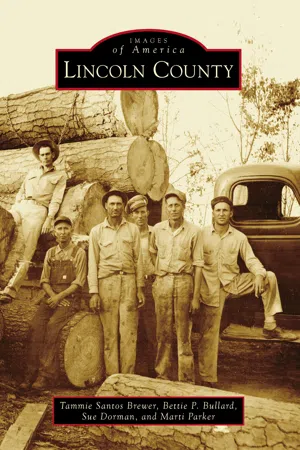
On April 7, 1870, an act of the state legislature created Lincoln County, named for Pres. Abraham Lincoln, from Lawrence, Franklin, Copiah, Pike, and Amite Counties. Settlement began more than 50 years earlier with Samuel Jayne's small trading post on St. Stephens Road. Extensive timber resources, the arrival of the railroad in 1857, and the 1859 founding of Whitworth Female College put the county on the map. Logging, lumber mills, and other industries brought scores of people to the region. The agricultural endeavors of cotton and farming provided a way of life before the oil boom of the 1940s. The varied ethnic and religious history of the residents further shaped the county into what exists today.
Trusted by 375,005 students
Access to over 1 million titles for a fair monthly price.
Study more efficiently using our study tools.
Information
One
LAND OF LONGLEAF PINE
The longleaf pine played a very important role in the history of Lincoln County and Mississippi, especially in the 1800s, when producers considered the supply of trees almost endless. It was widely reported that between 70 and 90 million acres of land in the United States were covered with the highly sought-after tree. Today, that figure stands at just over 3 million acres.
Several events in the mid-1800s contributed to the lumber industry’s growth: the manufacture of railroad locomotives made specifically for logging; a steam skidder, which could haul more logs; and demand for the yellow pine soon after the Civil War ended. Railroads also made it possible to transport lumber from remote areas; sawmill owners began constructing spurs and dummy lines to and from mills to main rail lines.
Built around 1886 by Frank Norwood and John S. Butterfield, the Norwood & Butterfield Lumber Company was one of the earliest mills in the southern part of Lincoln County. Norwood left the company several years later. The Butterfield shareholders sold the mill around 1915 to the Denkmann Lumber Company. Another significant mill began acquiring lands in the northwestern part of Lincoln County and began milling operations around 1899. Like many sawmills of the time, Pearl River Lumber Company not only brought equipment to mill pine trees, it also brought men to work the mills. Houses were built for workers. Stores to supply the workers sprouted up, and hospitals and schools were also built.
According to the Mississippi Department of Archives and History, Pearlhaven was chartered as a village on August 7, 1901, with 310 persons. Pearl River Lumber Company shut down and was sold around 1910, and its village was annexed into Brookhaven in 1912. All of its holdings were either sold or disbanded and shipped elsewhere. Some of the old mill houses can still be seen on Railroad and Main Streets in the community.
Many other mills could also be found throughout Lincoln County. The once abundant longleaf pine was a contributing factor, bringing scores of people to Lincoln County in the 19th and the early 20th centuries.

J.H. Williams (1850–1939), shown here in the white shirt at center, and his brother R.J. Williams were loggers in the late 19th and early 20th centuries. This photograph was taken about 1902. The name on the car behind the engine is “Natalbany Lumber Company, Ltd.,” which was a division of Denkmann Lumber Company. (LLF.)

Troy Allen hauls logs to Brookhaven around 1925 using mules and a wagon. Note the Chevrolet advertisement in the background. (Seth Allen.)

Cutting down large trees with only a crosscut saw was backbreaking work, and lunchtime was welcomed. These five men are taking time out to rest and eat their lunch. Charles Greer (far left) is the only logger identified. (Bonnie Cole Collection.)

George Godwin (right), born in 1876, and Wroten Godwin, born in 1907, haul logs to a nearby mill. (Elliott Smith.)

Pearlhaven started as a lumber community built by Pearl River Lumber Company beginning in 1899. According to the Mississippi Department of Archives and History, Pearlhaven was chartered as a village on August 7, 1901, with 310 people, stores, a hotel, a hospital, boardinghouses, a school, and churches. (Sue Dorman.)

The house at 306 Railroad Street, shown here in 1940, is one of many mill homes built for supervisors of Pearl River Lumber Company. It still stands today. The lumber company was eventually sold, and the homes were auctioned off to individuals between 1912 and 1917. Brookhaven annexed Pearlhaven as a subdivision in 1912. (Tammie Santos Brewer.)

Wroten Godwin, at the intersection of Jackson-Liberty Drive and St. Stephens (now Zetus) Road, hauls a load of milled lumber. The old Vaughan grocery can be seen in the background. (Elliott Smith.)

Ira Moak (left) ran a locomotive engine in the logging industry for Norwood & Butterfield Company, shown here around 1903. Moak was from the Ruth community. The person on the right is unidentified. (Martha Sinclair.)

Sam Moak (in derby hat) is one of the workers identified in this 1903 photograph of early logging efforts. The machine was used to lift logs onto railway cars to take to lumber mills. (Martha Sinclair.)

The Coffee Pot was a main attraction on Highway 51 when the Carruth family constructed it in 1931 as a café. It was touted as the first fast-food restaurant in the South. Operating one of the largest Masonite dealerships in Mississippi and Louisiana, Tom Hickman purchased the property in 1946. Hickman kept his office there until he died in 1975. The property was sold several years later. According to his grandson Bill Hickman, this was a “happening” part of town in the 1940s and 1950s. An icehouse and a canning factory were located nearby. (Bill Hickman.)
Two
REAL PIONEERS
The rich, fertile soils of south Mississippi lured pioneering families to the area. Tales of vast acres of uncut timber to build homes, farmlands that could be cleared for crops and pastures, plus an abundant water supply appealed to those looking for a place to call home.
Hardships were common in those days. Indian attacks, like the one at Fort Mims, Alabama, in 1813, did not deter early settlers. Forging roads from Indian trails, hunting for food, sleeping on the ground, and leaving personal possessions behind were just a few of the adversities endured. But, still the people came, and they continued to come into the raw Mississippi Territory. Thomas Maxwell Jr. and others moved from Franklin County, Georgia, around 1810 and made a home in the Fair River community of what is now Lincoln County. The Lewis, Dickerson, and Hollingsworth families traveled with the Maxwells.
Many others, including John Gill of South Carolina, obtained passports through the Indian Nations in 1812. Gill settled in the Cold Springs area near Bogue Chitto. Isham Smith and his large family made their homes from Fair River north across the area to the southern ...
Table of contents
- Cover Page
- Title Page
- Copyright Page
- Dedication
- Table of Contents
- Acknowledgments
- Introduction
- 1. Land of Longleaf Pine
- 2. Real Pioneers
- 3. Diversity in Industry, Agriculture, and Business
- 4. The Way They Traveled
- 5. Focus on Education
- 6. Worship as a Priority
- 7. Downtown in Brookhaven
- 8. Time for Entertainment and Leisure
- 9. The Way They Lived
- 10. Notable People
Frequently asked questions
Yes, you can cancel anytime from the Subscription tab in your account settings on the Perlego website. Your subscription will stay active until the end of your current billing period. Learn how to cancel your subscription
No, books cannot be downloaded as external files, such as PDFs, for use outside of Perlego. However, you can download books within the Perlego app for offline reading on mobile or tablet. Learn how to download books offline
Perlego offers two plans: Essential and Complete
- Essential is ideal for learners and professionals who enjoy exploring a wide range of subjects. Access the Essential Library with 800,000+ trusted titles and best-sellers across business, personal growth, and the humanities. Includes unlimited reading time and Standard Read Aloud voice.
- Complete: Perfect for advanced learners and researchers needing full, unrestricted access. Unlock 1.4M+ books across hundreds of subjects, including academic and specialized titles. The Complete Plan also includes advanced features like Premium Read Aloud and Research Assistant.
We are an online textbook subscription service, where you can get access to an entire online library for less than the price of a single book per month. With over 1 million books across 990+ topics, we’ve got you covered! Learn about our mission
Look out for the read-aloud symbol on your next book to see if you can listen to it. The read-aloud tool reads text aloud for you, highlighting the text as it is being read. You can pause it, speed it up and slow it down. Learn more about Read Aloud
Yes! You can use the Perlego app on both iOS and Android devices to read anytime, anywhere — even offline. Perfect for commutes or when you’re on the go.
Please note we cannot support devices running on iOS 13 and Android 7 or earlier. Learn more about using the app
Please note we cannot support devices running on iOS 13 and Android 7 or earlier. Learn more about using the app
Yes, you can access Lincoln County by Tammie Santos Brewer,Bettie P. Bullard,Sue Dorman,Marti Parker in PDF and/or ePUB format, as well as other popular books in History & North American History. We have over one million books available in our catalogue for you to explore.