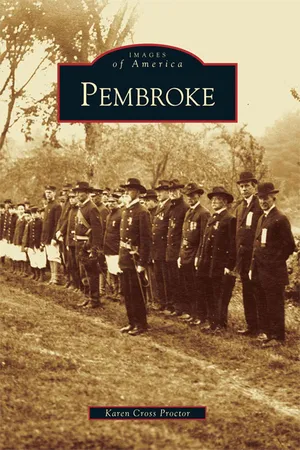
In the 1640s, Robert Barker and two companions canoed up the North River and turned onto one of the herring brooks, bringing Barker to the area where he eventually settled his family. Settlers from the coast soon began moving inland and small settlements sprang up. To incorporate the town of Pembroke in 1712, the First Church of Pembroke was established and a minister was settled. In the 18th and 19th centuries, Pembroke was defined by neighborhoods centering around eight district one-room schoolhouses. Each neighborhood had a distinct character, from the bustle of commerce in Bryantville, to the rural charm of Crookertown and Fosterville, to the shipbuilders, shoemakers, and iron founders in North Pembroke. The Bay Path, a main route from Boston to Plymouth, ran through the West Elm and High Street neighborhoods. Over the generations, these diverse and vibrant communities have helped to shape Pembroke into the town it is today.
- 128 pages
- English
- ePUB (mobile friendly)
- Available on iOS & Android
eBook - ePub
Pembroke
About this book
Trusted by 375,005 students
Access to over 1.5 million titles for a fair monthly price.
Study more efficiently using our study tools.
Information
Seven
NORTH PEMBROKE
For close to three centuries, the North River, which separates the towns of Marshfield and Pembroke from Scituate, Norwell, and Hanover, was a cradle of New England shipbuilding. When the North River is looked at today, it is hard to imagine majestic merchant ships sailing through these narrow, marshy waters. Over the centuries, storms and man’s increasing demand for water have dramatically changed the character of the river, making it narrower and more winding, so that today it is used almost exclusively by canoes and rowboats, leaving little evidence behind of the once thriving shipbuilding industry that once graced its banks.
During this shipbuilding period, which lasted roughly from 1678 to 1871, the North River afforded excellent access to the sea. A second factor that caused shipbuilders to come to inland towns such as Pembroke was the abundance of white oak and other hardwood trees, which could be made into excellent shipbuilding timber. A third factor was the existence of an iron furnace located on Furnace Pond that could provide nails, spikes, and other hardware, including anchors.
Perhaps because of its close proximity to the North River and the wealthy shipbuilding families, the area of North Pembroke became a haven for those in the area who wished to spend their hard-earned money or credit on store-bought and/or manufactured items. In addition, there were those necessities that had to be purchased by the average citizen, such as shoes, harnesses for horses, metalware, and the like.
The beehive of activity brought about by the North River led to jobs, which led to population growth. There were actually two district schools located in the North Pembroke area. District school No. 3 was moved several times but eventually was located on Schoosett Street. District school No. 8 was located on Washington Street.

Since the first Native Americans settled in the Pembroke area, the herring (actually alewives) have been an important food source for local residents. Each spring, as warmer weather approached, Pembroke residents gathered at the Herring Run (above) to observe and collect their individual herring quota under the watchful eyes of the herring superintendents (below). The amount of fish that each resident could take was carefully regulated. Pictured below are John LeFurgey (second from left), Lemuel LeFurgey, and, holding the nets, Richard Strang and Arthur Ford. One of the Snow boys (Arthur or Willard) watches the process. Although catching the fish is no longer permitted, residents still come to the Herring Run at Tommy Reading Park to view this annual rite of spring.


Legend says that the Indian Rock, located at the Herring Run in Tommy Reading Park, was a frequent gathering place for the Native Americans from Mattakeesett and surrounding areas. A hurricane many years ago toppled a tree near the rock and revealed, in its root system, stone chippings, the result of natives crafting spear points and other tools for their daily lives.
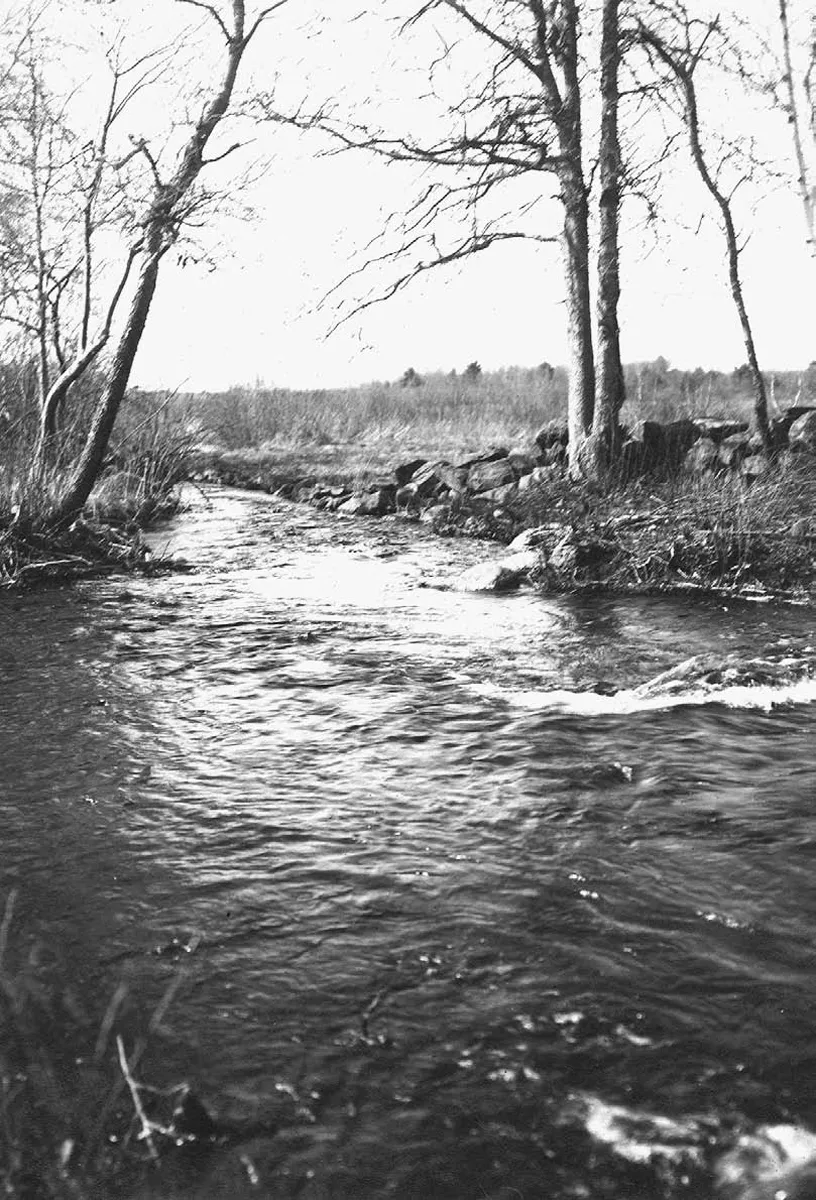
Each spring, runoff from melting snow and spring rains causes the Herring Brook at Tommy Reading Park to flow over its banks. Normally little more than a meandering brook, this picture shows the stream as it flows toward the Great Cedar Swamp. Before long, thousands of herring fight their way against the current toward the ponds where they are hatched, to spawn and die.

The importance of the herring to the Native Americans and the European settlers of Pembroke is clearly illustrated by this postcard, printed by Bryantville photographer/publisher George Edward Lewis. After the European settlement of Mattakeesett and the establishment of the town in 1712, the quantity of herring that could be taken from the brook was carefully regulated by Pembroke’s town fathers and the herring superintendents. Although called herring, the fish are actually alewives, which are related to herring but slightly smaller. They are grayish green in color and have silvery sides and underbelly. While they can reach up to 15 inches in length, most of Pembroke’s fish are traditionally smaller and weigh in at about one pound.

The records are confusing as to the builder of this Barker Street house, but it is thought that it was built in 1786 by Harris Hatch. The land was originally part of the Barker land grant, and by the 1830s, the home was owned by a descendant of Robert Barker Sr., also named Robert Barker. By 1905, after ownership by several generation...
Table of contents
- Title Page
- Copyright Page
- Table of Contents
- ACKNOWLEDGMENTS
- INTRODUCTION
- One BRYANTVILLE
- Two CENTER PEMBROKE
- Three CROOKERTOWN
- Four EAST PEMBROKE
- Five FOSTERVILLE
- Six HIGH STREET
- Seven NORTH PEMBROKE
- Eight WEST ELM STREET
- BIBLIOGRAPHY
Frequently asked questions
Yes, you can cancel anytime from the Subscription tab in your account settings on the Perlego website. Your subscription will stay active until the end of your current billing period. Learn how to cancel your subscription
No, books cannot be downloaded as external files, such as PDFs, for use outside of Perlego. However, you can download books within the Perlego app for offline reading on mobile or tablet. Learn how to download books offline
Perlego offers two plans: Essential and Complete
- Essential is ideal for learners and professionals who enjoy exploring a wide range of subjects. Access the Essential Library with 800,000+ trusted titles and best-sellers across business, personal growth, and the humanities. Includes unlimited reading time and Standard Read Aloud voice.
- Complete: Perfect for advanced learners and researchers needing full, unrestricted access. Unlock 1.5M+ books across hundreds of subjects, including academic and specialized titles. The Complete Plan also includes advanced features like Premium Read Aloud and Research Assistant.
We are an online textbook subscription service, where you can get access to an entire online library for less than the price of a single book per month. With over 1.5 million books across 990+ topics, we’ve got you covered! Learn about our mission
Look out for the read-aloud symbol on your next book to see if you can listen to it. The read-aloud tool reads text aloud for you, highlighting the text as it is being read. You can pause it, speed it up and slow it down. Learn more about Read Aloud
Yes! You can use the Perlego app on both iOS and Android devices to read anytime, anywhere — even offline. Perfect for commutes or when you’re on the go.
Please note we cannot support devices running on iOS 13 and Android 7 or earlier. Learn more about using the app
Please note we cannot support devices running on iOS 13 and Android 7 or earlier. Learn more about using the app
Yes, you can access Pembroke by Karen Cross Proctor in PDF and/or ePUB format, as well as other popular books in History & North American History. We have over 1.5 million books available in our catalogue for you to explore.