- 128 pages
- English
- ePUB (mobile friendly)
- Available on iOS & Android
eBook - ePub
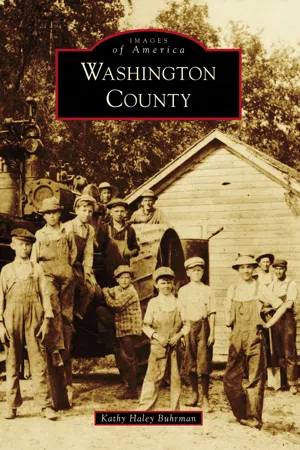
Washington County
About this book
The area that would become Washington County was first settled by the explorers, trappers, and fur traders who traveled by steamboat along the Missouri River to an area inhabited by the Otoe, Missouri, and Omaha Indians. These settlers were pioneers of German, English, Danish, and Irish ancestry who migrated west in search of a better life. They came by steamboat, flatboat ferry, the occasional canoe, on horseback, in wagon teams, and sometimes by foot, venturing into the vast great plains of the frontier. They staked their claims, built sod and hewn-log homes, and traveled on the first post roads using old Indian trails. From the timberland along the river, they pushed westward into the lush rolling hills of red top, timothy, clover, and prairie grasses and tilled the virgin soil to build their futures. It would be another 15 years before the railroad broke ground. These brave men and women journeyed westward, traveling with all their possessions, into the untamed territory that they would later call home.
Trusted by 375,005 students
Access to over 1 million titles for a fair monthly price.
Study more efficiently using our study tools.
Information
One
RIVER TOWNS
TAKING A GAMBLE ON
PUSHING THE FRONTIER
PUSHING THE FRONTIER
The early towns in Washington County were river towns along the Missouri River, established during the steamboat era before the railroad was built west of the Missouri. Fort Calhoun, DeSoto, and Cuming City were established along the river. Fontanelle (a misspelling that was never corrected) was a territorial town overlooking the Elkhorn River on the western edge of the county but had no river traffic. People, livestock, and necessary provisions arrived by steamboat, flatboat ferry, the occasional canoe, on horse-and-wagon teams, and sometimes by foot. In the summer of 1854, after the Nebraska Territory was opened for settlement, the first permanent settlement in Washington County was established two miles west of the original fort, and the name Fort Calhoun was adopted. On December 25, 1854, acting territorial governor Thomas B. Cuming appointed Thomas J. Allen, one of the first pioneers to settle in Washington County, as the first territorial sheriff of the county.
Fort Calhoun was the county seat and held that position until 1858, when a crowd of armed DeSoto citizens took the county seat by force. In 1866, by popular vote, it was again moved to Fort Calhoun. In 1869, the county seat was moved to the newly formed railroad town of Blair, where it has remained.
Fontanelle, a village of some 200 settlers, was incorporated and became the county seat of Dodge County, in which Fontanelle was then located, in March 1855. Fontanelle remained the county seat of Dodge County until January 12, 1860, when the western boundary of Washington County was redefined and extended to the west side of the Elkhorn River.

After the departure of the Engineer Cantonment expedition in 1820, the site was abandoned and the exact location lost. In 2002, archeologists discovered the location and excavation began. Building ruins, lead balls, a smoking pipe, ceramic pieces, and other artifacts of early 19th-century living began to emerge. In 2015, it was listed in the National Register of Historic Places. (Courtesy the Nebraska Historical Society.)

As master of ceremonies, William Henry Woods, Washington County’s first historian, leads the 1919 centennial parade of Fort Atkinson. Born in England in 1839, Woods emigrated to America as a boy. A recognized archeologist, he studied and excavated the grounds of the fort, discovering valuable bones of prehistoric animals, Indian relics, and the remains of soldiers in the cornfields (once the site of Fort Atkinson). Through Woods’s tireless efforts over the next 55 years, the history of the fort and the site of the Lewis and Clark expedition were preserved for future generations. Well known in and instrumental in preserving the history of his adopted community, Woods had a wish that Fort Atkinson be recognized as a national cemetery for the soldiers buried there. He died in 1927 and is buried in the Fort Calhoun Cemetery.

Fort Atkinson was the first military post west of the Missouri, with troops numbering over 1,100. The soldiers protected the fur traders but spent most of their time hunting, fishing, and farming. In 1827, the garrison transferred to a new camp at Jefferson Barracks in Missouri and the fort was abandoned.

In 1971, the Nebraska Game and Parks Commission began reconstructing the fort. Today, Fort Atkinson is a Nebraska State Historical Park and a National Historic Landmark. In 2003, a life-size bronze depiction of the Lewis and Clark historic meeting was installed on the grounds of Fort Atkinson. The bronze men were sculptured by artist Oreland C. Joe.

Fort Calhoun was claimed as a company town in 1854. In 1855, Elam H. Clark surveyed and platted the town into lots, and 100 lithographs were printed to advertise the rising settlement. In 1856, Fort Calhoun was incorporated and Elam Clark was mayor. Some of the early settlers in Fort Calhoun and the county were the Allen brothers and the Craig, Beale, Rohwer, and Arnold families.

A company cabin was built on the site of the old fort, in which to administer laws in the fledgling settlement. The first district court proceeding in the county was in June 1855, involving a case of claim jumping, common throughout the West in the early settlements. A courthouse constructed of logs and cottonwood boards was built in 1856 (pictured). It also served as the first church and school.

In 1854, a post road was constructed using old Indian trails. As communities settled, Fort Calhoun became a stopping point along the road. The Tew hotel, later known as the Worline Hotel, was originally a four-room log house of cottonwood built in 1856, for travelers to rest and dine. The hotel was one of the best-known hotels in the early West for many years. It was torn down in 1937.

In 1858, the Fort Calhoun flouring mills were put in operation by Z. Vanier & Brothers. Th...
Table of contents
- Cover Page
- Half Title
- Title Page
- Copyright Page
- Table of Contents
- Acknowledgments
- Introduction
- 1. River Towns: Taking a Gamble on Pushing the Frontier
- 2. Railroad Towns: We Heard the Whistle
- 3. Agriculture: Backbone of a County
- 4. Pride of a Community: From Hardships to Prosperity
- 5. United We Stood: Civic Duty
- 6. We Danced, Sang, and Played: Community Spirit
Frequently asked questions
Yes, you can cancel anytime from the Subscription tab in your account settings on the Perlego website. Your subscription will stay active until the end of your current billing period. Learn how to cancel your subscription
No, books cannot be downloaded as external files, such as PDFs, for use outside of Perlego. However, you can download books within the Perlego app for offline reading on mobile or tablet. Learn how to download books offline
Perlego offers two plans: Essential and Complete
- Essential is ideal for learners and professionals who enjoy exploring a wide range of subjects. Access the Essential Library with 800,000+ trusted titles and best-sellers across business, personal growth, and the humanities. Includes unlimited reading time and Standard Read Aloud voice.
- Complete: Perfect for advanced learners and researchers needing full, unrestricted access. Unlock 1.4M+ books across hundreds of subjects, including academic and specialized titles. The Complete Plan also includes advanced features like Premium Read Aloud and Research Assistant.
We are an online textbook subscription service, where you can get access to an entire online library for less than the price of a single book per month. With over 1 million books across 990+ topics, we’ve got you covered! Learn about our mission
Look out for the read-aloud symbol on your next book to see if you can listen to it. The read-aloud tool reads text aloud for you, highlighting the text as it is being read. You can pause it, speed it up and slow it down. Learn more about Read Aloud
Yes! You can use the Perlego app on both iOS and Android devices to read anytime, anywhere — even offline. Perfect for commutes or when you’re on the go.
Please note we cannot support devices running on iOS 13 and Android 7 or earlier. Learn more about using the app
Please note we cannot support devices running on iOS 13 and Android 7 or earlier. Learn more about using the app
Yes, you can access Washington County by Kathy Haley Buhrman in PDF and/or ePUB format, as well as other popular books in History & Economic History. We have over one million books available in our catalogue for you to explore.