- 128 pages
- English
- ePUB (mobile friendly)
- Available on iOS & Android
eBook - ePub
New River
About this book
Long before the cavalry and stagecoaches traveled through on military roads and the Old Black Canyon Stage Road, the ancient Hohokam people relied on New River's peaks for fortresses and lookouts. In the late 1800s, the military sweep of the last native people, the Apache and Yavapai, rendered the region safe for settlers. Situated between the cool north and the hot, arid Salt River Valley below, New River became a key location for watering sheep and cattle driven between seasonal pastures. Ranches, such as the Triangle-Bar, sprang to life in the cactus-studded foothills. From the 1920s to the 1940s, the arrival of tough, capable homesteaders formed the community that thrives today. Still an unincorporated area of north Maricopa County, New River retains its western heritage and scenic desert vistas
Trusted by 375,005 students
Access to over 1.5 million titles for a fair monthly price.
Study more efficiently using our study tools.
Information
One
THE VANISHED ONES
THE NATIVE PEOPLE
From fortresses on its highest peaks to grindstones (metates) found in its lowest washes, New River still bears ample evidence of the prehistoric people who once flourished here. Over 1,000 years ago, the Hohokams occupied the area, living in pit houses built over shallow pits scooped into the rocky earth. The agrarian Hohokams built the first canal system in the Salt River Valley. Appearing about AD 900, the culture peaked at about AD 1300. By 1450, they had vanished entirely. Some theorize they moved on because of water salinization; others blame drought and social conflict. They were likely the ancestors of today’s Papago and Pima; the name Hohokam is a Pima word roughly meaning “the vanished ones.”
Often making use of ancient Hohokam sites, Yavapai and Tonto Apache people left their own marks on the area. The Yavapais, although a separate tribe entirely, ranged south from the Prescott area and were often misidentified as Apaches. The Tonto Apaches occupied the Tonto Basin to the east of New River and certainly made forays into the area; however, the cavalry dispatched to seize control of the region often failed to distinguish between the two tribes. The Indians raided ranches such as Charles Morton Mullen’s Triangle-Bar Ranch and stations along the Old Black Canyon Stagecoach Road.
From 1866 to 1886, the US Army launched a campaign to drive all Native Americans from the Tonto Basin and onto reservations. In October 1870, Col. George Stoneman and a small escort followed an old native foot-path from Fort McDowell to Fort Whipple in Prescott. He hoped the new route would prove viable as a shortcut instead of the commonly used road through Wickenburg to the west. Stoneman’s troops later developed the wagon road that became Military Road through Cave Creek. Abandoned by the 1880s, the military road passed through the Triangle-Bar Ranch and continued 40 miles east to Fort McDowell. By 1886, the Apaches and Yavapais were gone—captured, killed, or relocated by the cavalry—and New River was considered safe for Anglo settlement.
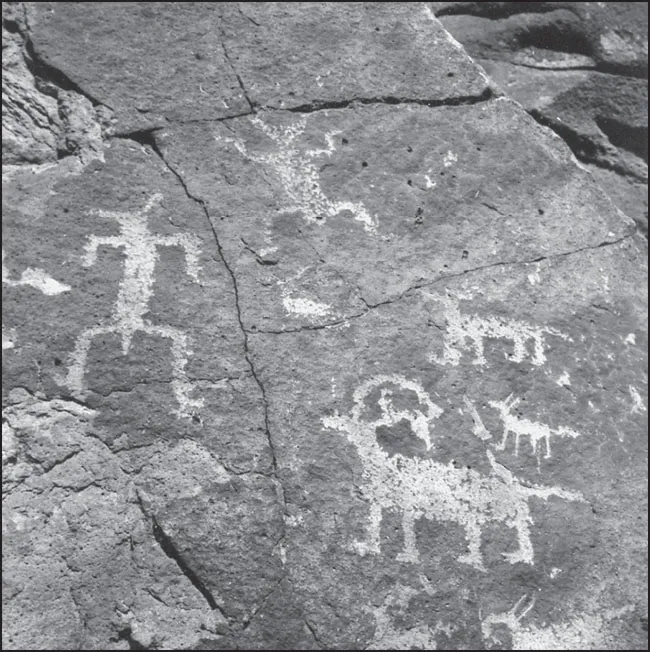
The native people carved rock art and symbols into the rock faces of hills and peaks throughout New River. Like the Hohokams, the bighorn sheep depicted in this petroglyph have since vanished from the region. Many of the petroglyphs have also been destroyed. (Courtesy of Jerry D. Jacka and Lois Essary Jacka.)

Despite the present of ancient hillside dwellings, rock art, and a peak-top fortress, this small but distinctive peak remains officially nameless and is unidentified on topographical maps. Designated as T:4:8 by archaeologists, it is sometimes erroneously called “Pyramid Peak” by locals. (Courtesy of Jerry D. Jacka and Lois Essary Jacka.)
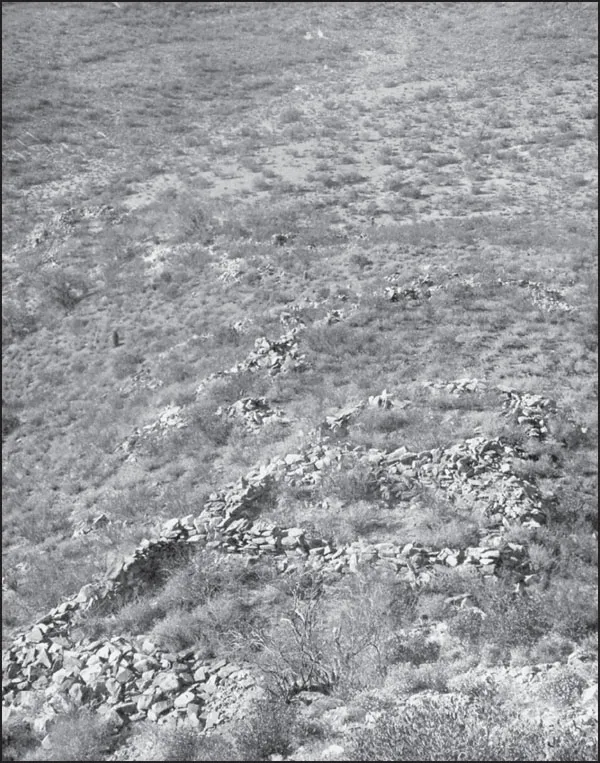
T:4:8, like many of the New River peaks, was used as a temporary dwelling by the Hohokams. They often hunted in the area before returning to the valley below, where the city of Phoenix is now located. The tactically advantageous pinnacle boasted an excellent lookout over the area. (Courtesy of Jerry D. Jacka and Lois Essary Jacka.)

The families who homesteaded New River lived among stunning reminders of the vanished ones. Potsherds and primitive tools were readily found. Here, Bill Essary stands beside the ruins of an impressive prehistoric wall on a hilltop near Black Canyon City, north of New River. (Courtesy of Jerry D. Jacka and Lois Essary Jacka.)
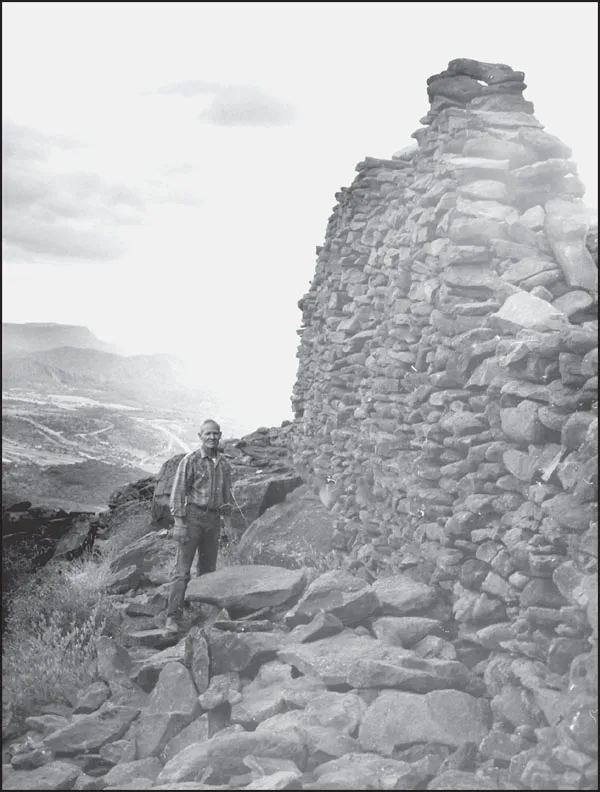
In the background behind Bill Essary, the roads and modern residences of Black Canyon City offer a sharp contrast to the silence of the ancient dwelling place. The loophole visible at the top of the rock wall offered the Hohokams an unobstructed view. (Courtesy of Jerry D. Jacka and Lois Essary Jacka.)

Pepsi Cap Mountain within the Tonto National Forest was once called “Table Top Mountain” by New River locals—not to be confused with Table Mesa, a larger landform not far away. Rowena Essary, one of the original homesteaders, named it Pepsi Cap for its cap-like peak. Archaeologists simply call it T:4:5. Pepsi Cap also boasts an array of Hohokam ruins. (Courtesy of Jerry D. Jacka and Loise Essary Jacka.)

Port Halle, owner of Wrangler’s Roost guest ranch, rode among many ruin-topped peaks. To the right is the small mesa locally known as “Indian Mountain” in honor of Hohokam ruins on its flat summit. Potsherds and partial rock walls still remain on and around the peak. New River Mesa, seen in the background, figured in the cavalry’s sweep of Apaches and Yavapais from the region in the late 1800s. (Courtesy of Lance Halle.)
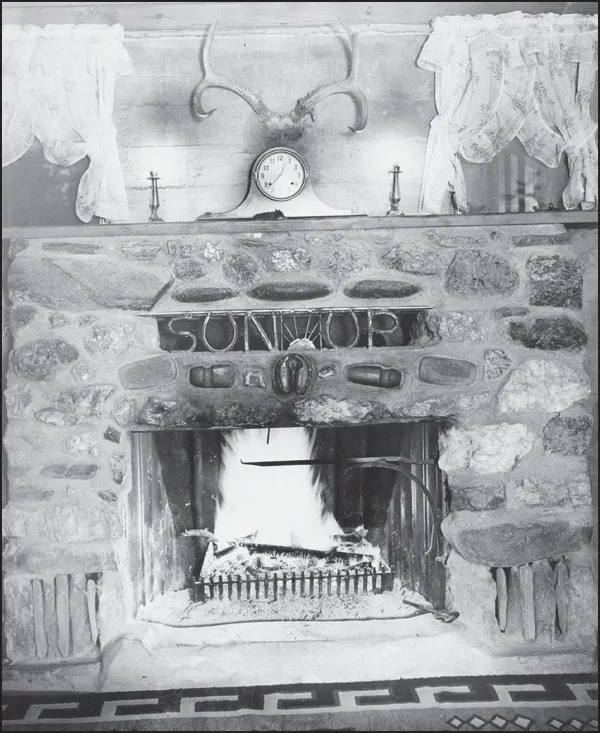
New River homesteaders not only lived among and appreciated the ruins, but also cherished the artifacts they found. Jerry Jacka Sr. incorporated metates and stone hand tools in the fireplace at the Sun-Up Ranch. Note the oxen shoes, also found on the homestead, at center. (From the book Sun-Up Ranch: An Arizona Desert Homestead by Jerry D. Jacka, courtesy of Jerry D. Jacka.)
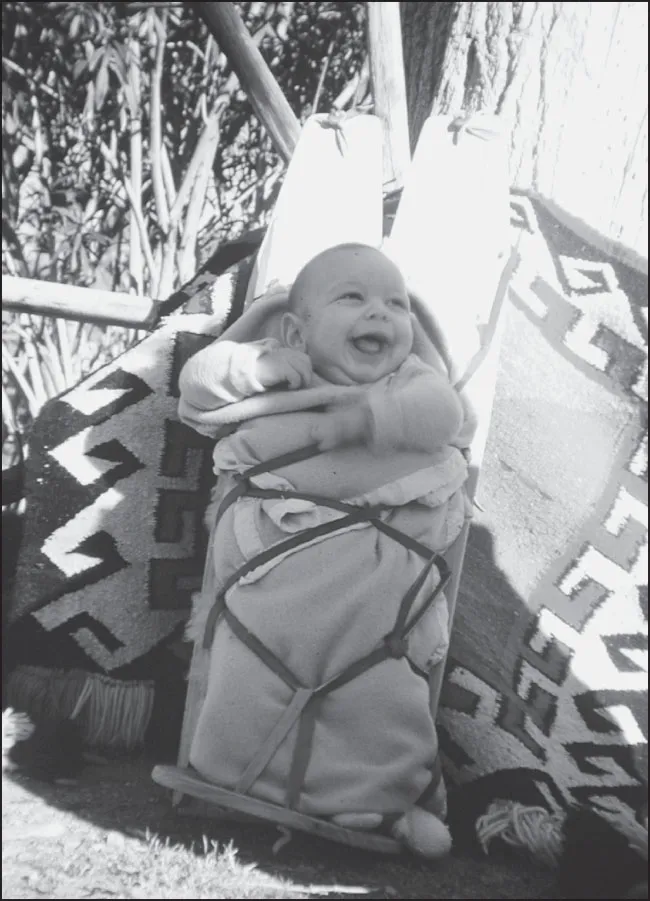
Though the indigenous people had long since vanished or been routed from the area, their cultural influence on later residents remained. Lois Halle of Wrangler’s Roost found the traditional Indian cradleboard to be the perfect way to keep young Lance Halle safe as she managed the constant work required to run a guest ranch. (Courtesy of Lance Halle.)

Legends and lore about the Apaches—some valid, some fanciful—are part of the tapestry of New River history. Leon and Frances Gee built this ranch in the shadow of Gavilan Peak. From the other side, the peak resembles an Apache’s profile. Gavilan means “chicken hawk” in Apache. One legend attributes the name to that of an Apache chief who lived near the peak. (Courtesy of Leon and Frances Gee.)
Two
NEW RIVER STATION
A STOP ON THE OLD
STAGECOACH ROAD
STAGECOACH ROAD
The “New River Station” mentioned in local histories was not just one but three different sites. One was “Lord” Darrell Duppa’s notoriously uncivilized stagecoach stop on the Agua Fria, a considerable distance from the community of New River. That stop, and activities associated with it, were often understandably confused with the stagecoach stop built along New River itself and run by George Hall. The latter was also officially referred to as New River Station.
In 1883, the Arizona Gazette wrote that Hall’s station was to be “one of the best places on the Black Canyon road,” praising the frame stable, hay barn, and chicken house “with a good shake roof . . . to protect his fowls from the coyotes, wildcats, polecats, and owls, which are very thick around there.” Hall’s stagecoach stop, which included six horses, burned to the ground in 1883. It stood where the small strip mall called Riverside Plaza stands today. Older residents recall the ruins of stone corrals for the livestock acro...
Table of contents
- Cover Page
- Title Page
- Copyright Page
- Dedication
- Table of Contents
- Acknowledgments
- Introduction
- 1. The Vanished Ones: The Native People
- 2. New River Station: A Stop on the Old Stagecoach Road
- 3. The T-Up T-Down Ranch: A Historic Cattle Ranch
- 4. The Homesteaders: The Heart of New River
- 5. Wrangler’s Roost: A Western Guest Ranch
- 6. A Changing Landscape: New Generations and Newcomers
Frequently asked questions
Yes, you can cancel anytime from the Subscription tab in your account settings on the Perlego website. Your subscription will stay active until the end of your current billing period. Learn how to cancel your subscription
No, books cannot be downloaded as external files, such as PDFs, for use outside of Perlego. However, you can download books within the Perlego app for offline reading on mobile or tablet. Learn how to download books offline
Perlego offers two plans: Essential and Complete
- Essential is ideal for learners and professionals who enjoy exploring a wide range of subjects. Access the Essential Library with 800,000+ trusted titles and best-sellers across business, personal growth, and the humanities. Includes unlimited reading time and Standard Read Aloud voice.
- Complete: Perfect for advanced learners and researchers needing full, unrestricted access. Unlock 1.5M+ books across hundreds of subjects, including academic and specialized titles. The Complete Plan also includes advanced features like Premium Read Aloud and Research Assistant.
We are an online textbook subscription service, where you can get access to an entire online library for less than the price of a single book per month. With over 1.5 million books across 990+ topics, we’ve got you covered! Learn about our mission
Look out for the read-aloud symbol on your next book to see if you can listen to it. The read-aloud tool reads text aloud for you, highlighting the text as it is being read. You can pause it, speed it up and slow it down. Learn more about Read Aloud
Yes! You can use the Perlego app on both iOS and Android devices to read anytime, anywhere — even offline. Perfect for commutes or when you’re on the go.
Please note we cannot support devices running on iOS 13 and Android 7 or earlier. Learn more about using the app
Please note we cannot support devices running on iOS 13 and Android 7 or earlier. Learn more about using the app
Yes, you can access New River by Marcy J. Miller in PDF and/or ePUB format, as well as other popular books in History & North American History. We have over 1.5 million books available in our catalogue for you to explore.