- 128 pages
- English
- ePUB (mobile friendly)
- Available on iOS & Android
eBook - ePub
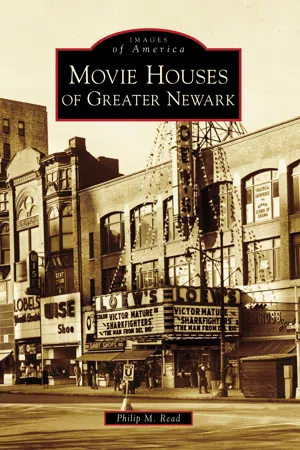
Movie Houses of Greater Newark
About this book
For decades, Newark and its environs have been lit up by the bright neon lights of grand movie palaces and theaters. In the early 20th century, stages that were originally built for vaudeville acts were turned over to silver screens and the flickering images from motion-picture projectors. This new technology ushered Hollywood movies to the East Coast and made cinema accessible for locals to enjoy. Movie houses and palaces provided moviegoers a new type of viewing experience. With ornate interiors and rich architecture, these institutions offered their patrons a beautiful setting to watch classic films. Over time, these establishments evolved and began hosting burlesque shows and rock concerts. Today, many of these downtown landmarks have been demolished, replaced, or adaptively renovated into the modern multiplexes of today. Images of the Paramount and the Mosque Theater help Movie Houses of Greater Newark tell the story of an era when going to the movies was an event.
Trusted by 375,005 students
Access to over 1.5 million titles for a fair monthly price.
Study more efficiently using our study tools.
Information
One
NEWARK

Loew’s State Theatre, the handiwork of architect Thomas W. Lamb of New York, was estimated to cost $500,000 to erect—far more than the more typical $80,000—when building plans were approved by Newark’s building department on February 11, 1921. (Author’s collection.)

In 1923, Loew’s State was showing The Trail of the Lonesome Pine, starring Mary Miles Minter in the last of her silent movie roles. From its December 1921 opening until 1927, Loew’s was managed by William A. Downs, who had made a name for himself as a songwriter. He was credited with writing the lyrics for “I’m Going Back to Carolina,” “Sail on Silv’ry Moon,” “Down in Melody Lane,” and “The Charlie Chaplin Walk.” Some of the recordings can be listened to today on the Library of Congress’s free National Jukebox. (Courtesy of the New Jersey Historical Society.)

In 1923, a crowd gathered outside Loew’s State on Newark’s Broad Street as a man on stilts promoted the attractions found elsewhere, namely at Palisades Amusement Park, which by then was already well promoted with a jingle titled “Palisaders,” composed by Ernest Luz. It would not be until 1965 when young baby boomers heard “Come on Over” and these memorable lyrics by Steve Clayton: “Palisades from coast to coast, where a dime buys the most / Palisades Amusement Park/swings all day and after dark / (bumm, baa, dumm, bumm, bummmm) / ride the coaster / get cool / in the waves in the pool / you’ll have fun . . . so / come on over / (dumm, de dum, da dum . . . dum).” (Courtesy of the New Jersey Historical Society.)
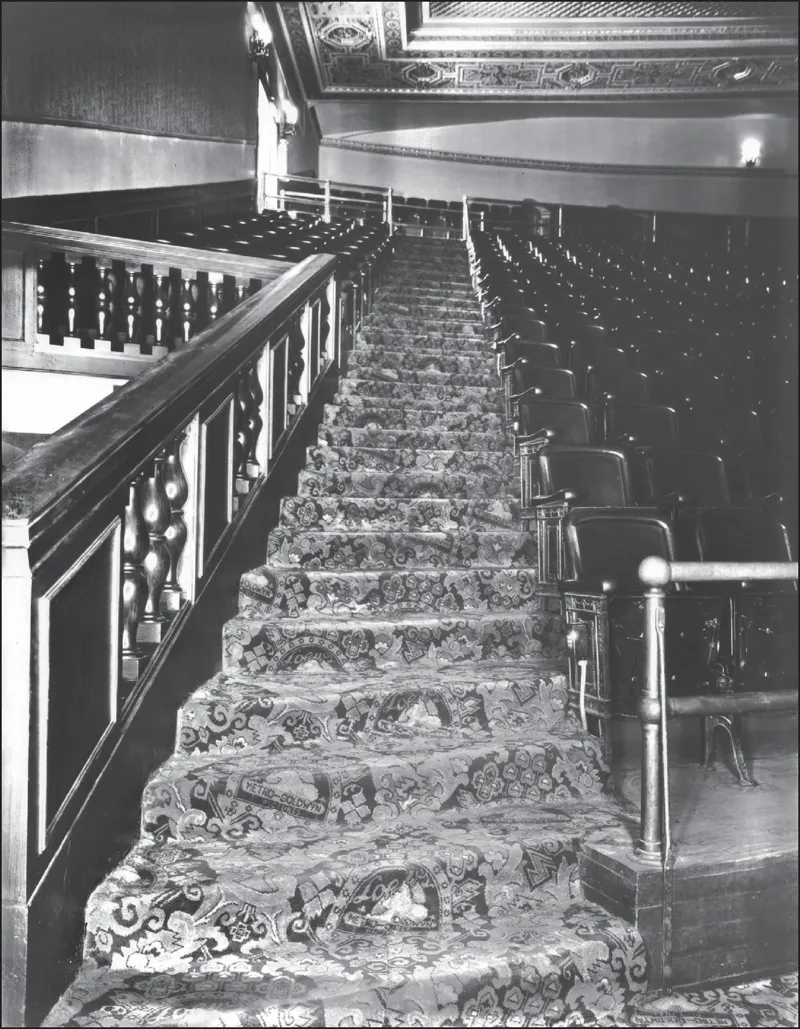
The ultimate in personalized carpeting announced “Loew’s” and “Metro-Goldwyn Pictures” at Loew’s State in Newark. On the chilly morning of January 25, 1940, crowds could not wait to warm up in those seats after lining up along New Street to Halsey Street for the Newark run of Gone with the Wind. “Long Line Shivers While Waiting for Movie Classic” read the newspaper headline. First to get his ticket that day was a young Frank Michelli of 241 North Fifteenth Street in Bloomfield, undaunted by the prospects of sitting through a four-hour-long film. “Did you bring your lunch?” he was asked. “No,” he answered. “I had a good breakfast. I can stick it out. I think it will be worth seeing.” The film had what was described as a “seven-week siege,” with 270,000 patrons passing through the theater till. William S. Phillips, the theater manager, summed it up this way: “There were no lost children, no requests for refunds, no enraged Yankees demanding justice for the North,” he said. “A few of the veterans of the Civil War didn’t relish the way Sherman’s march was shown. A very few walked out on the film; maybe they had another appointment.” (Courtesy of the New Jersey Historical Society.)

Loew’s State in Newark was showing Don’t Go Near the Water, a comedy set in World War II and starring Glenn Ford, in this 1957 street scene. Yet, it was the August 1964 debut of the Beatles movie A Hard Day’s Night that really grabbed the attention of the press. “No Place to Hide, Covering The Beatles is War Correspondent’s Job,” read one headline. Gunter David, a reporter for the Newark News, started his story this way: “Memo: City editor. Subject: Combat pay for covering special showing of first Beatles movie, ‘A Hard Day’s Night.’ I am battle scarred and weary. My knees are bruised and my ear drums still hurt. Last night I saw a mob in action. It was a mob of nice little girls. Two thousand of them. . . . They came to see their favorites, the Beatles, in a special showing at Loew’s.” (Courtesy of the New Jersey Historical Society.)

The feature film at the Branford Theatre, at Newark’s 11 Branford Place, in 1920 was Nomads of the North, whose stars included Lon Chaney in the romantic lead portraying a suitor in novelist James Oliver Curwood’s adventure tale. In the ensuing decades, there were other off-screen adventures. In 1957, police stopped the showing of Reform School Girl after a telephoned bomb threat. In August 1965, Newark News reporter Vincent DeP. Slavin met up with some 1,100 screaming teenagers who arrived at the Branford for an appearance by The Dave Clark Five, whose 1964 hit “Glad All Over” bested the Beatles’s “I Want to Hold Your Hand” on the British pop charts. His report, headed “In Another Orbit,” noted that the fans did not seem to care much about astronauts Gordon Cooper and Charles Conrad’s launch on an eight-day Gemini 5 mission. “The mobs screeched, ‘I love you, Dave’ . . . ‘touch me please’ . . . ‘here I am’ . . . and other unintelligible endearments,” he wrote. The Branford was one of three stops for the band, which also appeared in Paterson and Passaic. (Courtesy of the New Jersey Historical Society.)

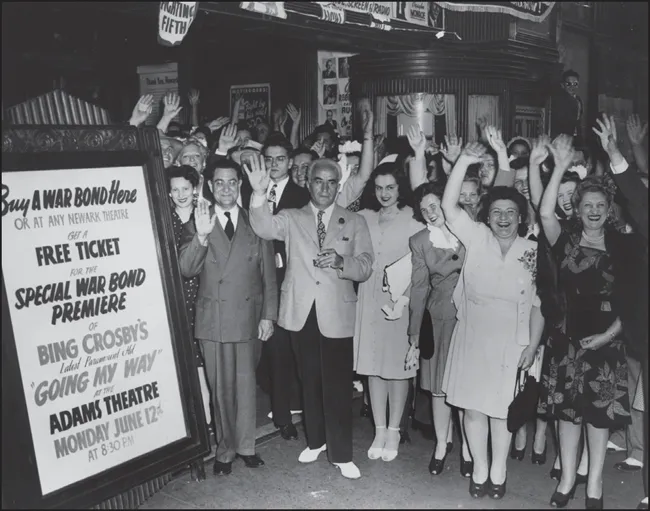
The Adams Theatre, on Newark’s Branford Place, brought out crowds for the “Special War Bond Premiere” of Bing Crosby’s Going My Way in June 1944 (above), with theatergoers backed up to Newark’s Halsey Street. Note the sign on the right for Hobby’s, the famed Newark delicatessen that continues to serve up classic Jewish pastrami sandwiches. The theater’s namesake, Adam A. Adams, was there (below, center), along with his daughter Dorothea and son Peter. (Courtesy of the Newark Public Library, Hellenic Heritage Collection.)
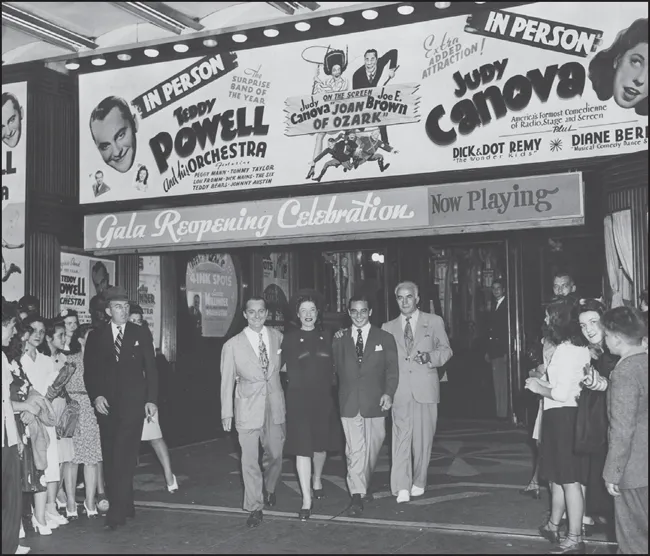
In the early 1940s, A.A. Adams (center group, far right) brought top big-band talent to the Adams, including Tommy Dorsey, Sammy Kaye, Gene Krupa, Artie Shaw, and Charlie Barnet. The hit parade also drew the likes of The Andrew Sisters, The Four Ink Spots, Ella Fitzgerald, and Cab Calloway. Here, he is joined by Teddy Powell (center group, far left), whose orchestra played such tunes as “Jersey Bounce” and “Blue Moon.” (Courtesy of the Newark Public Library, Hellenic Heritage Collection.)

Admission was gained only by the purchase of a US War Bond at many shows at A.A. Adams’s Newark theaters. Beside film premieres, the Adams Theatre in August 1943 was host to a beauty show featuring 125 young candidates hoping to be selected as Miss New Jersey and compete on September 6 at the Miss America finals in Atlantic City. (Courtesy of the Newark Public Library, Hellenic Heritage Collection.)

Big stars came to rub shoulders with Adam A. Adams at the Paramount. Above, the comedy team of Bud Abbott (far right) and Lou Costello (rear, center) are in the projection room with their agent and Adams. Below, comedian Jerry Lewis (dark suit), who once served as an usher at the Paramount, visits with his producer Hal Walli...
Table of contents
- Cover Page
- Title Page
- Copyright Page
- Table of Contents
- Foreword
- Acknowledgments
- Introduction
- 1. Newark
- 2. Suburban Essex
- 3. Paterson
- 4. Passaic
- 5. Suburban Passaic
- 6. Hudson
- 7. Bergen
- 8. Union
- 9. Elsewhere
- 10. After the Matinee
Frequently asked questions
Yes, you can cancel anytime from the Subscription tab in your account settings on the Perlego website. Your subscription will stay active until the end of your current billing period. Learn how to cancel your subscription
No, books cannot be downloaded as external files, such as PDFs, for use outside of Perlego. However, you can download books within the Perlego app for offline reading on mobile or tablet. Learn how to download books offline
Perlego offers two plans: Essential and Complete
- Essential is ideal for learners and professionals who enjoy exploring a wide range of subjects. Access the Essential Library with 800,000+ trusted titles and best-sellers across business, personal growth, and the humanities. Includes unlimited reading time and Standard Read Aloud voice.
- Complete: Perfect for advanced learners and researchers needing full, unrestricted access. Unlock 1.5M+ books across hundreds of subjects, including academic and specialized titles. The Complete Plan also includes advanced features like Premium Read Aloud and Research Assistant.
We are an online textbook subscription service, where you can get access to an entire online library for less than the price of a single book per month. With over 1.5 million books across 990+ topics, we’ve got you covered! Learn about our mission
Look out for the read-aloud symbol on your next book to see if you can listen to it. The read-aloud tool reads text aloud for you, highlighting the text as it is being read. You can pause it, speed it up and slow it down. Learn more about Read Aloud
Yes! You can use the Perlego app on both iOS and Android devices to read anytime, anywhere — even offline. Perfect for commutes or when you’re on the go.
Please note we cannot support devices running on iOS 13 and Android 7 or earlier. Learn more about using the app
Please note we cannot support devices running on iOS 13 and Android 7 or earlier. Learn more about using the app
Yes, you can access Movie Houses of Greater Newark by Philip M. Read in PDF and/or ePUB format, as well as other popular books in History & North American History. We have over 1.5 million books available in our catalogue for you to explore.