- 96 pages
- English
- ePUB (mobile friendly)
- Available on iOS & Android
eBook - ePub
Opryland USA
About this book
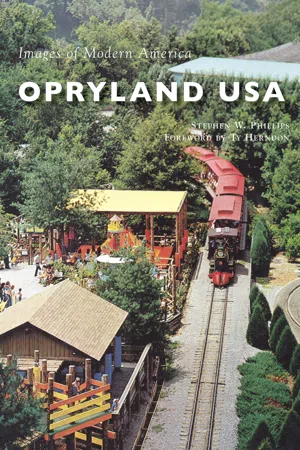
Opryland USA attracted millions of visitors each year and gave many celebrities their first taste of show business. As the "Home of American Music," Opryland USA still lives on in the hearts and minds of those who visited this show that made country music famous.
By the late 1960s, the Ryman Auditorium - the fifth home of the Grand Ole Opry - was a deteriorating firetrap in a seedy part of Nashville, yet it still attracted thousands of people each weekend to the "show that made country music famous." In an effort to develop an attraction that could sustain a larger Opry all week long, Opryland was born. Opryland USA operated from May 27, 1972, until December 31, 1997, attracting millions of visitors each year and giving many celebrities their first taste of show business. The park consisted of nine areas, dozens of rides, and Broadway-caliber shows featuring live bands and orchestras. As the "Home of American Music," Opryland USA still lives on in the hearts and minds of those who visited its wooded trails, lazy streams, exciting attractions, and toe-tapping performances.
One
A NEW HOME FOR THE
GRAND OLE OPRY
GRAND OLE OPRY

Lines of visitors to the Grand Ole Opry queue around the Ryman Auditorium in downtown Nashville during the 1960s. The show’s growing popularity, combined with the building’s dilapidated state and the seedy nature of the downtown neighborhood of the day, prompted the show’s owners, National Life and Accident Insurance Company, to look at options for the future of the historic radio program.

WSM president Irving Waugh had witnessed the success happening in Houston with the city’s new stadium. The Astrodome had recently been constructed; however, it was the attached theme park that was keeping visitors coming. Waugh thought the same thing could work with the Grand Ole Opry. A theme park attached to the two-day-a-week show could help pay for a new venue for the Opry. The “Oprytown” area marked on the map was a planned commercial district that would evolve into the Opryland Motel and eventually into the Opryland Hotel Resort and Convention Center. Decades later, the Oprytown idea would resurface as an (abandoned) concept to connect the Grand Ole Opry House to the hotel. (CSR.)

The Opryland theme park did not have a traditional ground breaking. In a setting that was fitting of the Grand Ole Opry’s roots, future Opry member Bashful Brother Oswald (also known as Pete Kirby) used a mule plow for the ground breaking of Opryland on June 30, 1970.

During the ground-breaking ceremonies on June 30, 1970, Roy Acuff blew the same steamboat whistle George D. Hay used to start every Opry performance. Hay was the first to use the term “Grand Ole Opry.” On December 10, 1927, WSM’s Barn Dance program followed the NBC Music Appreciation Hour, a program of classical music and selections from Grand Opera. Hay said, “For the past hour, we have been listening to music taken largely from Grand Opera. From now on, we will present the ‘Grand Ole Opry’.” As of 2016, the same whistle is on display backstage at the Grand Ole Opry House and visible on public tours. One of the highlights of the Opryland USA ground breaking was the attendance of Elizabeth Craig, the widow of Edwin Craig, the former chairman of the board of National Life and Accident Insurance Company. Edwin Craig spearheaded the development of WSM and the Grand Ole Opry. In the photograph below, Irving Waugh thanks Elizabeth Craig. (Both, TENN.)


After an exhaustive search for a feasible site, 369 acres were purchased from Rudy’s Farm, a sausage manufacturer located along the newly constructed Briley Parkway, 10 minutes from downtown Nashville. Transforming the rural Pennington Bend site into an entertainment theme park cost an estimated $28 million. (Author’s collection.)

This Opryland USA theme park scale model displays most of the opening day attractions, including the Timber Topper, Flume Zoom, American Music Theatre, and Tin Lizzies. The Grand Ole Opry, which was not scheduled to open until a later date, is still featured on the model.

Construction progresses in the American West area as workers build a replica of an 1870s town during the 1970s. Park designers were careful to use the natural environment to enhance the artificial landscapes that they were creating. Sidewalks were built to follow natural pathways. Streams and waterfalls were built to compliment natural surroundings. Gardens were planted to follow the natural curve of the terrain. (TENN.)

Buildings in the New Orleans area near completion as workers progress around the carousel lake to start work on other structures in the Hill Country of Opryland USA. These buildings were erected full-scale, opposed to the forced-perspective technique used at similar theme parks. (TENN.)

Original concept art shows the arts and crafts vendors in the Hill Country area of the park. When Opryland was originally under development, the themed lands were to be Little Ole New York (with the music of Broadway), the Old West, Dixieland, Old Mexico, and Haight-Ashbury (dedicated to what the 1960s counterculture referred to as the “Scene”).

Randall Duell and Associates of Santa Monica, California, designed Opryland USA. The firm had previously designed other theme parks, including Marriott’s Great America and the original Universal Studios Tour, as well as several pavilions at the 1964–1965 New York World’s Fair.

Workers lay ties and rails for Opryland Railroad. The park opened with two engines and two stations. One of the depots was named for the “El Paso” song by Marty Robbins and the other named Grinder’s Switch, for the fictional hometown of Grand Ole Opry star Minnie Pearl. (Both, TENN.)


Irving Waugh looks over his park just before opening. He once said, “We have 325,000 people to see the Opry every year. They come in town with time on their hands and nothing to do. We can’t build a new Opry House for just a few performa...
Table of contents
- Cover Page
- Title Page
- Copyright Page
- Dedication
- Table of Contents
- Foreword
- Acknowledgments
- Introduction
- 1. A New Home for the Grand Ole Opry
- 2. The Home of American Music
- 3. Come Share the Wonder
- 4. America’s Musical Showplace
- 5. The Most Fun in the Country
- 6. A Circle Broken
Trusted by 375,005 students
Access to over 1.5 million titles for a fair monthly price.
Study more efficiently using our study tools.
Information
Publisher
Arcadia PublishingYear
2016Topic
HistoryPrint ISBN
9781467116336
Subtopic
North American HistoryeBook ISBN
9781439657409
Index
HistoryFrequently asked questions
Yes, you can cancel anytime from the Subscription tab in your account settings on the Perlego website. Your subscription will stay active until the end of your current billing period. Learn how to cancel your subscription
No, books cannot be downloaded as external files, such as PDFs, for use outside of Perlego. However, you can download books within the Perlego app for offline reading on mobile or tablet. Learn how to download books offline
Perlego offers two plans: Essential and Complete
- Essential is ideal for learners and professionals who enjoy exploring a wide range of subjects. Access the Essential Library with 800,000+ trusted titles and best-sellers across business, personal growth, and the humanities. Includes unlimited reading time and Standard Read Aloud voice.
- Complete: Perfect for advanced learners and researchers needing full, unrestricted access. Unlock 1.5M+ books across hundreds of subjects, including academic and specialized titles. The Complete Plan also includes advanced features like Premium Read Aloud and Research Assistant.
We are an online textbook subscription service, where you can get access to an entire online library for less than the price of a single book per month. With over 1.5 million books across 990+ topics, we’ve got you covered! Learn about our mission
Look out for the read-aloud symbol on your next book to see if you can listen to it. The read-aloud tool reads text aloud for you, highlighting the text as it is being read. You can pause it, speed it up and slow it down. Learn more about Read Aloud
Yes! You can use the Perlego app on both iOS and Android devices to read anytime, anywhere — even offline. Perfect for commutes or when you’re on the go.
Please note we cannot support devices running on iOS 13 and Android 7 or earlier. Learn more about using the app
Please note we cannot support devices running on iOS 13 and Android 7 or earlier. Learn more about using the app
Yes, you can access Opryland USA by Stephen W. Phillips in PDF and/or ePUB format, as well as other popular books in History & North American History. We have over 1.5 million books available in our catalogue for you to explore.