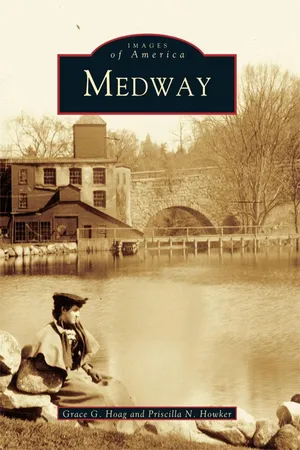
Incorporated in 1713, Medway began as a farming community of two hundred thirty-three. It was not long before the waterpower of the Charles River and Chicken Brook stimulated the formation of cotton and paper mills, straw and boot factories, and a variety of cottage industries. Through vintage images from the 1850s to the 1960s, Medway demonstrates the central importance of the Charles River and the thriving town that grew alongside it. Included are images of trains and streetcars; recreation, such as canoeing, picnicking, and fishing; Woodland Park, a popular stop that included a zoo; and the 1913 bicentennial celebration on the banks of the river. Today, the one-room schoolhouses are gone and the country stores have moved to the mall, but the open town meetings continue and Medway retains its small-town flavor.
- 128 pages
- English
- ePUB (mobile friendly)
- Available on iOS & Android
eBook - ePub
Medway
About this book
Trusted by 375,005 students
Access to over 1.5 million titles for a fair monthly price.
Study more efficiently using our study tools.
Information
Four
HOUSES OF WORSHIP, SCHOOLS, AND LIBRARIES
The churches have always been an important part of Medway’s life. In the early days, there was a lot of dissension among the churches. Occasionally, the dissension involved politics and personal matters rather than theology. Some prominent members were even excommunicated from the Second Church of Christ and formed the Third Congregational Church. The separation to form the Village Church was, however, amicable and deemed necessary.
For many years, there was a number of small schools around town. For the most part, they were very primitive and often did not even have water. They were not well heated and were very stuffy and overcrowded. As a result, there was a lot of sickness among the students. In spite of this, the townspeople voted down improvements including wells year after year. For some time, the high school students moved from village to village until it was finally decided to have a central high school
For many years, Medway had two libraries: Dean Library in Sanford Hall and the library at West Medway, which was first located upstairs in Smith’s Block and later in the Thayer Building. The libraries were combined in 1980, when the High Street School was converted to a central library.

The Second Church of Christ in West Medway was constructed on Rabbit Hill by builder Malachi Bullard in 1814. It replaced the original 1749 meetinghouse, located on the corner of Evergreen and Main. At that time, there were no homes near the Rabbit Hill site. The ell of the church was added in 1875. In 1886, the Third Congregational Church was organized by excommunicated and disaffected members of the Second Church. In 1891, the Second Congregational and Third Congregational Churches united.

This 1900 photograph shows the interior decorated to celebrate the 150th anniversary of the church. By this time, the church had changed its name to the Second Congregational Church. A portrait of Dr. Jacob Ide, pastor from 1814 to 1880, is on display. In 1846, the church was modernized. The square pews were removed, the aisles carpeted, and the windows opposite the entrance closed in. In 1873, more remodeling was done. The first pipe organ was installed in 1900. In 1910, the auditorium was restored to the Colonial style. Other changes were made in 1986.
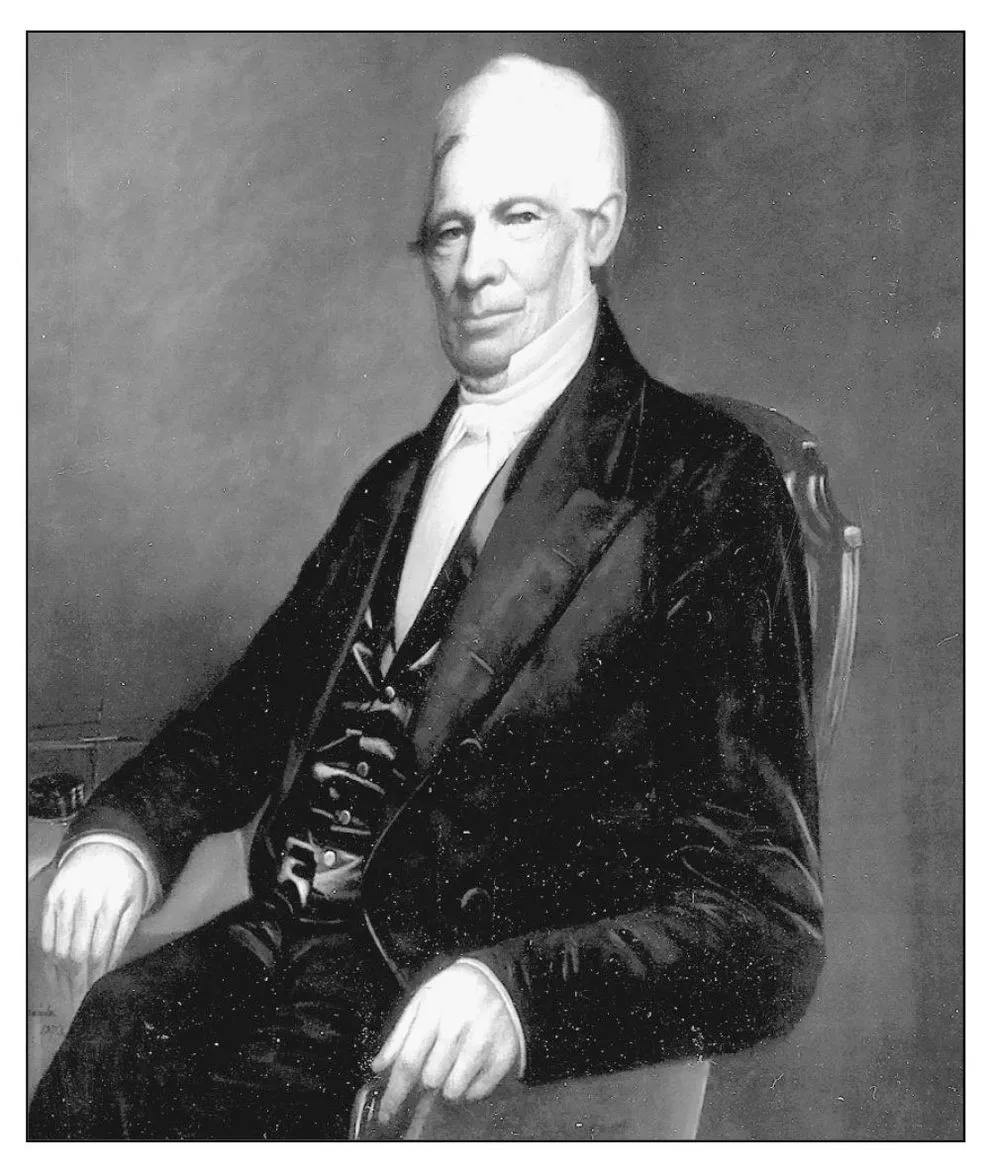
Dr. Jacob Ide, seen here in a portrait by Anson Daniels, was the first pastor of the church on Rabbit Hill. His 65 years with the church spanned the development of the West Medway area that is now Rabbit Hill Historic District. This portrait hangs in the entry hall at the church.
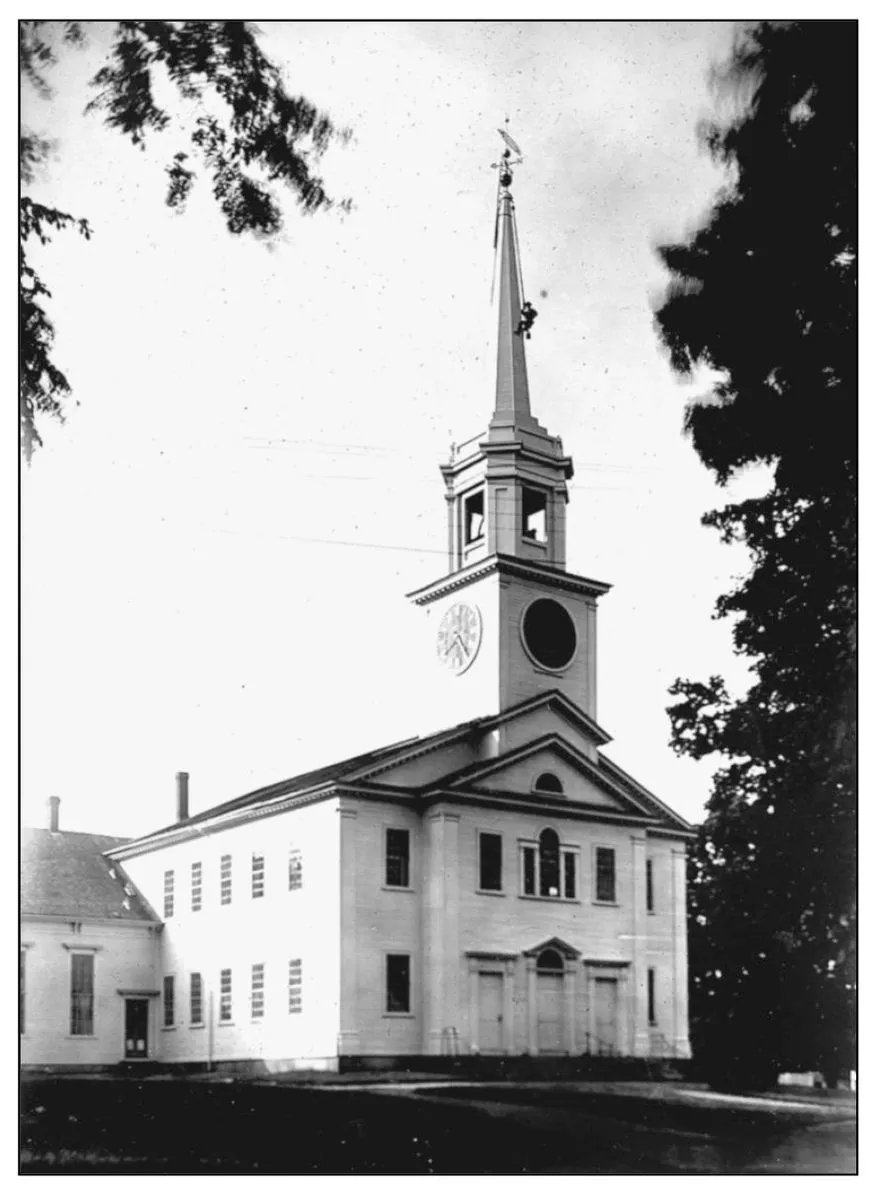
This Second Congregational Church steeple has had a dramatic history. When the church was built, it had a dome instead of a spire. The spire was erected in 1846. According to a September 30, 1882, report by the parish committee, “the steeple was rebuilt after the great blow of July 28, 1882 at which time the steeple was whirled in the air like a top and sent through the roof point first into auditorium room below and striking a large timber in the floor bounded back and lay on top of the pews in front of the pulpit doing a very little damage.” In the hurricane of 1938, the rebuilt steeple was destroyed. Then, in 1945, it was struck by lightning and severely damaged. This photograph was taken in 1896 while the steeple was being painted.
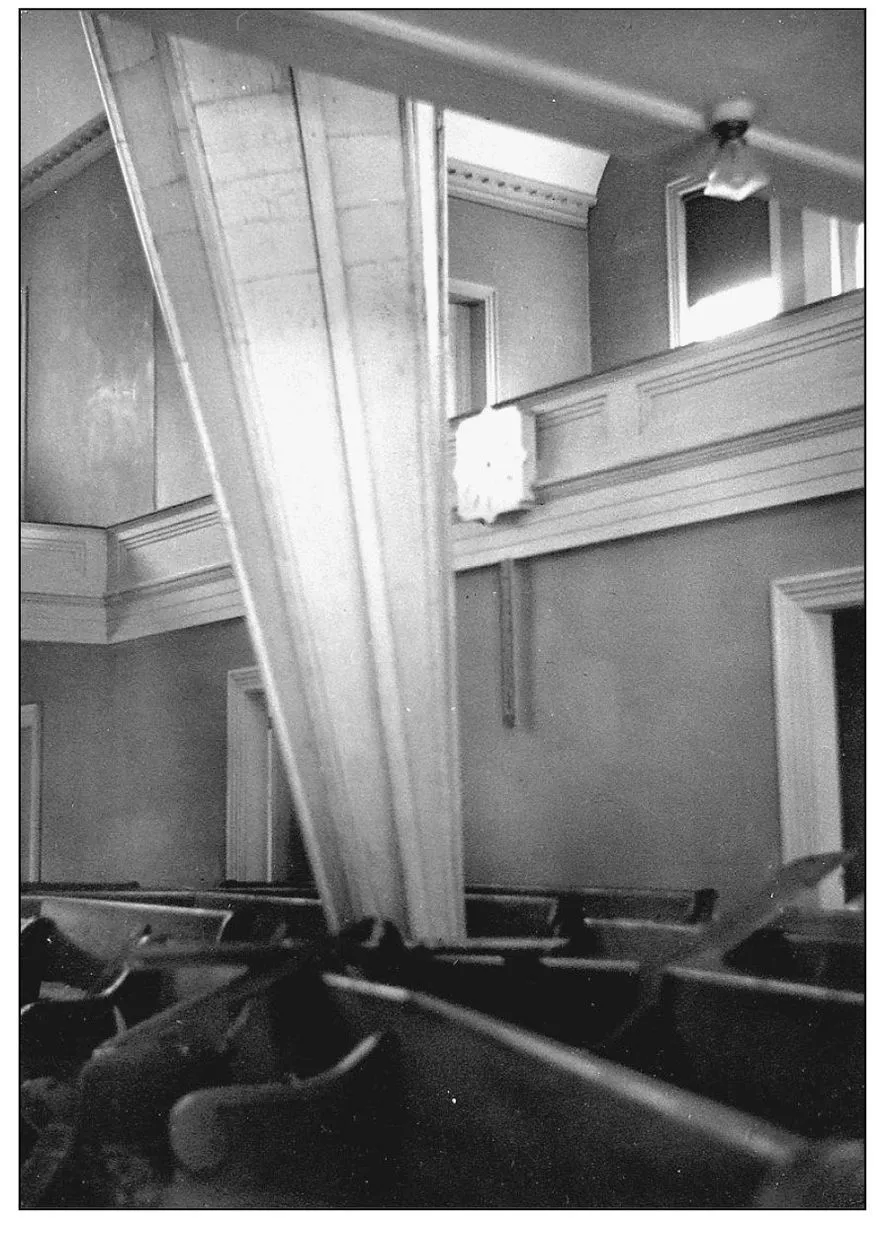
The hurricane of 1938 also brought the steeple into the sanctuary.

This 1930 photograph celebrates th...
Table of contents
- Title Page
- Copyright Page
- Table of Contents
- ACKNOWLEDGMENTS
- INTRODUCTION
- One - LOCAL SCENES
- Two - MILLS, FACTORIES, AND BUSINESSES
- Three - CIVIC MATTERS
- Four - HOUSES OF WORSHIP, SCHOOLS, AND LIBRARIES
- Five - HOMES, HOTELS, AND TAVERNS
- Six - RECREATION
- Seven - CELEBRATIONS
Frequently asked questions
Yes, you can cancel anytime from the Subscription tab in your account settings on the Perlego website. Your subscription will stay active until the end of your current billing period. Learn how to cancel your subscription
No, books cannot be downloaded as external files, such as PDFs, for use outside of Perlego. However, you can download books within the Perlego app for offline reading on mobile or tablet. Learn how to download books offline
Perlego offers two plans: Essential and Complete
- Essential is ideal for learners and professionals who enjoy exploring a wide range of subjects. Access the Essential Library with 800,000+ trusted titles and best-sellers across business, personal growth, and the humanities. Includes unlimited reading time and Standard Read Aloud voice.
- Complete: Perfect for advanced learners and researchers needing full, unrestricted access. Unlock 1.5M+ books across hundreds of subjects, including academic and specialized titles. The Complete Plan also includes advanced features like Premium Read Aloud and Research Assistant.
We are an online textbook subscription service, where you can get access to an entire online library for less than the price of a single book per month. With over 1.5 million books across 990+ topics, we’ve got you covered! Learn about our mission
Look out for the read-aloud symbol on your next book to see if you can listen to it. The read-aloud tool reads text aloud for you, highlighting the text as it is being read. You can pause it, speed it up and slow it down. Learn more about Read Aloud
Yes! You can use the Perlego app on both iOS and Android devices to read anytime, anywhere — even offline. Perfect for commutes or when you’re on the go.
Please note we cannot support devices running on iOS 13 and Android 7 or earlier. Learn more about using the app
Please note we cannot support devices running on iOS 13 and Android 7 or earlier. Learn more about using the app
Yes, you can access Medway by Grace G. Hoag,Priscilla N. Howker in PDF and/or ePUB format, as well as other popular books in History & North American History. We have over 1.5 million books available in our catalogue for you to explore.