- 128 pages
- English
- ePUB (mobile friendly)
- Available on iOS & Android
eBook - ePub
Central Georgia Textile Mills
About this book
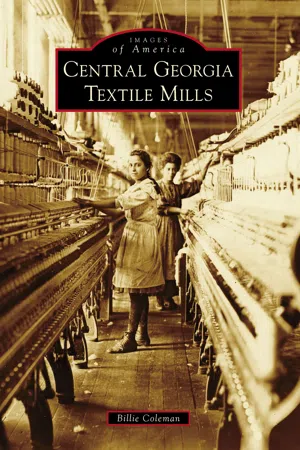
Cotton was once king throughout Georgia. Reconstruction investors and railroad tycoons saw this potential to open textile mills in the South instead of sending cotton up North. Towns across Central Georgia became a prime spot to locate textile mills because of the access to cotton from local farms, cheap labor, and nearby rivers to power the mills. Textile mills were operated in cities and towns across Central Georgia such as Macon, Columbus, Augusta, Tifton, Forsyth, Porterdale, and Hawkinsville, among others. The textile mills provided employment and sometimes a home in their villages to people across Georgia as the agrarian lifestyle gave way to industrial expansion. In these mills, photographer Lewis Hine captured iconic images of child labor. After the decline of production and closing of the mills, many have been revived into new usages that honor the legacy of the mill workers and their families who lived in the villages of the textile mills across Central Georgia.
Trusted by 375,005 students
Access to over 1.5 million titles for a fair monthly price.
Study more efficiently using our study tools.
Information
One
COTTON IS KING
“Bring the cotton mills to the cotton field” was the rallying cry of Georgians in the late 1880s. Businessmen and community leaders across Central Georgia raised funds to build cotton mills for their citizens and take advantage of the profits in the growing textile industry.
Many of the early mills were located near the rivers in Augusta and Columbus. These mills were built to take advantage of the waterpower from the rivers, which not only powered the mills but also created electricity for the city. Other mills utilized various power sources but were still connected to railroads and river ports where they could ship the cotton into the mills and ship out the completed goods. Railroad owners were investors in mills such as the Bibb Manufacturing Company, which started in Macon.
In Central Georgia, textile mills were built to take advantage of the proximity of the nearby cotton fields. By bringing a mill to their community, investors were also creating jobs and exposing rural communities to industry. The economies of the rural communities were devastated by the Civil War and the loss of the agrarian culture. The textile mills were seen as a turning point for the Southern economy of Central Georgia. The textile mills produced a wide variety of goods, including cloth, yarn, rope, tire fabric, hosiery, towels, denim, linens, blankets, and drapery. By the early 1900s, most of the textile goods made in America were produced in the South, and Central Georgia had some of the largest textile mills. Once again, cotton had become king throughout Central Georgia, and the textile industry led the economy.
This chapter will travel through the mills of Central Georgia as they begin to change the landscape and workforce in the early 1900s. Around many of the textile mills, villages take shape as mill owners build housing and amenities for their workers. As Central Georgia begins to leave its agrarian past, a new kind of industry takes shape with the textile mills.

This view is across the river from the Bibb City Mill in Columbus. This is an early image of the electrical generator that helped power the textile mill. The falling waters of the Chattahoochee River on the Georgia-Alabama border created power for the mills. (Library of Congress.)

This view downriver from the power plant and textile mill on the Chattanooga River in Columbus looks up towards the Bibb City Mill, owned by Bibb Manufacturing Company. The fast-moving water was used to create electric power to run the mill equipment. (Library of Congress.)

Pictured is the front entrance of the Bibb City Mill in Columbus. This is where many of the employees entered the large mills to start their day. Note the clock to make sure the employees were on time for their shifts. (Library of Congress.)

The Bibb City Mill in Columbus was the largest textile mill in the country. It produced textiles, carpet, and industrial products. This large textile mill stretched from the road to the river and supported the local economy. Bibb City grew up around the mill and was a home for the mill workers. (Library of Congress.)

Pictured are the storage facility and warehouses for the Bibb City Mill in Columbus. It was the largest textile mill in the country during its prime, and there was a need for constant supplies and shipments. A textile mill was a complex facility that consisted of many layers that had to work smoothly together to create the final products. (Library of Congress.)

This aerial shot shows the Columbus Electric Company, which was part of the Bibb City Mill. The dam and power plant were originally built to power Bibb City Mill and are now owned by Georgia Power. The electricity generated by the plant now powers the city of Columbus. (Library of Congress.)

Many trades over cotton communities in Georgia took place at the Augusta Cotton Exchange, located right on the Savannah River in downtown Augusta, Georgia. The exchange opened in 1866 and was once the second largest cotton exchange in the world. Without the local cotton trade, the textile mills of Central Georgia would not have been possible. (Library of Congress.)

Workers in Central Georgia tend to a field of cotton. By locating near the cotton fields, the mills had easy access to cotton shipments. The cotton textile mills of Central Georgia would not have been possible without hard work from the field workers. (Library of Congress.)

The Sibley Mill was located on the Augusta Canal. Petersburg boats like this one were used to haul goods up and down the canal to the Savannah River. These boats were made specifically for use on the canals and are still used today by the Augusta Canal Authority to take tourists...
Table of contents
- Cover Page
- Title Page
- Copyright Page
- Dedication
- Table of Contents
- Acknowledgments
- Introduction
- 1. Cotton Is King
- 2. The Southern Textile Mill Worker
- 3. Life in a Mill Village
- 4. A Changing Industry and the Future
- Bibliography
Frequently asked questions
Yes, you can cancel anytime from the Subscription tab in your account settings on the Perlego website. Your subscription will stay active until the end of your current billing period. Learn how to cancel your subscription
No, books cannot be downloaded as external files, such as PDFs, for use outside of Perlego. However, you can download books within the Perlego app for offline reading on mobile or tablet. Learn how to download books offline
Perlego offers two plans: Essential and Complete
- Essential is ideal for learners and professionals who enjoy exploring a wide range of subjects. Access the Essential Library with 800,000+ trusted titles and best-sellers across business, personal growth, and the humanities. Includes unlimited reading time and Standard Read Aloud voice.
- Complete: Perfect for advanced learners and researchers needing full, unrestricted access. Unlock 1.5M+ books across hundreds of subjects, including academic and specialized titles. The Complete Plan also includes advanced features like Premium Read Aloud and Research Assistant.
We are an online textbook subscription service, where you can get access to an entire online library for less than the price of a single book per month. With over 1.5 million books across 990+ topics, we’ve got you covered! Learn about our mission
Look out for the read-aloud symbol on your next book to see if you can listen to it. The read-aloud tool reads text aloud for you, highlighting the text as it is being read. You can pause it, speed it up and slow it down. Learn more about Read Aloud
Yes! You can use the Perlego app on both iOS and Android devices to read anytime, anywhere — even offline. Perfect for commutes or when you’re on the go.
Please note we cannot support devices running on iOS 13 and Android 7 or earlier. Learn more about using the app
Please note we cannot support devices running on iOS 13 and Android 7 or earlier. Learn more about using the app
Yes, you can access Central Georgia Textile Mills by Billie Coleman in PDF and/or ePUB format, as well as other popular books in History & Fashion & Textile Industry. We have over 1.5 million books available in our catalogue for you to explore.