
- 128 pages
- English
- ePUB (mobile friendly)
- Available on iOS & Android
eBook - ePub
Penn State University
About this book
Penn State University was founded in 1855. Then known as the Farmers' High School of Pennsylvania, the 400-acre campus had only one main building.
With almost 100,000 current students (including students at the Commonwealth Campuses) and having the largest dues-paying alumni association in the world, Penn State continues to be a world leader in education. Since its founding, picture postcards have been published to showcase the buildings and highlight the student activities while documenting the school's narrative.
Trusted by 375,005 students
Access to over 1.5 million titles for a fair monthly price.
Study more efficiently using our study tools.
Information
One
A WALK THROUGH CAMPUS

From the very beginning, the entranceway to Penn State was impressive. This postcard shows a side view of the main entrance across from Allen Street. The structure to the left of the original pillars is the Old Engineering Building, which would only stand for a few years before succumbing to a fire in 1918. (CPCCCHS.)

While there are many ways to access the University Park campus, the first and main entrance is located on College Avenue, across from Allen Street. This view shows that there was a road that went to some of the original buildings (Carnegie, Schwab, and so on). That road has since been covered in grass, and now a fence stands between the two pillars. Note the young age of the famous elm trees in this postcard from 1911.

The class of 1916’s gift to the college was the reconstruction of the main entrance. The new pillars were constructed in 1917. Note the absence of the two lion statues (named Ma and Pa) that sat atop the old pillars. These were lost during the construction period.

Though the main entrance was closed to automobile traffic in 1924, an iron grill was added in 1930, effectively blocking the road into the heart of campus. The mall was then covered in grass, and the entranceway was only accessible by foot. Parts of the Hammond and Sackett Buildings are seen in the background. (Photograph by Robert L. Goerder.)

In this view looking north, the Armory is on the left, and Schwab Auditorium is on the right. The newly built Pattee Library can be seen in the distance at the very end of the mall. The sender of this 1942 postcard was correct in writing, “They have a beautiful campus here.”

At the end of the walkway up the mall is the Pattee Library (now Pattee-Paterno Library), with Burrowes Building to the right. Both scenes must have been taken in between classes, as students and professors alike are shown strolling to their next classes. Unfortunately, quite a few of the elms contracted Dutch elm disease or elm yellows disease and had to be removed. Wood from the fallen trees has been used to make assorted Penn State souvenirs through the Penn State Elms Collection. A portion of the proceeds from the sale of these items is used to plant replacement trees. (Photographs by Richard C. Miller.)


As mentioned before, there once was a road extending from Allen Street to Old Main, Schwab Auditorium, Carnegie Building (Library), and the Armory. In this 1909 view from the Old Engineering Building, young elm trees line the original entrance road, along with a much older weeping willow tree.
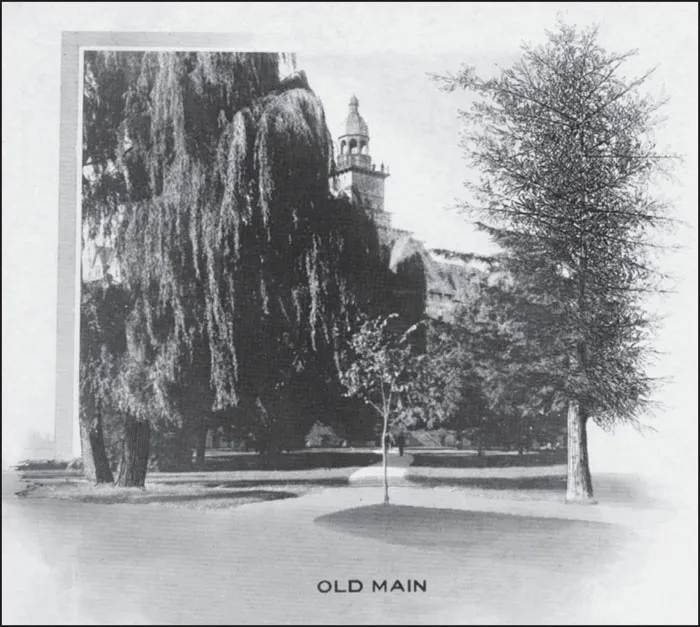
Another scene from 1909 provides a better view of the tree known as “Old Willow,” pictured here next to a young elm. Prof. William Waring planted Old Willow in 1858. It was actually a cutting from one of Alexander Pope’s willow trees in England that newly appointed president Dr. Even Pugh had brought with him when he started his position at Penn State.
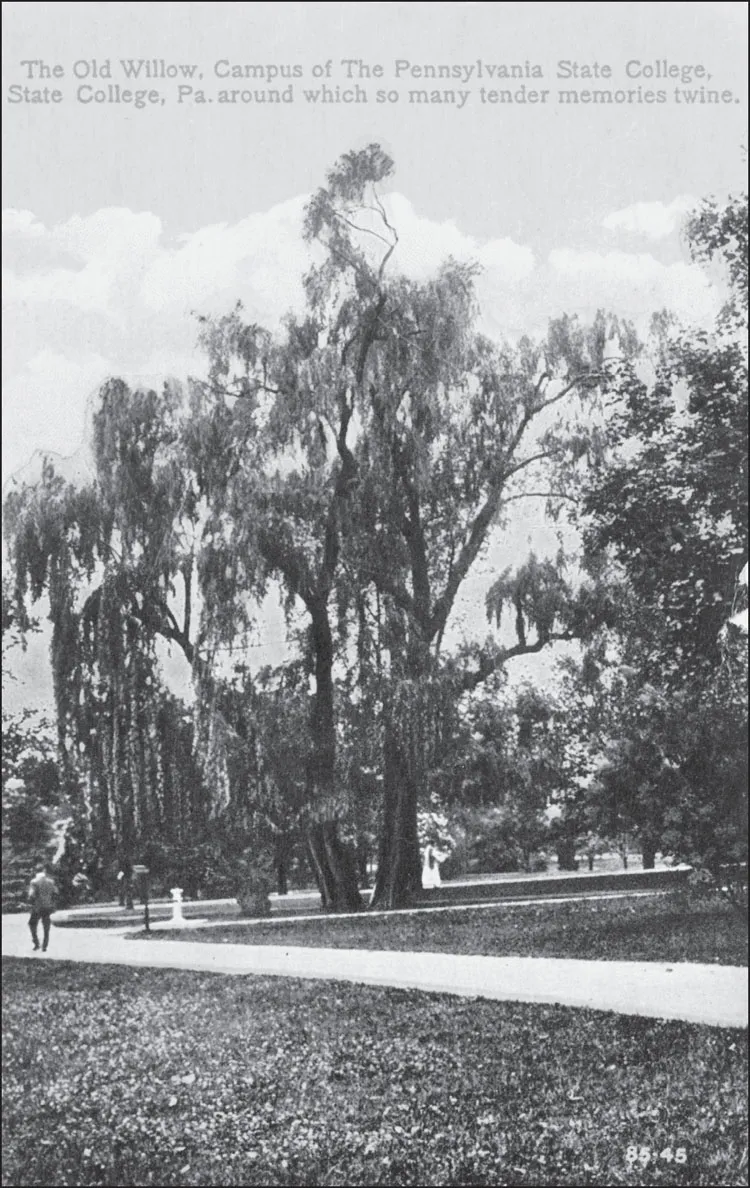
Old Willow served as a meeting place for students for many years until it was decimated during a storm in the early 1920s (multiple sources have stated a date from 1921 to 1923). After Old Willow was destroyed, numerous cuttings were planted in the same spot. The last of those planted in that area survived until 1976, when disease felled the offspring. Other descendants of Old Willow can be seen in the Arboretum at Penn State, at the homes of former trustees Anne Riley and George Henning, and just east of Old Main. In this scene postmarked 1916, the water fountain to the left of the tree was a gift from the class of 1914 and no longer exists. A historical marker now identifies where Old Willow once stood.

When the original Old Main was built, limestone was excavated from its front lawn. One area in particular was cleared, and a dip in the landscape occurred. This dip made a natural open-air theater in the southeast corner of the lawn. A historical marker identifies the location of the quarry and, in essence, the site of the theater.

The class of 1900 gifted 50 benches to the college, as well as a portrait of George W. Atherton. A portion of what were called the Senior Benches is pictured here. This card was postmarked in October 1911.

This oversized postcard shows Penn State as it appeared in 1908. On the left side of Main Avenue, which is currently the mall leading to the Pattee-Paterno Library, are the Obelisk (originally known as the polylith) and the Armory, with the Carnegie Building just behind it. To the far left is an open area where military maneuvers were held. On the right side of the road is the pathway to the original Old Main. This street view also shows the elm trees at an early age, along with a young willow tr...
Table of contents
- Cover Page
- Title Page
- Copyright Page
- Dedication
- Table of Contents
- Foreword
- Acknowledgments
- Introduction
- 1. A Walk through Campus
- 2. Where Learning Takes Place
- 3. Something Other Than Studying
- 4. A Place to Sleep
- 5. Hanging around Town
- Bibliography
- About the Organization
Frequently asked questions
Yes, you can cancel anytime from the Subscription tab in your account settings on the Perlego website. Your subscription will stay active until the end of your current billing period. Learn how to cancel your subscription
No, books cannot be downloaded as external files, such as PDFs, for use outside of Perlego. However, you can download books within the Perlego app for offline reading on mobile or tablet. Learn how to download books offline
Perlego offers two plans: Essential and Complete
- Essential is ideal for learners and professionals who enjoy exploring a wide range of subjects. Access the Essential Library with 800,000+ trusted titles and best-sellers across business, personal growth, and the humanities. Includes unlimited reading time and Standard Read Aloud voice.
- Complete: Perfect for advanced learners and researchers needing full, unrestricted access. Unlock 1.5M+ books across hundreds of subjects, including academic and specialized titles. The Complete Plan also includes advanced features like Premium Read Aloud and Research Assistant.
We are an online textbook subscription service, where you can get access to an entire online library for less than the price of a single book per month. With over 1.5 million books across 990+ topics, we’ve got you covered! Learn about our mission
Look out for the read-aloud symbol on your next book to see if you can listen to it. The read-aloud tool reads text aloud for you, highlighting the text as it is being read. You can pause it, speed it up and slow it down. Learn more about Read Aloud
Yes! You can use the Perlego app on both iOS and Android devices to read anytime, anywhere — even offline. Perfect for commutes or when you’re on the go.
Please note we cannot support devices running on iOS 13 and Android 7 or earlier. Learn more about using the app
Please note we cannot support devices running on iOS 13 and Android 7 or earlier. Learn more about using the app
Yes, you can access Penn State University by Thomas E. Range II in PDF and/or ePUB format, as well as other popular books in History & Education General. We have over 1.5 million books available in our catalogue for you to explore.