- 128 pages
- English
- ePUB (mobile friendly)
- Available on iOS & Android
eBook - ePub
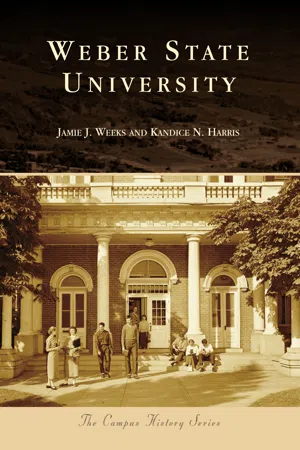
Weber State University
About this book
Nestled in the foothills of the beautiful Wasatch Mountains, Weber State University has been serving the Greater Weber and Davis County communities for over 125 years. On January 7, 1889, Weber Stake Academy opened its doors for the first time to approximately 100 students. The academy continued to grow and develop through five name changes and several relocations. Throughout this time, the institution survived many financial and political struggles. Today, the university has increased in size to accommodate over 26,000 students. This pictorial history was put together in commemoration of Weber's 125th anniversary, and it provides a compelling look into the struggles and ultimate survival of a historic academic institution.
Trusted by 375,005 students
Access to over 1.5 million titles for a fair monthly price.
Study more efficiently using our study tools.
Information
One
THE BIRTH
STAKE TO STATE, 1889 TO 1933
From the opening day of a small, church-operated, stake academy in 1889 to becoming a state college in 1933, the fledgling academic institution struggled to stay afloat while similar academies throughout the state closed their doors permanently. With just 98 students, Weber Stake Academy opened its doors to three different levels of education. The Ogden Standard newspaper advertised the opening of school along with a list of courses available upon registration:
Preparatory courses (fourth reader grade) teaching theology, reading, grammar, orthography, composition, geography, arithmetic, penmanship, hygiene, and vocal music. Intermediate courses (fifth reader grade) will add United States history, and Academic courses (higher levels as needed) will also include elocution, rhetoric, physiology, philosophy, botany, zoology, geology, algebra, geometry, surveying, astronomy, bookkeeping, and other topics as circumstances may demand.
In 1908, the school changed its name to Weber Academy to accommodate increased growth in the broader Weber County area. With an increase in the number of educated students, the academy found it necessary to add two years of college courses to the curriculum. In 1918, the school again changed its name, to Weber Normal College, to reflect the changes and growth as enrollment increased to almost 600 students (only 62 of whom were college students) and 32 faculty members. In 1922, the institution once again moved to change its name and the level of course curriculum. The 1922 Catalogue of the Weber College provides this explanation: “The school will be reorganized into two distinct departments: the senior high school, consisting of the tenth, eleventh, and twelfth years of school; and the college, consisting of two full years of college work. The name of the school has been changed to the Weber College.” The Utah state legislature of 1931 passed House Bill 101, declaring Weber College a state junior college; however, pending further negotiations, the school was not transferred to the state until July 1, 1933.

Lewis Warren Shurtliff was one of the original founding members of the Weber Stake Academy Board of Education. With it being a church-run school, the members of the board served in leadership roles in the Church of Jesus Christ of Latter-day Saints (LDS). As president of the LDS Weber Stake, Shurtliff served as president of the Board of Education from 1888 to 1908. He served as vice president of the Board of Trustees from 1909 until his death in 1922. Shurtliff was a strong advocate for education and felt a deep sense of relief when they were finally able to establish a location and instructor for the academy. He visited the academy often and spoke to the entire student body to provide encouragement and inspiration. Shurtliff was a successful businessman in Ogden with many responsibilities, including being president of American Falls Canal Company, a member of the Utah Territorial Council, a Weber County commissioner, a Weber County probate judge, a member of the state legislature, a delegate to the National Irrigation Congress, vice president of Utah Loan & Trust Co., and president of the Shurtliff Coal Co.

Charles F. Middleton was the first counselor to Lewis W. Shurtliff of the LDS Weber Stake and a founding member of the Weber Stake Academy Board of Education. Middleton served as constable, justice of the peace of Ogden, police judge, director of Utah Loan & Trust Co., and director of Zion’s Cooperative Mercantile Institution. Middleton served as a board member from 1888 until his death in 1915.

Nils Christian Flygare was a founding member of the Weber Stake Academy Board of Education. As second counselor of the LDS Weber Stake, he served as a member of the board from 1888 to 1899 and treasurer from 1899 to 1908. A successful building contractor, Flygare built the Utah Loan & Trust Company building, the ZCMI building, the First National Bank, and many other prominent Ogden structures. Flygare was instrumental in establishing the Ogden Herald and the Ogden Standard newspapers.

Joseph Stanford, a high counselor and historian of the LDS Weber Stake, served as secretary of the Weber Stake Academy Board of Education from 1888 to 1908. In 1894, he taught theology, geography, literature, history, and public speaking at Weber Stake Academy. Stanford served as an Ogden councilman, alderman, and justice of the peace. He was appointed bookkeeper in the financial department of the secretary of the US Senate in 1896.

Robert McQuarrie was bishop of the LDS Second Ward and offered this building as the first home of Weber Stake Academy. He served as treasurer of the Weber Stake Academy Board of Education from 1888 to 1899. In 1861, McQuarrie was one of the first police officers in Ogden. He was also a trustee of the Second School District, as well as Weber County treasurer, alderman, and city councilman.

Thomas Jordan Stevens was a founding member of the Weber Stake Academy Board of Education. As bishop of the LDS Fifth Ward, he served as a member of the board from 1888 until his death in 1900. Stevens served as Ogden city recorder, Weber County sheriff, treasurer of the Territorial Reform School, colonel on the governor’s staff, and a member of the first legislature of the state of Utah.
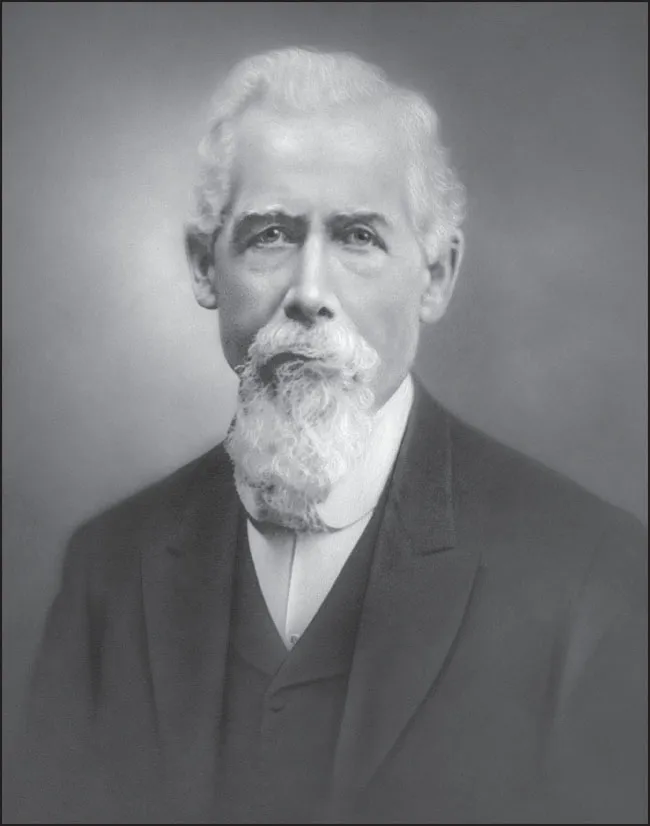
David McKay, bishop of the Huntsville Ward, was a founding member of the Weber Stake Academy Board of Education. He served as a member of the board from 1888 to 1908. He was elected a member of the first Utah state legislature and served in the state senate. McKay was a stockholder in several canal companies, the Huntsville Cooperative Mercantile Institution, and the Ogden Valley Creamery Company.

The first principal of Weber Stake Academy was Louis Frederick Moench. As principal, he was also a founding member of the Board of Education. He was considered one of the most notable early educators in Utah, as he taught in the Salt Lake City Academy (now University of Utah) and Deseret University (now Brigham Young University) before moving to Weber Stake Academy. Moench served two terms as principal—from 1888 to 1892 and again from 1894 to 1902, a move that kept the school from closing. During his tenure, he also taught classes in several subjects, including theology and penmanship. Because of his strong influence, the first building constructed was named in his honor. When the campus moved from the downtown location to its current site in the foothills, a statue was created in honor of Moench and plac...
Table of contents
- Cover Page
- Title Page
- Copyright Page
- Dedication
- Table of Contents
- Acknowledgments
- Introduction
- 1. The Birth: Stake to State, 1889 to 1933
- 2. The Move: Jefferson to Harrison, 1933 to 1963
- 3. The Growth: College to University, 1963 to 1991
- 4. The Anniversary: 125 Years Realized, 1991 to 2014
- Bibliography
Frequently asked questions
Yes, you can cancel anytime from the Subscription tab in your account settings on the Perlego website. Your subscription will stay active until the end of your current billing period. Learn how to cancel your subscription
No, books cannot be downloaded as external files, such as PDFs, for use outside of Perlego. However, you can download books within the Perlego app for offline reading on mobile or tablet. Learn how to download books offline
Perlego offers two plans: Essential and Complete
- Essential is ideal for learners and professionals who enjoy exploring a wide range of subjects. Access the Essential Library with 800,000+ trusted titles and best-sellers across business, personal growth, and the humanities. Includes unlimited reading time and Standard Read Aloud voice.
- Complete: Perfect for advanced learners and researchers needing full, unrestricted access. Unlock 1.5M+ books across hundreds of subjects, including academic and specialized titles. The Complete Plan also includes advanced features like Premium Read Aloud and Research Assistant.
We are an online textbook subscription service, where you can get access to an entire online library for less than the price of a single book per month. With over 1.5 million books across 990+ topics, we’ve got you covered! Learn about our mission
Look out for the read-aloud symbol on your next book to see if you can listen to it. The read-aloud tool reads text aloud for you, highlighting the text as it is being read. You can pause it, speed it up and slow it down. Learn more about Read Aloud
Yes! You can use the Perlego app on both iOS and Android devices to read anytime, anywhere — even offline. Perfect for commutes or when you’re on the go.
Please note we cannot support devices running on iOS 13 and Android 7 or earlier. Learn more about using the app
Please note we cannot support devices running on iOS 13 and Android 7 or earlier. Learn more about using the app
Yes, you can access Weber State University by Jamie J. Weeks,Kandice N. Harris in PDF and/or ePUB format, as well as other popular books in History & Education General. We have over 1.5 million books available in our catalogue for you to explore.