- 128 pages
- English
- ePUB (mobile friendly)
- Available on iOS & Android
eBook - ePub
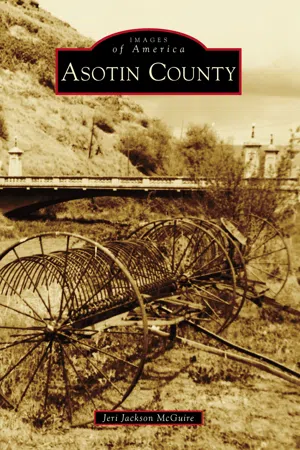
Asotin County
About this book
Asotin, Anatone, Cloverland, Clarkston, and Silcott are all towns within Asotin County, an area rich in local history. Names like Lewis and Clark, Chief Joseph, Capt. Benjamin Bonneville, Capt. Edward Steptoe, Chief Looking Class, Chief Timothy, and Henry Spaulding all had early ties to the area. Asotin was carved out of Garfield County on October 27, 1883. There are fascinating stories of early pioneers, such as Weissenfels, Floch, Wilson, Stone, Critchfield, Halsey, and many more, who came from far and wide to settle the area, becoming farmers, building towns, and establishing an irrigation system. Through the years, Asotin has encountered floods, murders, hangings, a disastrous fire, and a fight to retain the county seat. At one point, the residents thought they might have to battle the Nez Perce Indians, but they were peaceful and very kind to the people.
Trusted by 375,005 students
Access to over 1.5 million titles for a fair monthly price.
Study more efficiently using our study tools.
Information
One
A NEW WORLD
HOW ASOTIN COUNTY EVOLVED
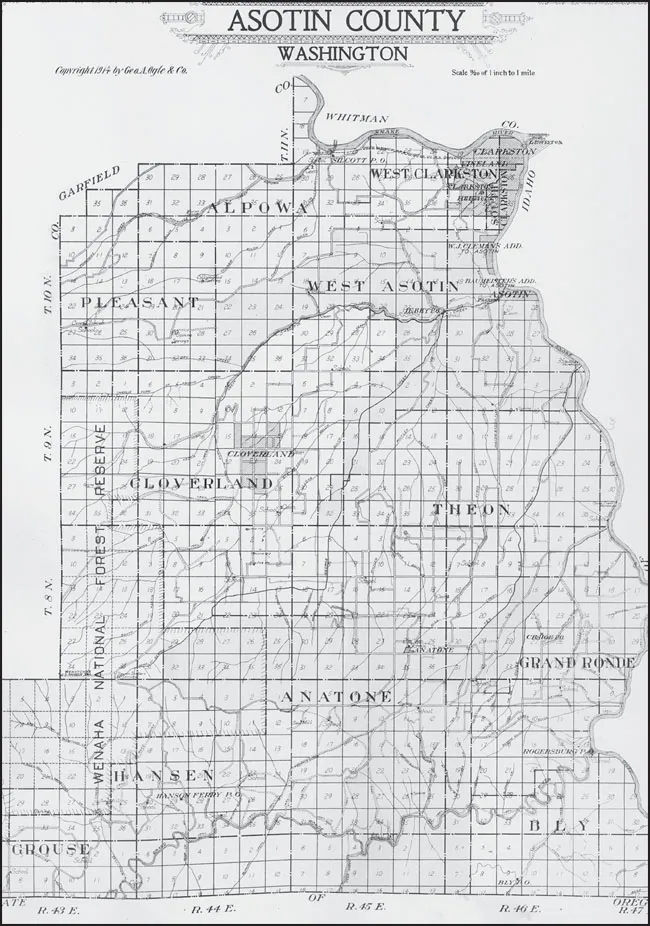
Asotin County was first a part of both Walla Walla County and Columbia County, which comprised a total of three counties—Asotin, Garfield, and Colombia. They were divided into three separate counties by the territorial legislature on November 11, 1875. Belle Critchfield used to say that she lived in three counties without ever having to move. (Courtesy of Marla Wilson Doty.)

On their journey to discover the West, Lewis and Clark camped with Chief Timothy on the banks of the Clearwater River. The spot that is Asotin today was originally the summer camping ground of the Nez Perce Indians. Author Washington Irving wrote in his book The Adventures of Captain Bonneville that Captain Bonneville left the military to become an explorer and was one of the first white men to travel to the area. At first, the Indians were shocked when they saw Bonneville, as he was bald then, thinking he had been scalped. From then on he was referred to as the Bald Chief. (Author’s collection.)

Apash Wyakaikt acquired his more familiar English moniker, Chief Looking Glass, upon meeting expedition leaders William Clark and Meriwether Lewis for the first time in 1805. They distributed gifts of small, circular metal mirrors with an eyelet attached to the rim of each through which a cord could be tied. (Courtesy of the Asotin County Museum.)

For centuries before the first non-Indians reached the Northwest, this spot near the confluence of what are now known as Asotin Creek and the Snake River was a favorite winter resort for Indians of the region. A relatively warm winter climate and an abundance of freshwater eel in the mouth of the creek attracted a large annual encampment of Alpowai Nez Perce Indians. (Courtesy of Gary Hanchett.)

Captain Bonneville also had the pleasure of meeting Chief Looking Glass. He hosted Bonneville at his winter home near Asotin in February 1834. Bonneville and his party enjoyed a great feast, fine accommodations, and an array of entertainment for one night before pressing on towards Walla Walla. (Courtesy of Phyllis Hower Keith.)

Chief Timothy assisted Col. Edward Steptoe and helped lead his column to safety after being besieged by Cayuse and Palouse warriors near Rosalia, Washington. Timothy’s band lived on the Snake River, just above present-day Lewiston. He was one of the Nez Perce leaders to sign the 1863 treaty. Timothy did not participate in the 1877 war and died in 1891. (Author’s collection.)
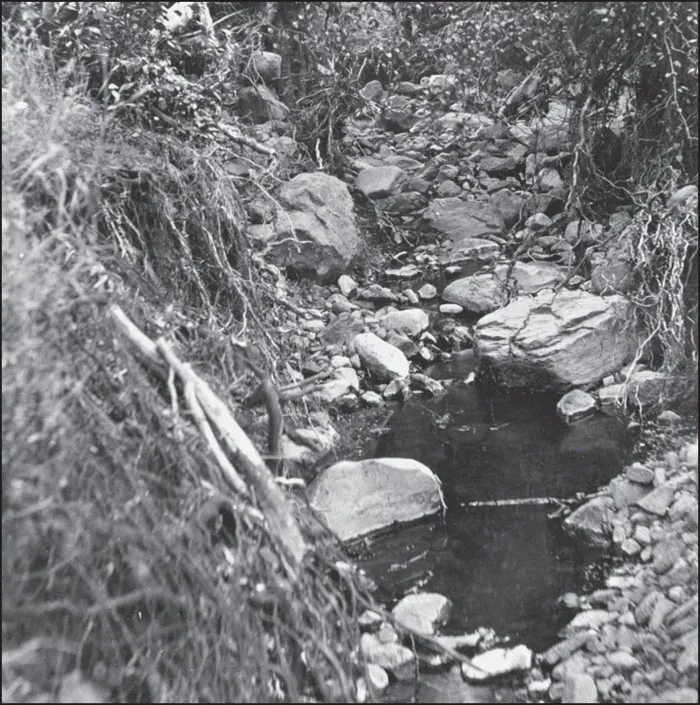
The territory that is now Asotin County was once part of an Indian reservation in 1857. The reservation was a large territory halfway between Alpowa and Pataha; it eventually encompassed all of present-day Asotin. Asotin was named after the Indian word Has-shu-in, meaning “eel,” as there were many eels in the Snake River. (Courtesy of Gary Hanchett.)

On either side of an area known as Buffalo Eddy, formed by a series of sharp bends in the Snake River, are found densely grouped clusters of petroglyphs and a few pictographs. These fascinating artifacts are evidence of the longevity of the Nez Perce in the region and contain hundreds of distinct images that possibly date from as early as 4,500 years ago. (Courtesy of the Asotin County Museum.)

Previous to the Nez Perce war, the Indians and the white man lived in perfect harmony, with most of the Indians being held in high esteem for their honesty and friendliness. Chief Timothy remained loyal to the white man throughout, but some Asotin Indians joined Chief Joseph and went on the warpath. (Courtesy of Sherri Ross Willenborg.)

During the Nez Perce war, a few families in the Anatone region began to panic and fled. The settlers held on and decided to hold their homes but made preparations to defend themselves in case of attack. The residences of Jerry Maguire and William Hopwood were converted into forts. Fortunately for the pioneers, the Indians never crossed the Snake River. (Courtesy of Gary Hanchette.)
Two
WELCOME TO HARD TIMES
THE PIONEERS

John Henry Schiebe attained his squatter’s rights in 1878, James Sangster arrived around 1877, and Bradshaw Hodges was the first registered homesteader in the Cloverland area in 1878. Later, Melvin Fred Reeves came from North Carolina in the 1900s, as well as the Nelsons, the Favors, the Nichols, the Ausmans, the McFarlands, and many more. Space does not permit naming them all, but some of the others will appear later in the book. (Courtesy of the Asotin County Museum.)
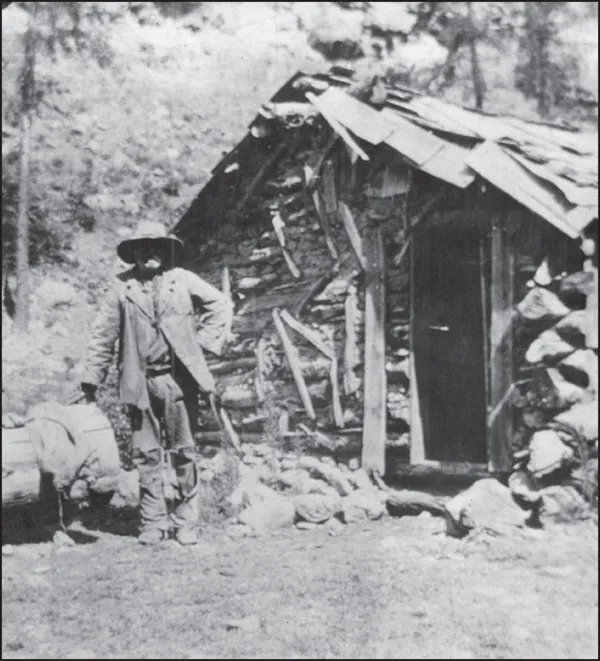
Robert “Bob” Bracken (1841–1906), pictured here, was the first man to settle in Asotin. Sam Smith had moved in near the confluence of Alpowa Creek and the Snake River. Smith opened a store and hotel to service travelers heading to and from the Orofino gold mines in Idaho. Smith soon left the region. Bracken established his first permanent home eight miles south of present-day Asotin in 1862. (Courtesy of the Asotin County Museum.)

Jenny and Henry Critchfield were two of the oldest pioneers. He was one of the founding fathers, a town leader, and one of the commissioners. He hauled trees for timber but also planted trees on Asotin’s Main Street, and prepared land for Asotin Park. They built a home on Critchfield Ri...
Table of contents
- Cover Page
- Title Page
- Copyright Page
- Dedication
- Table of Contents
- Acknowledgments
- Introduction
- 1. A New World: How Asotin County Evolved
- 2. Welcome to Hard Times: The Pioneers
- 3. A River Runs through It: Asotin
- 4. No Country for Old Men: Anatone, Cloverland, and More
- 5. True Grit: Disasters, Hangings, Floods, and the Chinese Massacre
- 6. Little House on the Prairie: Schools, Lodges, and Post Offices
- 7. The Day of the Cowboys: Asotin County Rodeo and Fair
- 8. Destry Rides Again: Clarkston, Aplowa, and Peola
Frequently asked questions
Yes, you can cancel anytime from the Subscription tab in your account settings on the Perlego website. Your subscription will stay active until the end of your current billing period. Learn how to cancel your subscription
No, books cannot be downloaded as external files, such as PDFs, for use outside of Perlego. However, you can download books within the Perlego app for offline reading on mobile or tablet. Learn how to download books offline
Perlego offers two plans: Essential and Complete
- Essential is ideal for learners and professionals who enjoy exploring a wide range of subjects. Access the Essential Library with 800,000+ trusted titles and best-sellers across business, personal growth, and the humanities. Includes unlimited reading time and Standard Read Aloud voice.
- Complete: Perfect for advanced learners and researchers needing full, unrestricted access. Unlock 1.5M+ books across hundreds of subjects, including academic and specialized titles. The Complete Plan also includes advanced features like Premium Read Aloud and Research Assistant.
We are an online textbook subscription service, where you can get access to an entire online library for less than the price of a single book per month. With over 1.5 million books across 990+ topics, we’ve got you covered! Learn about our mission
Look out for the read-aloud symbol on your next book to see if you can listen to it. The read-aloud tool reads text aloud for you, highlighting the text as it is being read. You can pause it, speed it up and slow it down. Learn more about Read Aloud
Yes! You can use the Perlego app on both iOS and Android devices to read anytime, anywhere — even offline. Perfect for commutes or when you’re on the go.
Please note we cannot support devices running on iOS 13 and Android 7 or earlier. Learn more about using the app
Please note we cannot support devices running on iOS 13 and Android 7 or earlier. Learn more about using the app
Yes, you can access Asotin County by Jeri Jackson McGuire in PDF and/or ePUB format, as well as other popular books in History & North American History. We have over 1.5 million books available in our catalogue for you to explore.