- 128 pages
- English
- ePUB (mobile friendly)
- Available on iOS & Android
eBook - ePub
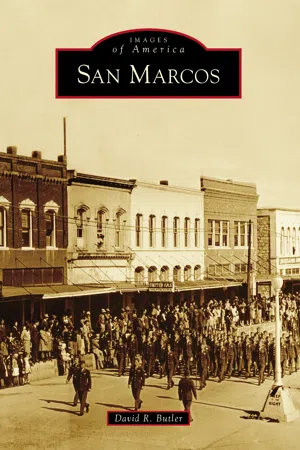
San Marcos
About this book
San Marcos, Texas, permanently settled in 1846, was founded by former members of John C. Hays's company of Texas Rangers. The town was designated the county seat of Hays County by the Texas legislature in 1848 and was formally laid out in 1851. A center for local commerce associated with cattle and cotton production, San Marcos became an educational center with the chartering in 1899 and subsequent opening in 1903 of the Southwest Texas State Normal School. The normal school is now Texas State University, the fourth largest university in Texas with more than 36,000 students. This volume tells the story of a formerly sleepy college town on the edge of the Texas Hill Country that has become the fastest-growing city in the United States.
Trusted by 375,005 students
Access to over 1 million titles for a fair monthly price.
Study more efficiently using our study tools.
Information
One
SAN MARCOS
THE EARLY DAYS
The presence of the permanently flowing San Marcos Springs has attracted settlers to what is now San Marcos for thousands of years. Mastodon bones and Clovis point arrowheads from the area date back to more than 12,000 years ago. Spanish attempts at colonizing the area began in 1755 but were short-lived and abandoned by 1812.
In 1846, the first Anglos settled in the vicinity of San Marcos Springs and along the San Marcos River. These settlers were former members of John “Jack” C. Hays’s company of Texas Rangers and included Thomas G. McGehee and William W. Moon, identified as the first resident of the site that became San Marcos proper. In 1848, Edward Burleson (a former vice president of the Republic of Texas), together with Eli Merriman and William Lindsey, founded what would become the community of San Marcos. That same year, the Texas legislature organized Hays County, created from the southern end of Travis County to the north, and designated the young community of San Marcos as the county seat. The City of San Marcos recognizes 1851 as the official year the town was founded, with the filing of an official plat of the town’s layout.
In the years leading up to the Civil War, San Marcos was primarily an agricultural community. In the 1850 census, San Marcos had 387 residents, of whom 128 were slaves owned by 19 families. By 1860, thirty-seven percent of the population of San Marcos was slaves. When the Civil War began, many men of San Marcos served in the Confederate army. Following the war, many displaced Southerners moved west and settled in San Marcos. San Marcos incorporated in 1877, and by the 20th century, it flourished as a cotton-producing center. This growth was assisted by the arrival of the railroad in 1881, linking San Marcos to San Antonio and Austin with more rapid transportation. In 1870, San Marcos’s population was only 742, but it jumped to over 2,300 in the decade following the railroad’s arrival. In the mid-1890s, the US Fish and Wildlife Service established the first warm-water hatchery west of the Mississippi River, near the headwaters of the San Marcos River. The hatchery was focused on production and development of efficient cultural techniques of warm-water sport fish.

JACK HAYS, NAMESAKE FOR HAYS COUNTY. Hays County, Texas, of which San Marcos is the county seat, is named after John Coffee “Jack” Hays (1817–1883). Born in Tennessee, Hays came to Texas in 1836. He only lived in Texas for 13 years, but during that time was a leader in the Texas Rangers during the Mexican-American War. He moved to California in 1849 during the Gold Rush. (HCHC.)

EDWARD BURLESON, SAN MARCOS PIONEER. Born in North Carolina, Edward Burleson (1798–1851) came to Texas in 1831 and settled near Bastrop, northeast of what would become San Marcos. This 1850 daguerreotype is the only known photographic image of Burleson. In 1848, Burleson introduced a resolution to establish Hays County and donated the land for the courthouse in what was to become San Marcos. (TSLAC.)

BURLESON HOMESTEAD. This image of the Burleson Homestead in San Marcos is taken from an old postcard. It shows the cabin’s east side. According to the Center for Archaeological Studies at Texas State University, it is thought that the postcard photograph was taken after the family had abandoned the cabin but prior to its collapse in a heavy rainstorm in 1917. (SMPL.)

HISTORIC MERRIMAN HOME IN SAN MARCOS. Eli Merriman, one of the original founders of San Marcos, established his homestead along the southern banks of the San Marcos River. His cabin has subsequently been moved twice and existed for several years as an attraction at the Aquarena Springs Resort. When Texas State University acquired that resort, the university gifted the cabin to the Heritage Association of San Marcos, and it was relocated to the Veramendi Plaza history park on C.M. Allen Parkway.

CHARLES S. COCK HOUSE. The Charles S. Cock House, erected in 1867, is the oldest remaining residential building in San Marcos. It is a modest Vernacular Greek Revival structure and today serves as a museum as well as the home of Cottage Kitchen, where volunteers prepare a home-cooked lunch on Fridays from 11:00 a.m. to 1:00 p.m.

OLD “SECOND” HAYS COUNTY JAIL. Pictured here in 1966, the old Hays County Jail is located on Fredericksburg Street not far from the courthouse square. The building, designed in the Italianate style, is a two-story limestone block structure. This jailhouse, designed by Edward Northcraft, was completed in 1885 and served as the county jail until 1936. (SMPL.)

GRISTMILL AT SPRING LAKE DAM. This 1906 real-photo postcard features an old waterwheel at the site where Edward Burleson dammed the San Marcos River and created Spring Lake in 1849. He built a gristmill at the site, for which this waterwheel presumably served as the power source. Today, a popular local restaurant sits at this site. (SMPL.)

OLD EAST END SCHOOL CLASS. Pictured here is the class of 1912–1913 at the Old East End School on Wood Street. In 1912, the San Marcos School Board began a partnership with Southwest Texas State Normal School to allow students there to teach local children. The San Marcos East End Ward School (the first eight grades of the school district) was moved onto the normal school campus in 1917. (SMPL.)

HISTORIC FIRST BAPTIST CHURCH, DUNBAR DISTRICT. The old First Baptist Church, built in 1908 on Comal (now M.L. King) Street, is shown here in the early 20th century with its ori...
Table of contents
- Cover Page
- Title Page
- Copyright Page
- Dedication
- Table of Contents
- Acknowledgments
- Introduction
- 1. San Marcos: The Early Days
- 2. Downtown San Marcos: Change over the Years
- 3. Texas State: From Teachers’ College to Emerging Research University
- 4. San Marcos’s Most Famous Citizen: LBJ
- 5. The Town Lifeline: Spring Lake and the San Marcos River
- 6. Around Town: Icons and Landmarks
- 7. Modern Destinations: Town Growth and the Outlet Mall
- Bibliography
Frequently asked questions
Yes, you can cancel anytime from the Subscription tab in your account settings on the Perlego website. Your subscription will stay active until the end of your current billing period. Learn how to cancel your subscription
No, books cannot be downloaded as external files, such as PDFs, for use outside of Perlego. However, you can download books within the Perlego app for offline reading on mobile or tablet. Learn how to download books offline
Perlego offers two plans: Essential and Complete
- Essential is ideal for learners and professionals who enjoy exploring a wide range of subjects. Access the Essential Library with 800,000+ trusted titles and best-sellers across business, personal growth, and the humanities. Includes unlimited reading time and Standard Read Aloud voice.
- Complete: Perfect for advanced learners and researchers needing full, unrestricted access. Unlock 1.4M+ books across hundreds of subjects, including academic and specialized titles. The Complete Plan also includes advanced features like Premium Read Aloud and Research Assistant.
We are an online textbook subscription service, where you can get access to an entire online library for less than the price of a single book per month. With over 1 million books across 990+ topics, we’ve got you covered! Learn about our mission
Look out for the read-aloud symbol on your next book to see if you can listen to it. The read-aloud tool reads text aloud for you, highlighting the text as it is being read. You can pause it, speed it up and slow it down. Learn more about Read Aloud
Yes! You can use the Perlego app on both iOS and Android devices to read anytime, anywhere — even offline. Perfect for commutes or when you’re on the go.
Please note we cannot support devices running on iOS 13 and Android 7 or earlier. Learn more about using the app
Please note we cannot support devices running on iOS 13 and Android 7 or earlier. Learn more about using the app
Yes, you can access San Marcos by David R. Butler in PDF and/or ePUB format, as well as other popular books in History & North American History. We have over one million books available in our catalogue for you to explore.