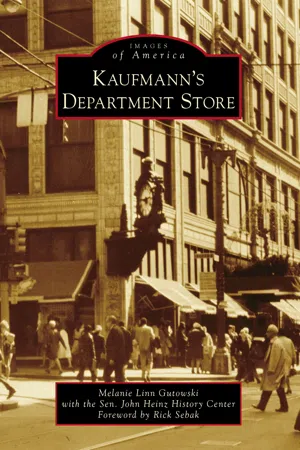
- 128 pages
- English
- ePUB (mobile friendly)
- Available on iOS & Android
eBook - ePub
Kaufmann's Department Store
About this book
Kaufmann's Department Store was a force in Pittsburgh retail from its humble beginnings in 1871 until its merger with Federated Department Stores in 2006.
The "Big Store" downtown was a landmark shopping emporium with 12 floors of everything from cosmetics and groceries to wedding gowns and lawn mowers. Under the leadership of Edgar J. Kaufmann and his wife, Liliane, the store became a forum for exhibitions of art, cutting-edge technology, and Parisian haute couture. Generations of Pittsburghers hold fond memories of meeting friends and family under the famous Kaufmann's clock to lunch at the Tic Toc Restaurant, pick up cookies at the Arcade Bakery, or peer into the store's enchanting Christmas window displays each December.
Trusted by 375,005 students
Access to over 1.5 million titles for a fair monthly price.
Study more efficiently using our study tools.
Information
One
BEGINNINGS
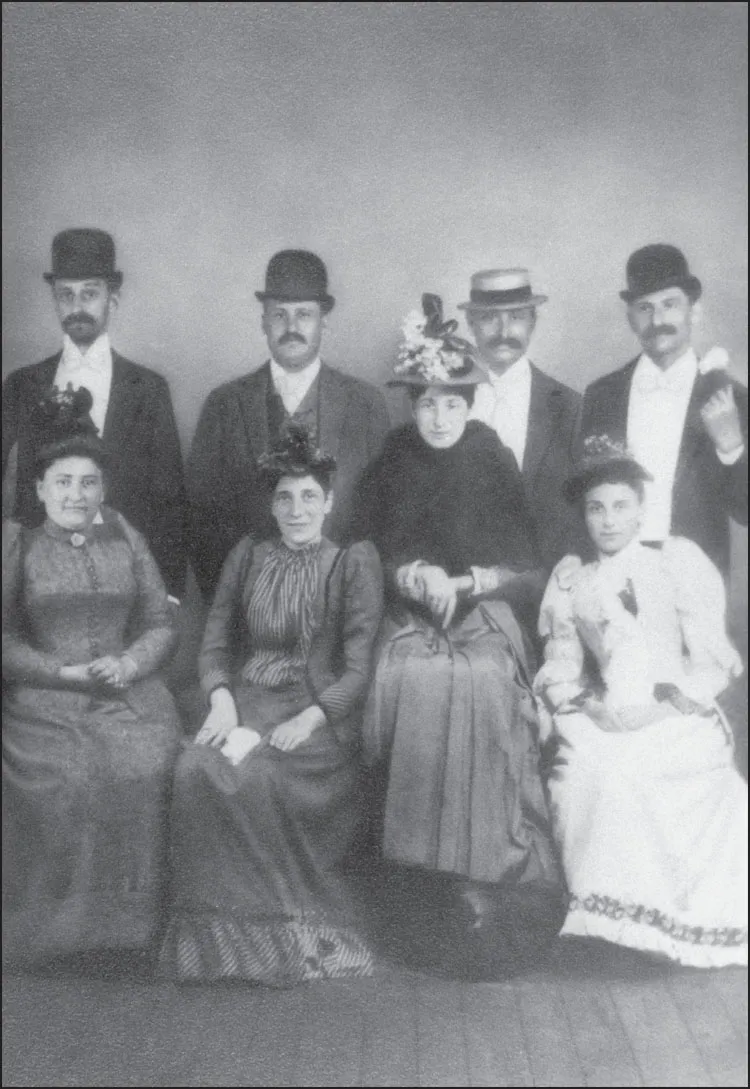
The founding generation of Kaufmann’s Department Store is seen here in the 1890s along with their wives. From left to right are Jacob and Augusta, Henry and Theresa, Morris and Betty, and Isaac and Emma. Morris and Betty were the parents of Edgar J. Kaufmann, the longtime visionary chairman of the company. Isaac and Emma were the parents of Edgar’s future wife, Lillian.
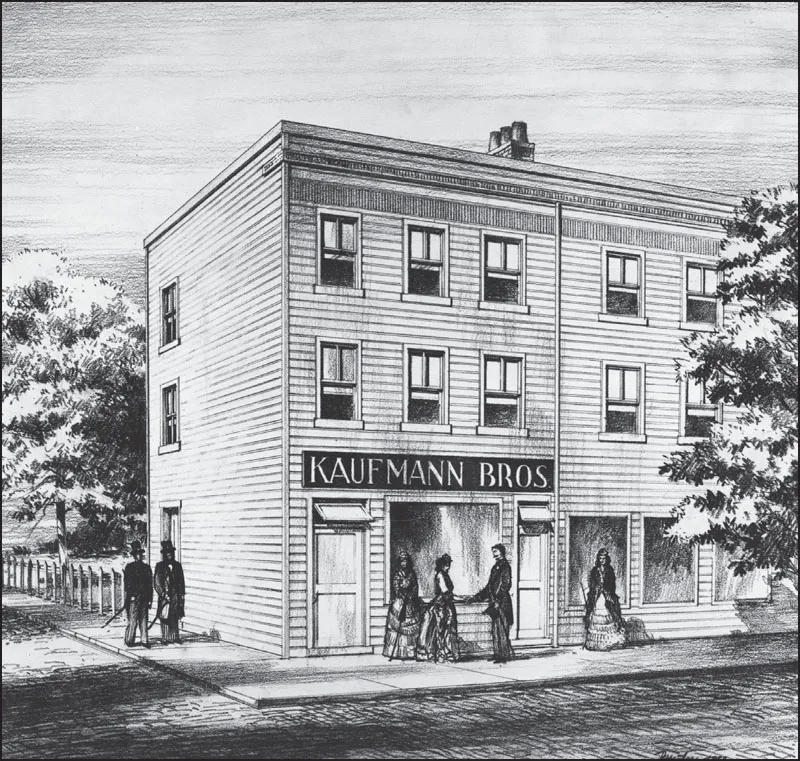
Jacob and Isaac Kaufmann opened the family’s first store, J. Kaufmann & Bro., in 1871 at 1916 Carson Street in the town of Birmingham, now known as Pittsburgh’s South Side. The single-floor shop specialized in men’s clothing, particularly in suits custom-made by the Kaufmanns themselves. Brother Morris Kaufmann arrived from Germany in 1872, shortly after the brothers had moved to a slightly larger store at 1932 Carson Street.
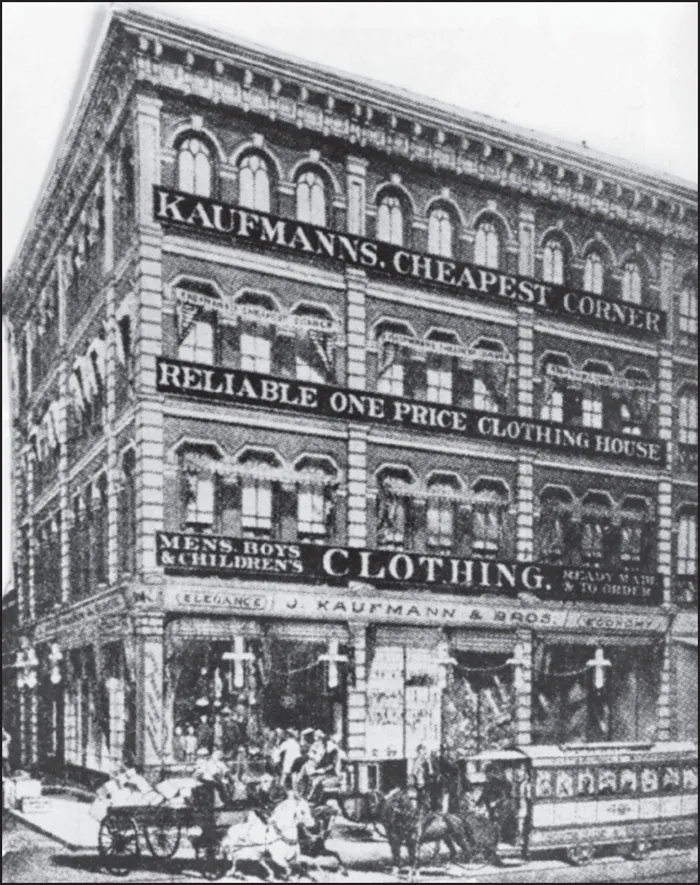
In 1875, the Kaufmann brothers opened a branch store in Allegheny City, now Pittsburgh’s North Side. They soon closed both that store and their Carson Street shop in favor of a larger store in downtown Pittsburgh. By this time, brother Isaac had immigrated and joined the business, now known as Kaufmann’s Cheapest Corner. Opened in 1879, the new four-story building sat at the corner of modern-day Forbes Avenue (then known as Diamond Alley) and Smithfield Street. In 1882, a grand staircase and “electric burners” (electric lights) were installed, the first steps of many to modernize Kaufmann’s.
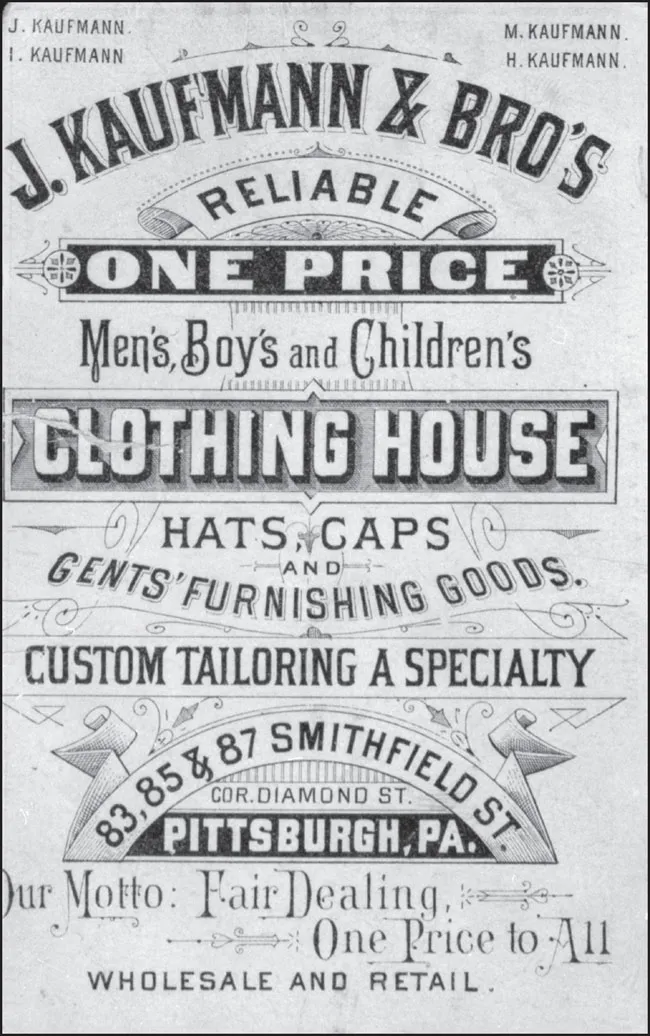
Once the Kaufmann brothers had a foothold on a major downtown Pittsburgh thoroughfare, their store began to grow down the block of Smithfield Street toward Fifth Avenue. This c. 1883 advertisement shows that J. Kaufmann & Bro. occupied 83, 85, and 87 Smithfield Street.

In 1885, the Kaufmann brothers began construction on a new store at the corner of Smithfield Street and Fifth Avenue. This building became known as Kaufmann’s Grand Depot and cost $60,000 to build. It opened in 1885 to great fanfare and, in 1886, the company added women’s clothing to its offerings.

Kaufmann’s Grand Depot truly lived up to its name with its dramatic turret on the corner of Smithfield Street and Fifth Avenue, topped by a statue of the allegorical figure Liberty, her torch lighted by natural gas.

This late 1880s advertising piece shows the first-floor interior of the Grand Depot from the Smithfield Street entrance. This store had electricity from its opening day, a necessity with such a large area to light. Daylight from the building’s large windows alone would not have sufficed.

The reverse of the same advertising piece shows a view of “the largest clothing floor in the country,” including measurements. The store also featured a large auto supply department that produced its own catalog in 1912, before auto supply shops became commonplace.

Between 1891 and 1913, Kaufmann’s acquired the remainder of their block along both Smithfield Street and Fifth Avenue. In 1898, the company commissioned architect Charles Bickel to design a new expansion at the Forbes Avenue end of the block, to the right of the Grand Depot building. Bickel’s building remains in place today.

These photographs, both taken on April 9, 1912, at the corner of Smithfield and Diamond Streets (formerly Diamond Alley and now Forbes Avenue), show the new building Charles Bickel designed for Kaufmann’s. Note the Belle Epoque–style awning, reminiscent of the grand department stores of Europe. These entrances led to a hub of bargain shopping in what the company then called its Annex Shops. (Both, courtesy of the University of Pittsburgh Archives Service Center.)


This c. 1930s image shows the façade detail of the upper floors of the Charles Bickel building (right). The building at left was constructed in 1913 by the firm of Janssen & Abbott. Together, these two buildings occupied the entire block of Smithfield Street between Fifth and Forbes Avenues extending back to Cherry Way.
Two
THE MERCHANT PRINCE AND
PRINCESS BUILD AN EMPIRE
PRINCESS BUILD AN EMPIRE
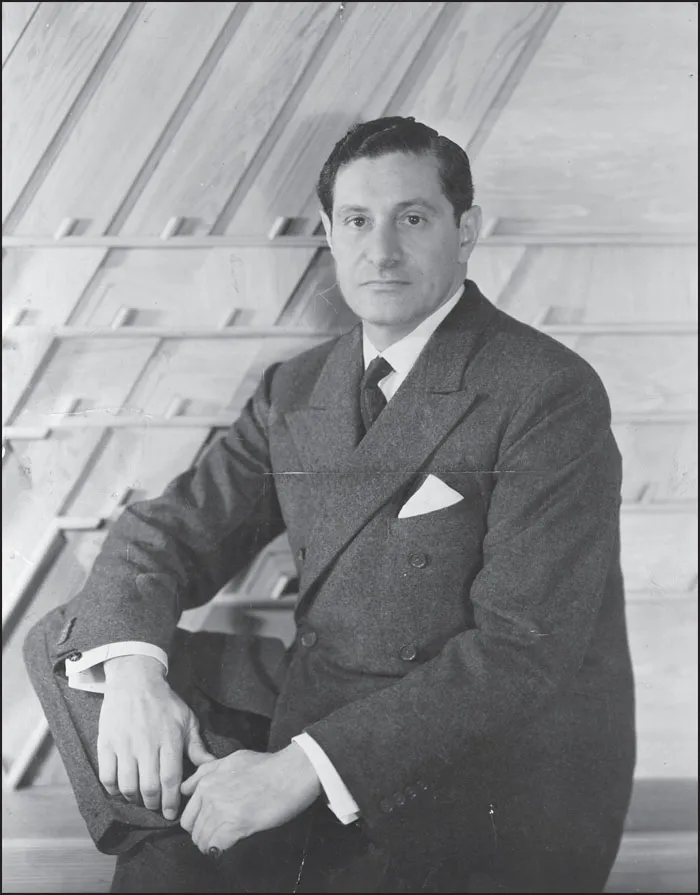
Edgar Jonas Kaufmann (1885–1954), son of store cofounder Morris Kaufmann, became known in the popular press as “the merchant prince” due to his status as the heir to the business his father and uncles had built. E.J., as he was called, began working in the family business in 1909 as a shipping clerk and worked his way up to company president in 1913. That same year, after he and his father bought out the shares of seven co-owners, E.J. incorporated the business as Kaufmann Department Stores Inc.
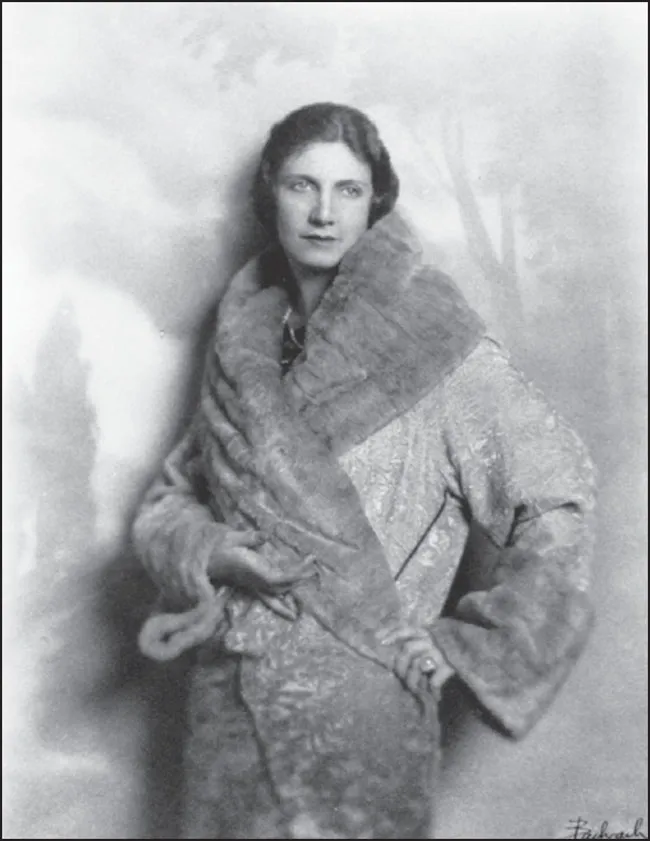
Lillian Kaufmann (1889–1952) was the only daughter of Kaufmann’s cofounder Isaac Kaufmann. She married her first cousin E.J. Kaufmann in 1909, consolidating much of th...
Table of contents
- Cover Page
- Title Page
- Copyright Page
- Dedication
- Table of Contents
- Foreword
- Acknowledgments
- Introduction
- 1. Beginnings
- 2. The Merchant Prince and Princess Build an Empire
- 3. Meet Me under the Clock
- 4. After the Merchant Prince
- 5. Everything under the Sun
- 6. Window Shopping
- 7. Every Convenience
- 8. For Everything under the Tree
- 9. Expansion
- 10. Last Days
- Bibliography
- About the Organization
Frequently asked questions
Yes, you can cancel anytime from the Subscription tab in your account settings on the Perlego website. Your subscription will stay active until the end of your current billing period. Learn how to cancel your subscription
No, books cannot be downloaded as external files, such as PDFs, for use outside of Perlego. However, you can download books within the Perlego app for offline reading on mobile or tablet. Learn how to download books offline
Perlego offers two plans: Essential and Complete
- Essential is ideal for learners and professionals who enjoy exploring a wide range of subjects. Access the Essential Library with 800,000+ trusted titles and best-sellers across business, personal growth, and the humanities. Includes unlimited reading time and Standard Read Aloud voice.
- Complete: Perfect for advanced learners and researchers needing full, unrestricted access. Unlock 1.5M+ books across hundreds of subjects, including academic and specialized titles. The Complete Plan also includes advanced features like Premium Read Aloud and Research Assistant.
We are an online textbook subscription service, where you can get access to an entire online library for less than the price of a single book per month. With over 1.5 million books across 990+ topics, we’ve got you covered! Learn about our mission
Look out for the read-aloud symbol on your next book to see if you can listen to it. The read-aloud tool reads text aloud for you, highlighting the text as it is being read. You can pause it, speed it up and slow it down. Learn more about Read Aloud
Yes! You can use the Perlego app on both iOS and Android devices to read anytime, anywhere — even offline. Perfect for commutes or when you’re on the go.
Please note we cannot support devices running on iOS 13 and Android 7 or earlier. Learn more about using the app
Please note we cannot support devices running on iOS 13 and Android 7 or earlier. Learn more about using the app
Yes, you can access Kaufmann's Department Store by Melanie Linn Gutowski,The Senator John Heinz History Center in PDF and/or ePUB format, as well as other popular books in History & Business History. We have over 1.5 million books available in our catalogue for you to explore.