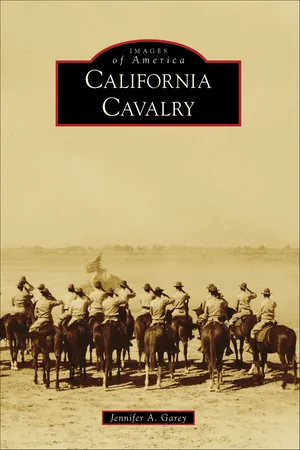
California was home to the one of the first Native American cavalries and one of the first African American cavalries, commonly known as the Buffalo Soldiers. It was in California where the country saw the last official military cavalry in operation. California Cavalry displays the history of cavalry battalions and regiments, detailing a critical and controversial period and the eventual change from horse to mechanized technology. This book attempts to approach the topic of the cavalry in California both from indigenous and from military perspectives. Geographic regions are expanded beyond California to give context and continuity to the movement of military operations.
- 128 pages
- English
- ePUB (mobile friendly)
- Available on iOS & Android
eBook - ePub
California Cavalry
About this book
Trusted by 375,005 students
Access to over 1 million titles for a fair monthly price.
Study more efficiently using our study tools.
Information
One
CAVALRY SENT WEST
The photographs in this section depict the early period of California history. It was a period of power struggles between the Californio rancheros, indigenous nations, and Mexico. In 1846, Pres. James K. Polk and Secretary of War William Marcy ordered Col. Stephen W. Kearney, commander of the 1st Dragoons, the early 1st Cavalry, to march into California and seize Monterey and San Francisco. Polk and his administration wanted to ensure that, if peace agreements were made with Mexico, the United States would achieve military control of California.
Cavalry regiments sent into the Western United States were tasked with forcibly acquiring real estate, maintaining a power position through either violent means or forced treaties, and controlling newly acquired land. This included processes of attempted extermination and relocation of Native Americans, the owners of the real estate. It also included establishing military posts, towns, and rail lines to claim the land and protect the new white westward immigration across the continent, and it included the planned systematic extermination of the Plains Indians’ main resource, the buffalo.

Pictured are the officers of Troops D and L of the 1st Cavalry, also known as the Machine Gun Platoon and Field Artillery Battery. From left to right are (sitting) Lieutenant Haiz; Captain Poillon, 1st Cavalry, Troop D, commander; Captain Harbord, 1st Cavalry, Troop L; Captain Hilton; and Lieutenant Van Kirk, MD; (standing) Lieutenant Kabbi, 1st Cavalry, Troop L; Lieutenant Bell, 1st Cavalry, M.C. Platoon; Lieutenant Brown, 1st Cavalry, Troop D; Lieutenant Wainwright, 1st Cavalry, Troop L; and Lieutenant Spencer, 1st Cavalry, Troop D. Hilton’s dog, Tony, is also pictured. (NARA 106817.)

The 4th Cavalry Orchestra is pictured at Fort Bowie after Geronimo’s surrender in 1886. Geronimo (Mescalero Chiricahua) Goyathlay was a leader of the Bedonkohe Apache Nation. In 1858, Mexican soldiers attacked and killed his mother, wife, and three children, after which he pursued and fought Mexico and the United States for several decades. Some of the people identified in the photograph are William A. Raymond, Charles Kimball, Peter Siteloronor, Thomas O’Brien, and John J. Kelley. (NARA 87373.)

Captain Keogh’s horse Comanche was the sole survivor of the Custer massacre. Comanche was captured somewhere on the southern plains and brought to a remount station in St. Louis, Missouri, in 1868. There, he was broken in and then shipped to Fort Leavenworth. At the fort, he was selected to be loaded on a train bound for Ellis Station, where the 7th Cavalry was encamped. He arrived at the encampment on May 19, 1868, and caught the eye of Captain Keogh, and they were inseparable until the Battle of Little Bighorn in June 1876. (NARA 111-SC-83342.)

Originally ruled by Mexico, the Presidio in San Francisco came under the control of the United States in 1846. With the discovery of gold in California in 1849, the US government established the Presidio as a permanent military post. During the 1870s through the 1880s, the Presidio was camp to many cavalry regiments ordered to fight the Modoc Nation in Northern California and the Apache Nation in the southwest plains. (NARA 87839.)
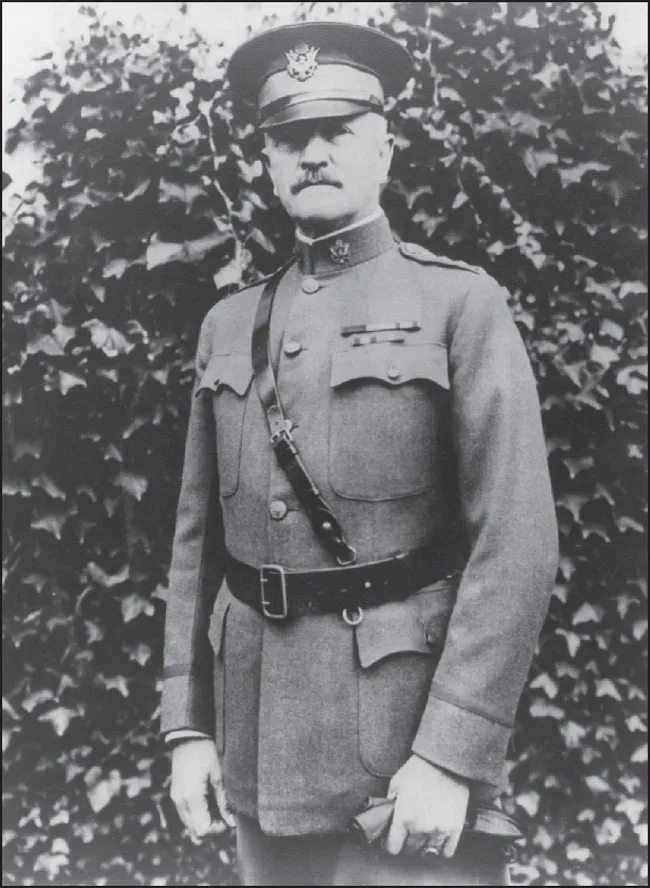
In 1914, Gen. John J. “Black Jack” Pershing commanded the 8th Cavalry, dispatched from the Presidio to pursue Mexican revolutionary Francisco “Pancho” Villa. While Pershing was on the expedition, his wife, Frances, and their three daughters perished in a fire; only their five-year-old son, Warren, survived. (NARA 87841.)

Maj. Gen. Arthur McArthur, who changed his name to “MacArthur” after the Civil War, was commissioned a brigadier general in 1896. He fought in the Spanish-American War and was appointed military governor of the Philippines from 1900 to 1901 during the American occupation. He died of a massive heart attack on September 5, 1912, while addressing a reunion of veterans from the 24th Wisconsin Infantry. Here, he is seen commanding a review of troops at the Presidio of San Francisco in 1904. (NARA 83641.)

Maj. Gen. Arthur McArthur was father to Douglas MacArthur, the first father and son to both be awarded the Medal of Honor. Here, Maj. Gen. Arthur McArthur is seen commanding a review of troops at the Presidio in 1904. (NARA 83640.)

Pictured here is Fort Yuma, known for its relentless heat. Gen. George C. Thomas, commander from 1851 to 1855, recollected: “One of the most disagreeable posts garrisoned by the Army ... 116 degrees in the shade. Sleep before midnight was impossible and then only on the rooftops.” (NARA 87799.)

Officers stationed at Benicia Barracks, California, in January 1896, pose for a photograph. Many of these men were later to be stationed in Yosemite National Park. Third from right appears to be Merritte Weber Ireland, who became the US surgeon general from October 4, 1918, to May 31, 1931. (NARA 103752.)

Camp Merritt in San Francisco is pictured in 1898. The camp was also known as the “Concourse,” a trotting racetrack south of the Presidio and north of Golden Gate Park. It became Camp Merritt on May 29, 1898, and operated only long enough for a fleet to be assembled for the 18,000 troops disembarking for the Philippines. (NARA 82962.)

When Fort Bidwell was established in 1865, the cavalry was tasked with protecting white immigrant settlers from the Modoc Nation. The Fort Bidwell general store, built in 1874, remains one of the longest continuously operating stores in the state of California. In 1893, Fort Bidwell was converted into a government boarding school for Native American children, who were captured and forced to assimilate to Western culture. (NARA 83466.)

Pres. Millard Fillmore declared Alcatraz in San Francisco a military reservation in 1850, and by 1859, troops were permanently garrisoned at the post. About 40 years later, m...
Table of contents
- Cover Page
- Title Page
- Copyright Page
- Dedication
- Table of Contents
- Acknowledgments
- Introduction
- 1. Cavalry Sent West
- 2. The Horse and the Mule
- 3. A Day in the Life of a Trooper
- 4. The Last of the 11th and the End of an Era
- Bibliography
Frequently asked questions
Yes, you can cancel anytime from the Subscription tab in your account settings on the Perlego website. Your subscription will stay active until the end of your current billing period. Learn how to cancel your subscription
No, books cannot be downloaded as external files, such as PDFs, for use outside of Perlego. However, you can download books within the Perlego app for offline reading on mobile or tablet. Learn how to download books offline
Perlego offers two plans: Essential and Complete
- Essential is ideal for learners and professionals who enjoy exploring a wide range of subjects. Access the Essential Library with 800,000+ trusted titles and best-sellers across business, personal growth, and the humanities. Includes unlimited reading time and Standard Read Aloud voice.
- Complete: Perfect for advanced learners and researchers needing full, unrestricted access. Unlock 1.4M+ books across hundreds of subjects, including academic and specialized titles. The Complete Plan also includes advanced features like Premium Read Aloud and Research Assistant.
We are an online textbook subscription service, where you can get access to an entire online library for less than the price of a single book per month. With over 1 million books across 990+ topics, we’ve got you covered! Learn about our mission
Look out for the read-aloud symbol on your next book to see if you can listen to it. The read-aloud tool reads text aloud for you, highlighting the text as it is being read. You can pause it, speed it up and slow it down. Learn more about Read Aloud
Yes! You can use the Perlego app on both iOS and Android devices to read anytime, anywhere — even offline. Perfect for commutes or when you’re on the go.
Please note we cannot support devices running on iOS 13 and Android 7 or earlier. Learn more about using the app
Please note we cannot support devices running on iOS 13 and Android 7 or earlier. Learn more about using the app
Yes, you can access California Cavalry by Jennifer A. Garey in PDF and/or ePUB format, as well as other popular books in History & Military & Maritime History. We have over one million books available in our catalogue for you to explore.