- 96 pages
- English
- ePUB (mobile friendly)
- Available on iOS & Android
eBook - ePub
Old Cowtown Museum
About this book
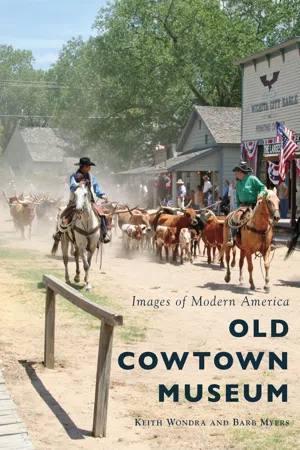
Old Cowtown Museum originally started as a shrine to the pioneers and founders of Wichita. It later reinvented itself according to Hollywood's version of the Old West. After the peak of Western films, the museum once again updated its theme to reflect Wichita's agricultural history. In recent years, Old Cowtown Museum has become a nationally recognized and accredited living history museum. A product of 1950s Old West nostalgia, it has become one of the most beloved of all of Wichita's museums and institutions. Inside this book is the story of how Old Cowtown Museum became the regional and cultural attraction it is today, along with images of the museum throughout its 66-year history, including people, events, and stories, many of which have never been published before.
Trusted by 375,005 students
Access to over 1.5 million titles for a fair monthly price.
Study more efficiently using our study tools.
Information
One
FOUNDATION
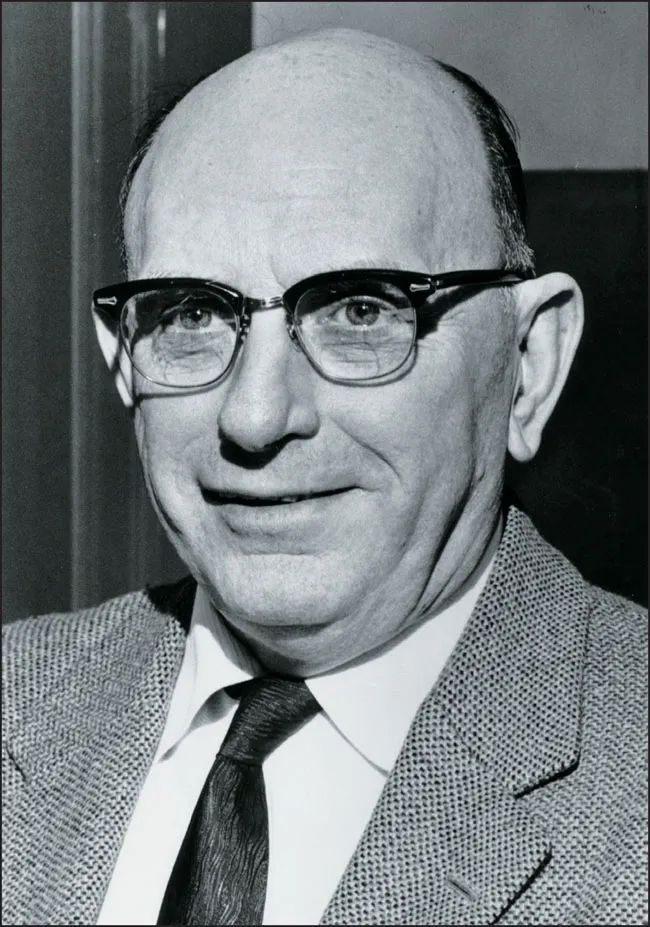
Dick Long was editor of the Wichita Eagle morning edition in the 1940s and the primary force behind the formation of Historic Wichita, Inc. in 1950. The nonprofit was responsible for the purchase, remodeling, reconstruction, and upkeep of the buildings “deemed to have historic merit” to the city’s history. Long was the president of Historic Wichita, Inc. from 1950 to 1961. (Courtesy Old Cowtown Museum and the Wichita-Sedgwick County Historical Museum.)

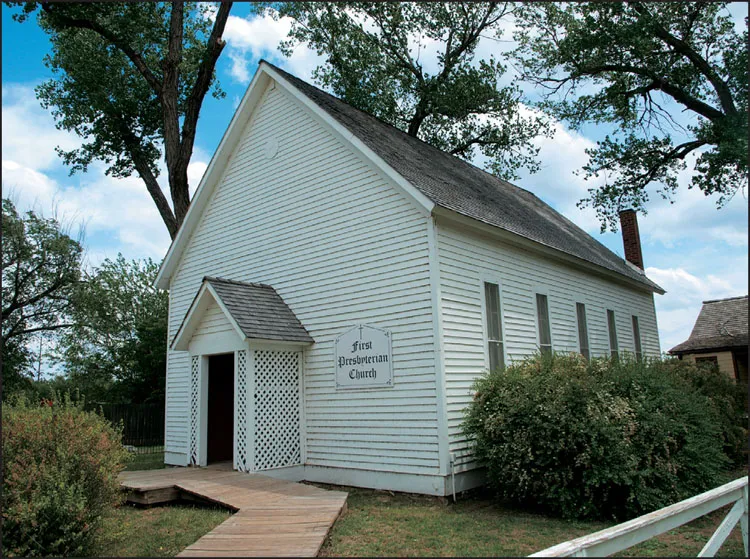
Historical articles written by Dick Long in the 1940s led to a bid by Victor Murdock to buy the first permanent church building, located at 605 North Main Street. This was the First Presbyterian Church, originally built in 1870. It had been sold to the Catholic Church in 1875 and was purchased in 1886 by Millie and Wesley Hodge. By World War II, the building was utilized as a boardinghouse, and Millie Hodge declined Murdock’s offer. However, in 1948, Dick Long heard that the building had been condemned, and he was able to purchase it and the building next door for $400 in 1952. (Above, courtesy Wichita Eagle; below, courtesy Keith Wondra)

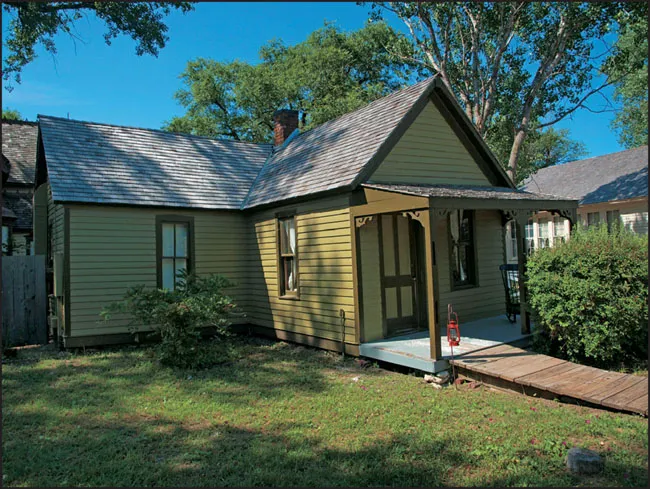
When the boardinghouse, formerly known as the First Presbyterian Church, was purchased for $400 by Dick Long in 1945, the building next to it was given to him as well. Until recently, it was thought that this was the church’s parsonage. In fact, it was the home of Wesley and Millie Hodge, one of the earliest African American families in Wichita, who arrived in 1876. Millie, a member of Calvary Baptist Church, owned and operated the boardinghouse until her death in 1935. It was located at 607 North Main Street before it became one of the four founding buildings of Old Cowtown Museum, along with the First Presbyterian Church, jail, and the Munger House. (Above, courtesy Wichita Eagle; below, courtesy Keith Wondra.)

Wichita’s first jail, or calaboose, was built at Second and Market Streets in 1871 and moved to Twelfth and Main Streets in 1874. The Wichita School District sold the building, which was being used for storage, to Historic Wichita, Inc. for $1, so that a new playground could be built at that location. The only renovations needed to the jail were new locks, which were donated by Fred J. Cooley, and keys, donated by Wichita Key, Lock and Safe Company. The jail was named the Wyatt Earp Memorial Jail in 1955 as part of the opening ceremony of Cow Town, with George Earp, first cousin of Wyatt Earp, in attendance. In reality, Wyatt Earp was hired by the city after the jail had already become a storage shed. (Above, courtesy Wichita Eagle; below, courtesy Keith Wondra.)
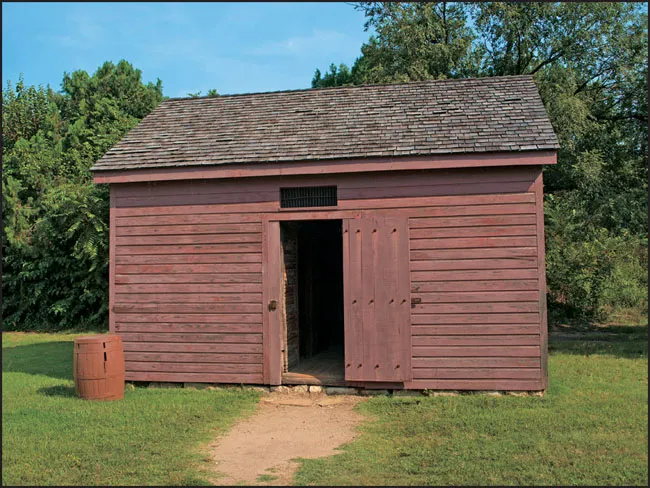

The Munger House, the first permanent structure built in Wichita, was erected by Darius S. Munger in 1869. Located at Ninth Street and Waco Avenue, it was used as the first post office, hotel and meeting place. W.C. Woodman bought the home from Munger in 1874 and renovated it into what he named Lakeside Manor. Dr. Dalton Fuller bought the renovated house in the 1920s and moved it to Back Bay Boulevard. The building was acquired by the Eunice Sterling Chapter of the Daughters of the American Revolution in 1944. The chapter donated it as shown above to Historic Wichita in 1952. It is the only building at Cowtown that is listed in the National Register of Historic Places. (Above, courtesy Wichita Eagle; below, courtesy Keith Wondra.)
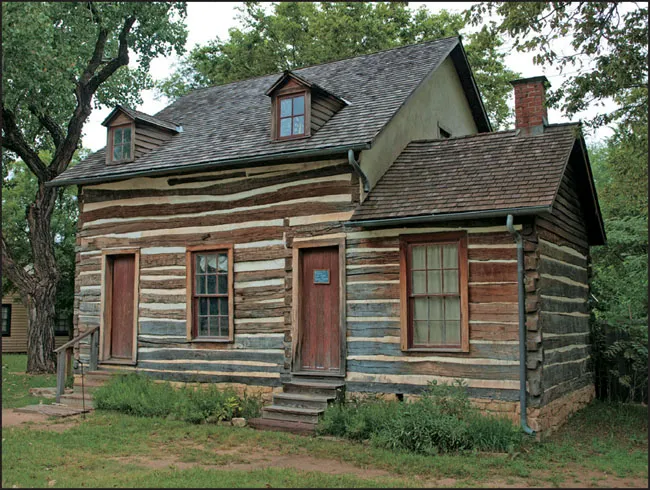

In 1951, Historic Wichita, Inc. leased 23 acres of land from the Wichita Water Company. As seen this c. 1951 aerial view, the land was north of the Big Arkansas River and south of the Wichita Water Company. Sim Park is in the upper left, with the land Old Cowtown Museum is on surrounded by the black arrows. (Courtesy Wichita Eagle.)
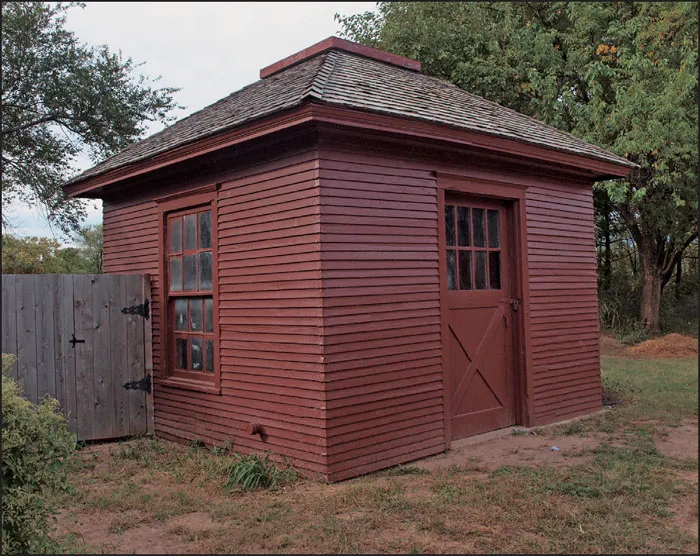
In the 1930s, the Wichita Water Company built six well houses north of the Arkansas River to be used as emergency wells. When Historic Wichita, Inc. leased the land, it inherited the well houses. Over the years, they were torn down, with only this one remaining. (Courtesy Keith Wondra.)

The replica of St. John’s Episcopal Church (seen above), also known as Wichita’s first school, was constructed in 1953 and sponsored by McCormick Armstrong. The church originally met in the Munger House with Rev. John Rice Hilton, until the original church was built from oak logs in 1870. The two-story building at 712 North Market, constructed in 1893, was also moved to Cowtown in 1953. The move was sponsored by Steffen’s Dairy, with the intent to make the first floor a drugstore and the second floor a replica of a land office. However, a windstorm in 1953 knocked the building down (seen below), so it became the one-story Bon-Ton Drug Store.


After the windstorm blew down the second story of the drugstore, plans were modified due to insurance only covering one story and not the damaged second story. The building included one of the first soda fountains in Kansas, which came from Junction City. The piece of the second story was used to erect the building that would become the Barber Shop (now the Land Office) on the left. In 1996, the structure was moved west of the general store, and it became the McGinn’s Feed and Seed. (Above, courtesy Treva Mathur; below, courtesy Keith Wondra.)
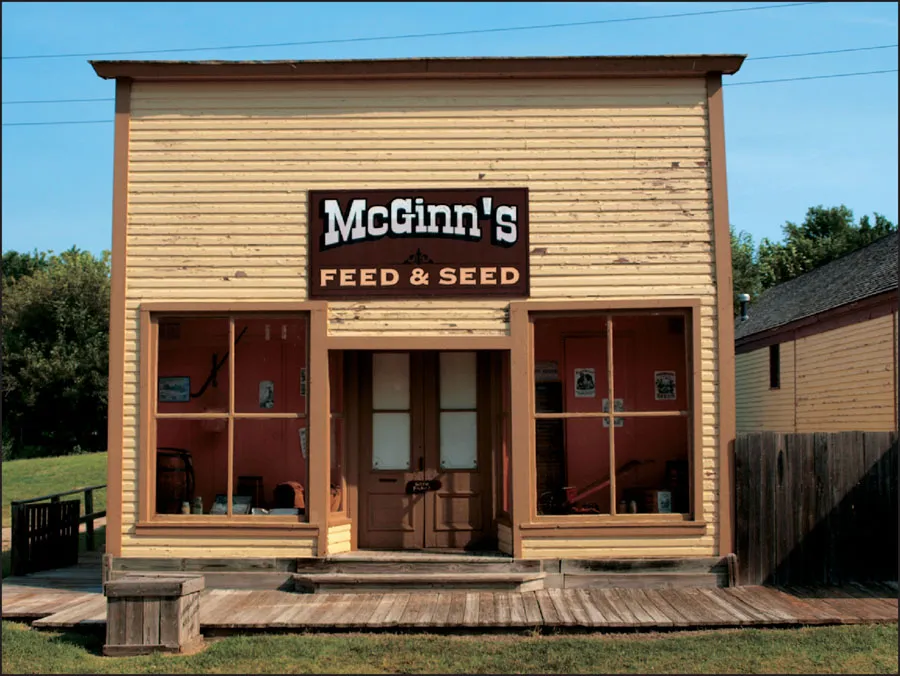

The Children’s Corner Creative Emporium was built on-site in 1954 as home to the Cow Town Fire Station No. 1, which housed the museum’s volunteer fire department. It was the second building erecte...
Table of contents
- Cover Page
- Title Page
- Copyright Page
- Dedication
- Table of Contents
- Acknowledgments
- Introduction
- 1. Foundation
- 2. Living History
- 3. Events and Groups
- 4. Myth and Reality
- 5. Decline and Resurgence
- Bibliography
Frequently asked questions
Yes, you can cancel anytime from the Subscription tab in your account settings on the Perlego website. Your subscription will stay active until the end of your current billing period. Learn how to cancel your subscription
No, books cannot be downloaded as external files, such as PDFs, for use outside of Perlego. However, you can download books within the Perlego app for offline reading on mobile or tablet. Learn how to download books offline
Perlego offers two plans: Essential and Complete
- Essential is ideal for learners and professionals who enjoy exploring a wide range of subjects. Access the Essential Library with 800,000+ trusted titles and best-sellers across business, personal growth, and the humanities. Includes unlimited reading time and Standard Read Aloud voice.
- Complete: Perfect for advanced learners and researchers needing full, unrestricted access. Unlock 1.5M+ books across hundreds of subjects, including academic and specialized titles. The Complete Plan also includes advanced features like Premium Read Aloud and Research Assistant.
We are an online textbook subscription service, where you can get access to an entire online library for less than the price of a single book per month. With over 1.5 million books across 990+ topics, we’ve got you covered! Learn about our mission
Look out for the read-aloud symbol on your next book to see if you can listen to it. The read-aloud tool reads text aloud for you, highlighting the text as it is being read. You can pause it, speed it up and slow it down. Learn more about Read Aloud
Yes! You can use the Perlego app on both iOS and Android devices to read anytime, anywhere — even offline. Perfect for commutes or when you’re on the go.
Please note we cannot support devices running on iOS 13 and Android 7 or earlier. Learn more about using the app
Please note we cannot support devices running on iOS 13 and Android 7 or earlier. Learn more about using the app
Yes, you can access Old Cowtown Museum by Keith Wondra,Barb Myers in PDF and/or ePUB format, as well as other popular books in History & North American History. We have over 1.5 million books available in our catalogue for you to explore.