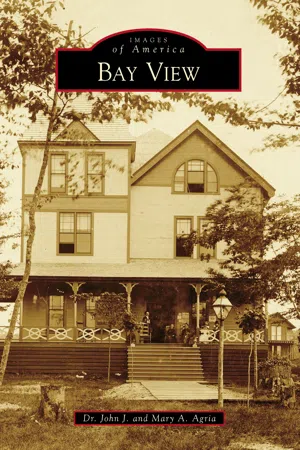
- 128 pages
- English
- ePUB (mobile friendly)
- Available on iOS & Android
eBook - ePub
Bay View
About this book
Bay View is a jewel box of a Northern Michigan Chautauqua community along the shores of Little Traverse Bay, southwest of the Mackinac Bridge. Founded in 1875 and now a National Historic Landmark, its 31 public buildings and 450 cottages are among the most pristine examples of 1900-era High Victorian architecture in the United States. Historical photographs capture the fascinating journey via rail and Great Lakes steamer to the early campground?s beech-forested hillside. Rare images trace its path from a wilderness Methodist campground to a vibrant embodiment of Chautauqua?s four pillars: the arts, education, recreation, and religion. Building on the Camp Meeting and Chautauqua traditions, the founders forged a unique lifestyle that ends every November only to resume with renewed energy every April. The turrets, towers, and gingerbread of this timeless Brigadoon excite the imagination today just as they did more than 135 years ago.
Trusted by 375,005 students
Access to over 1.5 million titles for a fair monthly price.
Study more efficiently using our study tools.
Information
One
TRACKS INTO
THE WILDERNESS
THE WILDERNESS

The times were turbulent. In 1874, the country was still recovering from the Civil War. Northern Michigan was largely a wilderness, accessed primarily via rail and water. Yet, visionary founders picked this time and place—the pristine waters, forested hillsides, and sandy shores of Lake Michigan’s Little Traverse Bay outside of Petoskey—to pursue their dream to create a haven of spiritual, intellectual, and cultural renewal. Shown here is an early view of the Bay View shoreline with a grove of birch trees and a simple wooden dock. (BV Heritage Collection.)

When Mr. and Mrs. O.S. Knapp of Jackson, Michigan, visited Petoskey in 1874 for Sarah’s health, the idea of developing a camp meeting drove them to explore the area for a site. Historian Fennimore credits them with building a cottage on the future Bay View’s block 2, lot 2, later named Barclay Cottage. The railroad would be essential to the venture. Another founder, Rev. J.H. McCarty from the Methodist Episcopal Church in Jackson, approached the Grand Rapids & Indiana Railroad’s lawyer about acquiring land for the campground. The railroad did not own the site but quickly purchased it from the local Odawa and Chippewa tribes. The postcard advertisement publicizes the area’s resources and depicts its Native American heritage in 1875. (Above, BVAA; below, LTHS.)

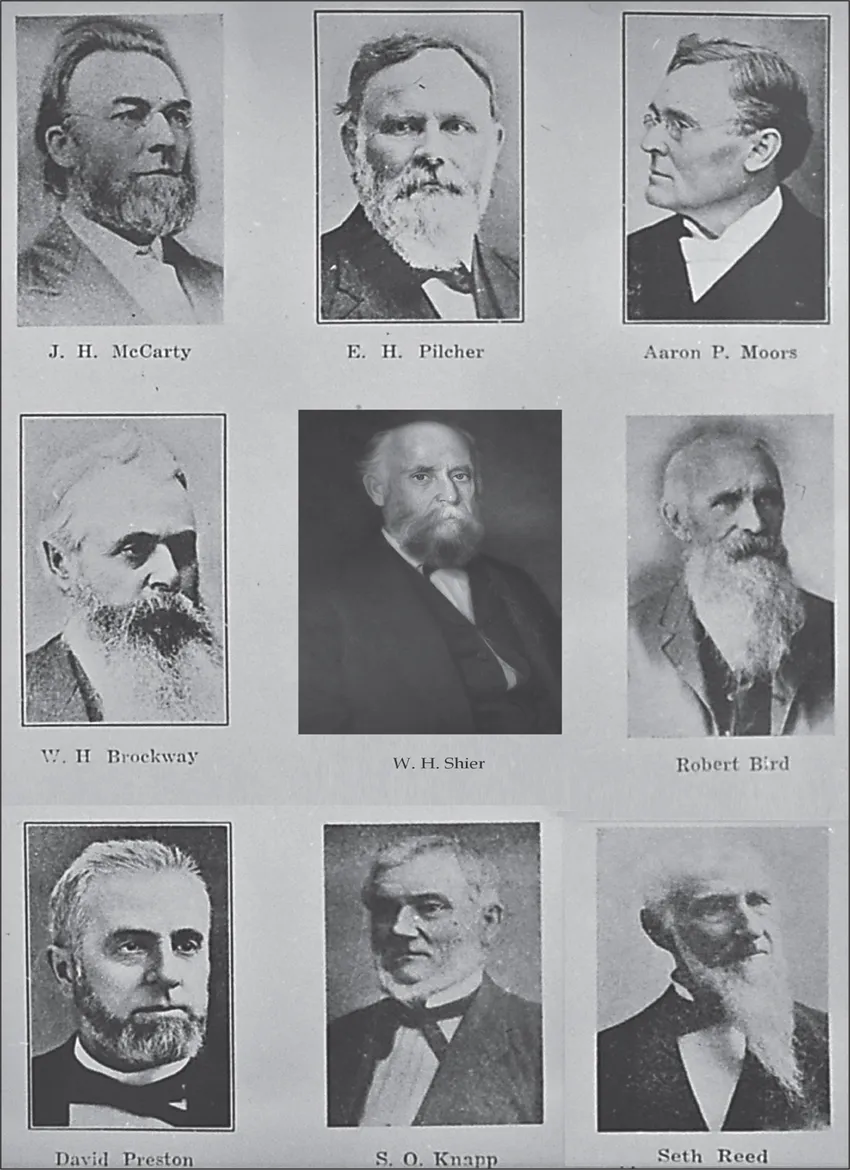
Reverend McCarty convened a committee in Jackson, Michigan, on November 9, 1875, to organize the first camp meeting. He is shown here with the other founding representatives from the Detroit Conference (Pastors Pilcher, Reed, and Bird and Detroit banker Preston) and Michigan Conference (Pastors McCarty, Brockway, and Moors and Upper Peninsula mining executive Knapp) of the Methodist Episcopal Church. Reverend Shier is included with the group because of his role as a trustee in those early years. Petoskey businessman H.O. Rose was influential in helping raise local funds for developing the site and accompanying the Grand Rapids & Indiana Railroad representatives as they negotiated the purchase of the 326.18 acres of land, minus the rail right-of-way, for the campground from the local Odawa and Chippewa leaders.
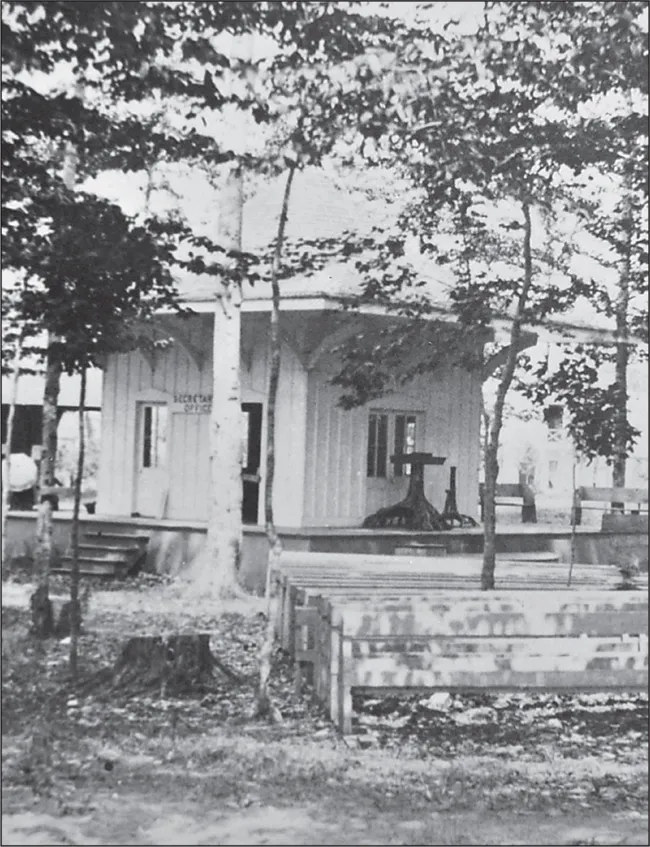
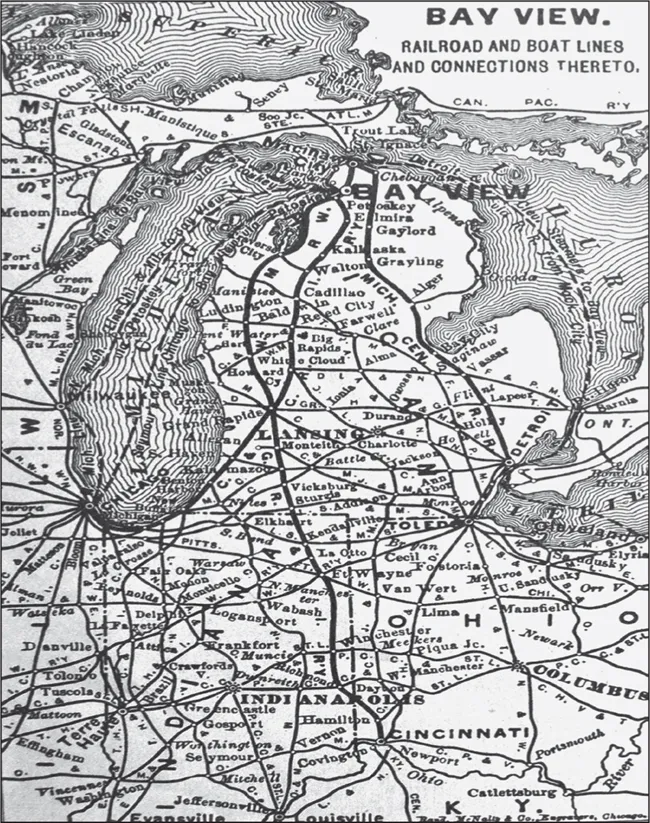
Bay View’s first camp meeting began on August 2, 1876, and ran for six days. In this early photograph of the campground’s speaker platform, even the tree stumps have not yet been removed. Simple benches under the trees created a gathering place to hear prominent speakers, hold rallies, and conduct worship services. Rail would be crucial for providing access from Indiana, Illinois, Ohio, Wisconsin, and elsewhere. The map below shows the extensive network serving Petoskey. But, at first to get from Petoskey to Bay View, visitors relied on either ferryboats or an improvised mule-drawn trolley. Installation of a second set of tracks eventually simplified main-line train service to Bay View and enabled it to have its own station. (Left, BVAA; below, BV Bulletin.)

A photographer caught the crowd assembled at the second camp meeting in 1877. By that second camp meeting, a Sunday school teacher training congress was added, staffed by instructors familiar with the program at Chautauqua, New York. The speaker platform (also called the speaker stand) and nearby small administration building (also formerly the Chautauqua bookstore) are still located in Encampment Park today as museums.
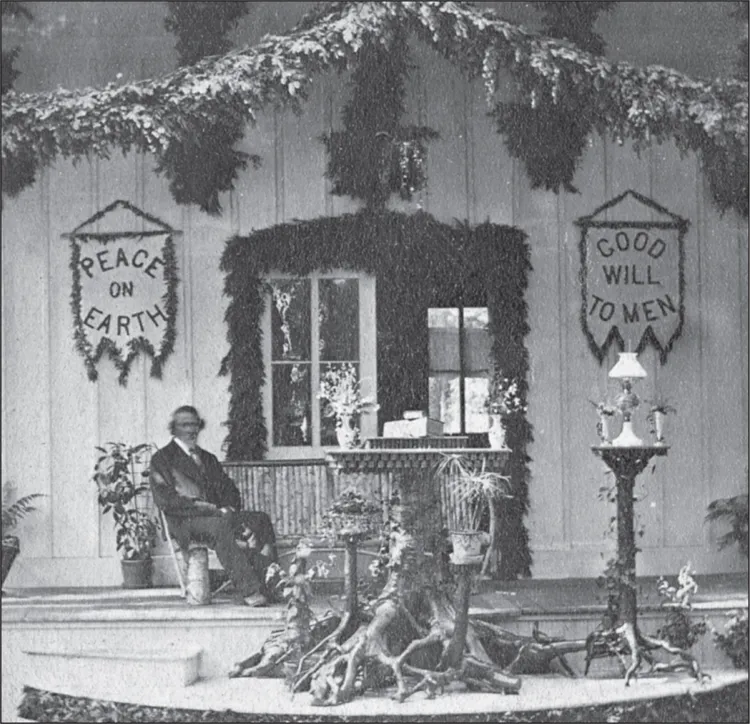
Seated on the platform is one of the early speakers, Odawa Chief Petoskey (Pet-o-sega). In 1877, trustee Ralph Connable created the podium from a cluster of roots found on the grounds. Missing for many years, the stand was found under Hitchcock Hall in 1966. Connable came to Bay View for relief from asthma. The Western Hay Fever Association was one of several groups that participated in the campground. (LTHS.)

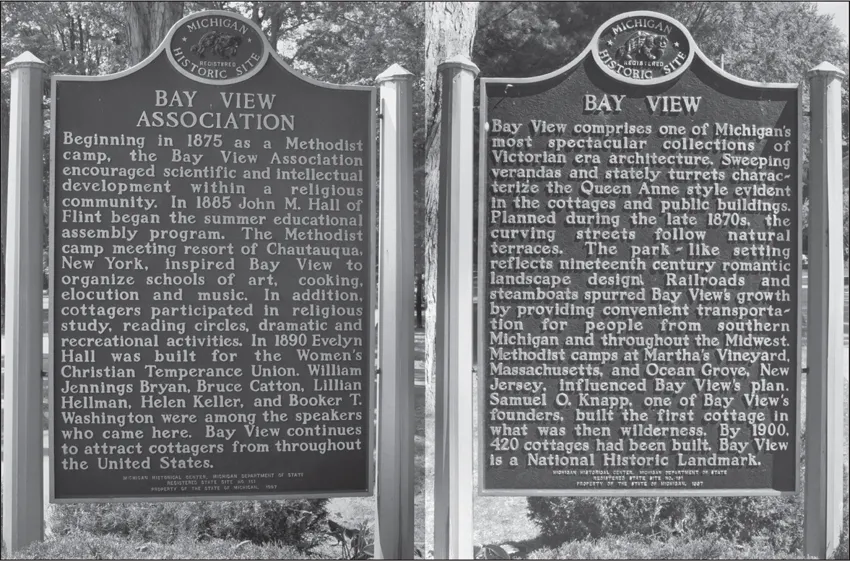
From the tents of that first six-day camp meeting of the Michigan Campground Association of the Methodist Episcopal Church in 1876, the founders went on to shape what was to become the Bay View Association: a summer community of 450 cottages and 31 public buildings. The 25th anniversary booklet summed up their unique vision. Though proud of its United Methodist origins, Bay View “is not a church or denominational establishment.” Its vibrant programs rested firmly on the four pillars of Chautauqua: arts, education, recreation, and religion. Summer activities today are second only in scope to those of the original Chautauqua in Fair Point, New York, established in 1874. A historical marker outside of Evelyn Hall commemorates the designation of the entire community as a National Historic Landmark in 1986. The pages that follow document that story. (Above, BVAA; below, J. Agria.)
Two
EARLY CAMPGROUND LIFE

Bay View Governance Articles were adopted in late 1875 at the meeting convened by Reverend McCarty in Jackson. Here, a group of trustees stands in front of the administration tent in the very early years of the campground. Trustees called the first camp meeting in 1876 small, with just a few tents. But at the 75th Golden Jubilee in 1950, one speaker recalled the event as a “city in the wilderness.” The original 1876 crowd was estimated at 600, including several hundred Native Americans. (PNR.)
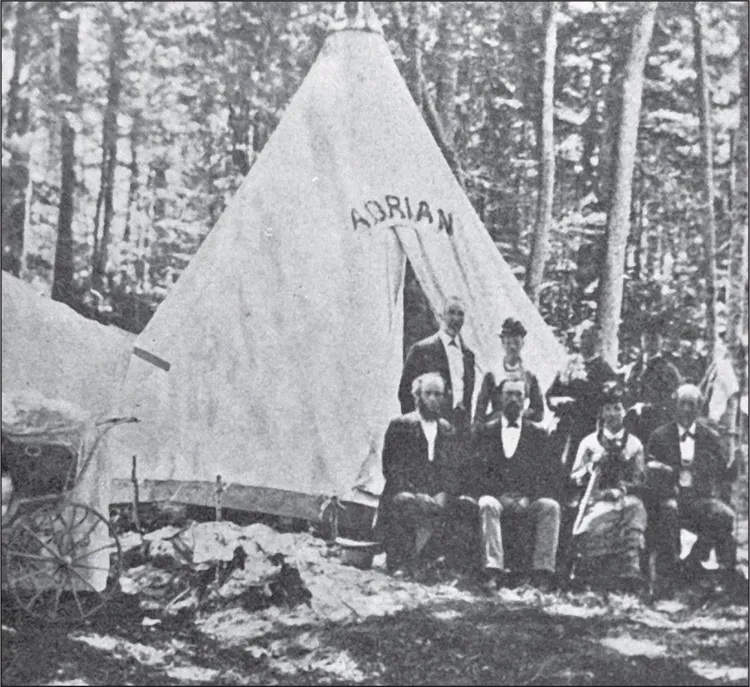
Pioneers of Bay View pose before a tepee-style tent in 1876. The railroad contract required that the campground make $10,000 in improvements within five years. The founders also promised to sponsor camp meetings for 15 seasons. O.S. Knapp took leadership in laying out blocks and lots, a system that still identifies cottages today. By the end of the second season in 1877, a total of 20 cottages were built.

Historian Mary Jane Doerr credits the decision to rename the site Bay View to the first president, Reverend Pilcher. Reverend Reed made that motion at a trustee meeting in 1890. After the first six-day camp meeting in 1876, each of the trustees pledged to build a cottage worth at least $100 by 1877. Rail service to Petoskey had begun in 1873, but to further encourage growth, in 1878 railroads in Michigan offered half-fares to association members and their families. Shown here are rare photographs of an early Bay View cottage and a transitional cottage-tent. (Left, BV Heritage Collection; right, LTHS.)

Shown here is a 20-person boarding tent, run by Rev. W.H. Brockway of Albion. Men stayed on one end and women on the other, with a curtain divider ...
Table of contents
- Cover Page
- Title Page
- Copyright Page
- Dedication
- Table of Contents
- Acknowledgments
- Introduction
- 1. Tracks into the Wilderness
- 2. Early Campground Life
- 3. From Camp Meeting to Chautauqua
- 4. Four Pillars
- 5. An Architectural Treasure Trove
- 6. From Tents to Turrets and Gingerbread
- 7. Centennials and Jubilees
Frequently asked questions
Yes, you can cancel anytime from the Subscription tab in your account settings on the Perlego website. Your subscription will stay active until the end of your current billing period. Learn how to cancel your subscription
No, books cannot be downloaded as external files, such as PDFs, for use outside of Perlego. However, you can download books within the Perlego app for offline reading on mobile or tablet. Learn how to download books offline
Perlego offers two plans: Essential and Complete
- Essential is ideal for learners and professionals who enjoy exploring a wide range of subjects. Access the Essential Library with 800,000+ trusted titles and best-sellers across business, personal growth, and the humanities. Includes unlimited reading time and Standard Read Aloud voice.
- Complete: Perfect for advanced learners and researchers needing full, unrestricted access. Unlock 1.5M+ books across hundreds of subjects, including academic and specialized titles. The Complete Plan also includes advanced features like Premium Read Aloud and Research Assistant.
We are an online textbook subscription service, where you can get access to an entire online library for less than the price of a single book per month. With over 1.5 million books across 990+ topics, we’ve got you covered! Learn about our mission
Look out for the read-aloud symbol on your next book to see if you can listen to it. The read-aloud tool reads text aloud for you, highlighting the text as it is being read. You can pause it, speed it up and slow it down. Learn more about Read Aloud
Yes! You can use the Perlego app on both iOS and Android devices to read anytime, anywhere — even offline. Perfect for commutes or when you’re on the go.
Please note we cannot support devices running on iOS 13 and Android 7 or earlier. Learn more about using the app
Please note we cannot support devices running on iOS 13 and Android 7 or earlier. Learn more about using the app
Yes, you can access Bay View by Dr. John J. Agria,Mary A. Agria in PDF and/or ePUB format, as well as other popular books in History & North American History. We have over 1.5 million books available in our catalogue for you to explore.