- 128 pages
- English
- ePUB (mobile friendly)
- Available on iOS & Android
eBook - ePub
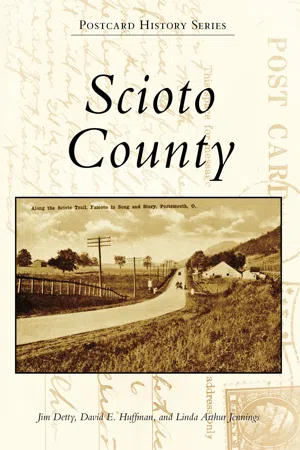
Scioto County
About this book
When Scioto County was established in March 1803, no one could have imagined the wide-ranging series of events that would encompass its history for the next 200-plus years. Situated in south-central Ohio along the Ohio River, the region experienced incredible prosperity with the Ohio and Erie Canal and later the railroads during the 1800s. In the early 1900s, shoe factories, steel mills, and brick plants produced jobs and merchandise that benefitted millions. Unfortunately, economic hardship followed in the latter half of the 20th century when these factories and many others closed. While some say the best days have come and gone, many would strongly disagree. Every day, men and women work hard to make Scioto County as proud and prosperous as ever before.
Trusted by 375,005 students
Access to over 1.5 million titles for a fair monthly price.
Study more efficiently using our study tools.
Information
One
WHEELERSBURG AND
FRANKLIN FURNACE
FRANKLIN FURNACE

Founded in 1827, the Masonic lodge in Wheelersburg is the oldest such organization in Scioto County. Originally located on Gallia Street at Shela Boulevard, it was relocated three times and was unfortunately the victim of three disastrous fires. In May 1924, the $50,000 brick fireproof structure featured on this postcard was completed at Gallia Pike and Center Street. The money was well spent; the building remains standing today. (Bill Glockner Collection.)
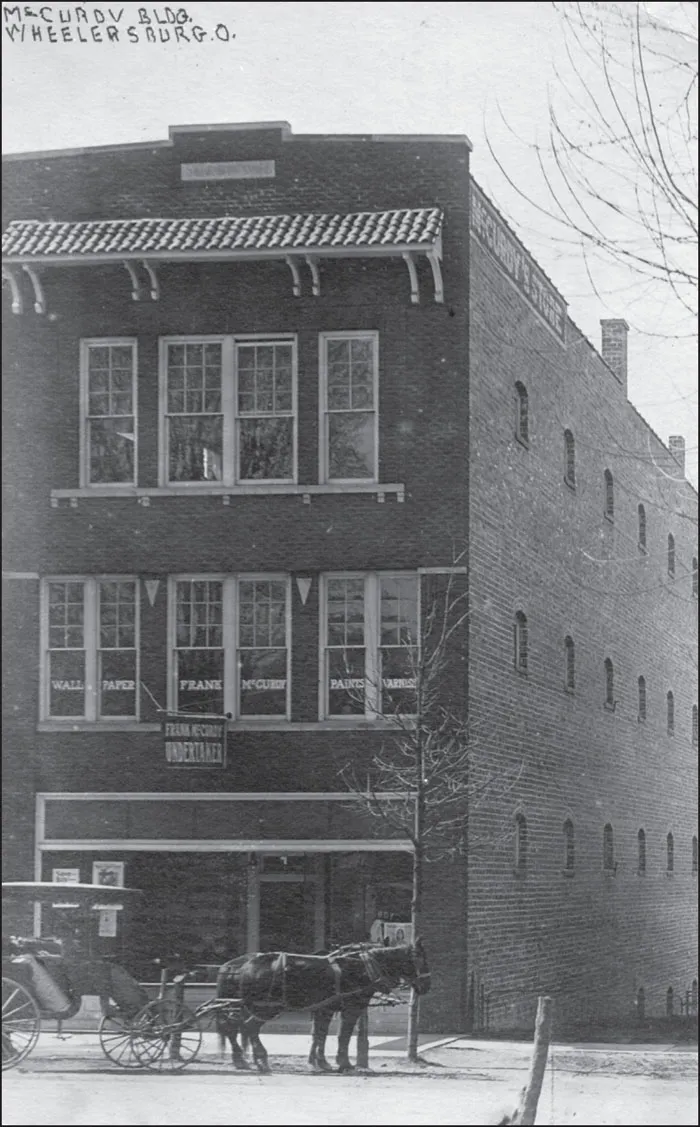
The McCurdy Building was completed in the summer of 1915 at a cost of $8,000. Located on Gallia Pike near Center Street, it was the first three-story building constructed in Wheelersburg and was hailed as a skyscraper by the local press. The Portsmouth Daily Times excitedly followed its construction, printing weekly updates on its progress. At 100 feet long and 28 feet wide, the brick structure became a Wheelersburg landmark. When the building was completed, Will McCurdy opened his successful general store in the basement and first f loor, while his brother Frank operated an undertaker business and, strangely enough, paint store on the second f loor. The third f loor was used by local lodges and other civic groups. Frank started one of the first ambulance services in the area in 1925, advertising day or night transport for those who needed it. The funeral home relocated in 1927, while the general store remained for several years longer. At over 100 years old, the building remains standing today. (Bill Glockner Collection.)

Concord was settled around 1800 and surveyed by Rev. Daniel Young and his brother Johnathon in October 1824. Daniel, who named the settlement after the capital of his native state of New Hampshire, was a Methodist minister and politician in the Granite State. Daniel, who was frustrated with the political corruption in New Hampshire and had a desire to spread his religious beliefs, brought his family and several friends to Ohio in 1820. After purchasing property from early settler Amos Wheeler, Daniel focused his attention on organizing a Methodist church. Johnathon, who focused on establishing a formal education system in the area, started the first school in the growing settlement in 1822. The name “Concord” remained in use until 1833, when the United States decided to establish a post office in the area and learned that a Concord, Ohio, already existed. Town leaders met and decided to change the name to Wheelersburg as a tribute to early settler and War of 1812 veteran Porter Wheeler, whose first name was used to label Porter Township. A typical day in early Wheelersburg is shown on this 1905 postcard. (Sharon Bender Collection.)

In 1924, an eight-room elementary school (above) was constructed on Center Street just west of the current location of Porter Township Fire Department. Offering instruction in grades one through eight, it soon became one of the largest schools in the area, with an enrollment of more than 800 children. In 1939, the elementary school was expanded and converted into the new Wheelersburg High School (below), and the former high school (shown at the bottom of page 13) became the elementary school. Another expansion of the high school in 1951 only delayed the inevitable, and a brand new high school was constructed on Thompson Street in 1958; the old high school was razed shortly thereafter. (Both, Paul O’Neill Collection.)


Wheelersburg’s school system began in 1822 with a one-room building at Center Street and Hayport Road, where US Bank is now located. John Young was the first teacher and earned $10 per month for a three-month term. In 1907, this three-story brick school was constructed on South Street and considered one of the finest of its time. (Bill Glockner Collection.)

Despite a highly publicized campaign against the costly construction of a new Wheelersburg High School, voters overwhelmingly approved a bond levy in December 1915. The school, which was located on a hill near the current location of Ed Miller Stadium, opened for classes in September 1916 and cost $35,000 to construct. It was converted into an elementary school in 1939. (Bill Glockner Collection.)

Hillcrest Children’s Home, also known as the Scioto County Children’s Home, opened in Wheelersburg in April 1921 (replacing the original children’s home in Portsmouth’s Mound Park) and provided a much-needed home for thousands of orphans over the years. It contained 50 rooms on 17 acres of property and could house, feed, and clothe over 100 children at any given time, more than doubling the capacity provided by the original children’s home. During the home’s nearly 50 years in operation, each Christmastime, the employees of the phone company and the Kiwanis Club, with the help of and donations from other area businesses and citizens, purchased and delivered toys to the Hillcrest children. With foster homes becoming more popular, in addition to the increasing expense of operating the large house, county commissioners closed the structure in the early 1970s. After vandals and thieves destroyed the building, it was sold at auction and razed to make room for residential development. Today, hundreds of former residents attend annual reunions, with many traveling from several states away. (Bill Glockner Collection.)

Few people impacted a town as much as Ray Litteral did in Wheelersburg. Litteral, a former fire chief with the Porter Township Fire Department, always gave to his community. Born in 1909, he opened his first grocery store in 1937. He later owned two grocery stores named after his daughters—the Nancy Rae in Wheelersburg and the Anna Lou in South Shore, Kentucky. From 1964 until 1985, he gave one percent of all sales at the stores to nonprofit organizations. In 1972, he opened the Pioneer Village of Wheelersburg, Ohio, on Ohio River Road as a way to represent and document life in Scioto County between 1800 and 1935. Litteral purchased, dismantled, relocated, and reconstructed several original vintage log buildings found throughout the county. After completion of the village, he filled the buildings with various antiques and historical displays for people to enjoy. Following his death in December 1998, a dedicated group of volunteers continued the preservation of Pioneer Village, and in August 2014, their group, Pioneer Village of Wheelersburg, Ohio, was certified in Ohio as a nonprofit organization. This devoted organization remains active in pursuing the goal of complete restoration of the village and the realization of Litteral’s dream of educating visitors about appreciating the past. (Paul O’Neill Collection.)

During the 1800s, several mills were built in southeastern Scioto County and produced a variety of products ranging from f lour to wool. In the c. 1900 postcard above, a mule-pulled wagon waits at the rear of a mill along Pine Creek, now known as Giant Oaks Mill Road. The mill shown the 1930 scene below is a short distance downstream, near Wizard Oil Bridge, on what is now Mill Road. In the mid-1800s, the bridge in the photograph was covered and made of wood, and the Wizard Oil medicinal company supplied the paint for the structure in exchange for the company’s name being painted in 10-foot-tall letters on the side of the bridge. The original bridge was replaced in 1888, but the name remained and is still in use today. (Both, Bill Glockner Collection.)


Pine Creek, near Wheelersburg, was occasionally used for recreational purposes. During the mid-1870s, it was a popular location where local men organized for fox hunts, and dozens would arrive with foxhounds and whiskey. When the intoxicated hunters returned home with only groundhogs and skunks, the true reason for the “hunt” was revealed. (Bi...
Table of contents
- Cover Page
- Title Page
- Copyright Page
- Dedication
- Table of Contents
- Acknowledgments
- Introduction
- 1. Wheelersburg and Franklin Furnace
- 2. McDermott and Lucasville
- 3. Friendship and West Portsmouth
- 4. Sciotoville and New Boston
- 5. Rarden and Otway
- 6. South Webster and Minford
- 7. Rosemount and Portsmouth
Frequently asked questions
Yes, you can cancel anytime from the Subscription tab in your account settings on the Perlego website. Your subscription will stay active until the end of your current billing period. Learn how to cancel your subscription
No, books cannot be downloaded as external files, such as PDFs, for use outside of Perlego. However, you can download books within the Perlego app for offline reading on mobile or tablet. Learn how to download books offline
Perlego offers two plans: Essential and Complete
- Essential is ideal for learners and professionals who enjoy exploring a wide range of subjects. Access the Essential Library with 800,000+ trusted titles and best-sellers across business, personal growth, and the humanities. Includes unlimited reading time and Standard Read Aloud voice.
- Complete: Perfect for advanced learners and researchers needing full, unrestricted access. Unlock 1.5M+ books across hundreds of subjects, including academic and specialized titles. The Complete Plan also includes advanced features like Premium Read Aloud and Research Assistant.
We are an online textbook subscription service, where you can get access to an entire online library for less than the price of a single book per month. With over 1.5 million books across 990+ topics, we’ve got you covered! Learn about our mission
Look out for the read-aloud symbol on your next book to see if you can listen to it. The read-aloud tool reads text aloud for you, highlighting the text as it is being read. You can pause it, speed it up and slow it down. Learn more about Read Aloud
Yes! You can use the Perlego app on both iOS and Android devices to read anytime, anywhere — even offline. Perfect for commutes or when you’re on the go.
Please note we cannot support devices running on iOS 13 and Android 7 or earlier. Learn more about using the app
Please note we cannot support devices running on iOS 13 and Android 7 or earlier. Learn more about using the app
Yes, you can access Scioto County by Jim Detty,David E. Huffman,Linda Arthur Jennings in PDF and/or ePUB format, as well as other popular books in History & North American History. We have over 1.5 million books available in our catalogue for you to explore.