- 128 pages
- English
- ePUB (mobile friendly)
- Available on iOS & Android
eBook - ePub
About this book
Nestled in the hills 38 miles west of Boston, the area that would become Grafton originally belonged to the Nipmuc Indians. In the mid-1600s, John Eliot, a Puritan missionary, traveled throughout Massachusetts converting the natives to Christianity. He created a series of "praying Indian" villages, including Hassanamesit. In 1728, most of Hassanamesit was purchased by a group of investors, and in 1735 it was incorporated as the town of Grafton. By the early 19th century, Grafton was a national leader in leather tanning and shoe production. Textile mills appeared along the rivers, attracting emigrant workers from Canada and Europe. Three geographic areas evolved, each with its own identity: Grafton Center, North Grafton, and South Grafton. Today, residents celebrate the differences and salute the forces that brought them together to form one united town. Grafton is the birthplace of the famous Willard clock makers--Simon, Benjamin, Ephraim, and Aaron--whose home and clock shop are now the Willard House and Clock Museum. Grafton is the birthplace of Robert Bailey Thomas, the founder, editor, and publisher of the Old Farmer's Almanac. Native Jerome Wheelock invented a steam valve system, revolutionizing transportation worldwide. Grafton is also the childhood home of noted American poet Frank O'Hara.
Tools to learn more effectively

Saving Books

Keyword Search

Annotating Text

Listen to it instead
Information
One
HASSANAMESIT
Grafton is home to the Hassanamisco Reservation, an historic site with approximately four acres of land that has never been owned or lived on by nonnative people. The reservation is part of the original 8,000-acre Hassanamesit Plantation of praying Indians, established by the Reverend John Eliot, a Puritan missionary. A Grafton Indian, James the Printer, aided Eliot by helping to translate the Bible into the Indian language.
The center of that early Hassanamesit settlement is thought to be located on Keith Hill in present-day Grafton, where a church was reported to have been built in 1671. Between 2003 and 2014, the Fiske Center for Archeological Research excavated that site hoping to identify the early village location. Its work uncovered the home of Sarah Boston, a descendant of the original praying Indians.
King Philip’s War, an uprising of natives in 1675, ended the praying Indian towns, and the natives of Hassanamesit Plantation were dispersed. In 1698, a few native families returned to claim their land. The sale of land to English investors in 1728 left the Nipmucs only 1,200 acres. Corrupt practices and financial misfortunes resulted in the loss of most of this land, so that by 1861, they owned only the small reservation tract.
The reservation, on the eastern slope of Brigham Hill, is the location of an 1801 building known as the Homestead. During the early 20th century, the Cisco family resided there and became tribal leaders and stewards of the reservation. James Lemuel Cisco (1846–1931) became chief of the Hassanamisco in the 1920s. He was succeeded by his son Samuel and later by his daughter Sarah Cisco Sullivan, also known as Princess Sweet Flower. Sarah lived on the reservation all her life, serving as hostess of the Indian fairs and educating local young people about Indian culture. Her daughter Zara Cisco Brough, known as Princess White Flower, also held the title of chief of the Nipmuc tribe and can trace her ancestry back to James the Printer.
Annual tribal gatherings at the reservation began in the 1920s and have continued into the present day. Renamed the Annual Hassanamisco Indian Fair, the event engages the public in tribal ceremonies. The Homestead is no longer used as a residence, but it continues to be the focus of Nipmuc cultural activities. The reservation is maintained by the Nipmuc Nation Tribal Council.
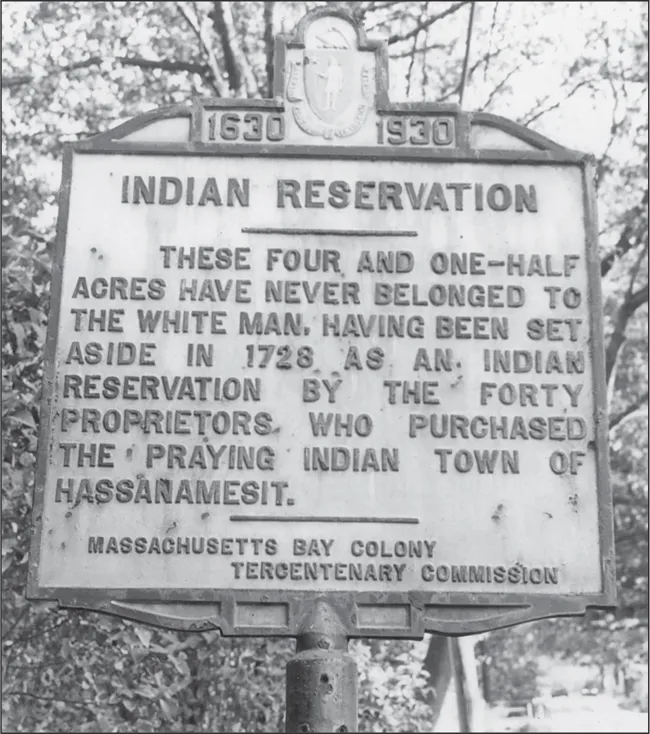
This sign identifying the Hassanamisco Reservation was erected by the Massachusetts Tercentenary Committee in 1938 on the 300th anniversary of the founding of Massachusetts Bay Colony. Grafton is unique in having two other signs: one signifying the Thomas Hooker trail that passed through Grafton and one near Grafton Common designating the early native village of Hassanamesit.

The Hassanamisco Reservation, located on the eastern slope of Brigham Hill, is part of the original 8,000-acre Hassanamesit Plantation of praying Indians established by the Reverend John Eliot, a Puritan missionary. This homestead is the only building on the present-day reservation, parts of which date from 1801. During the 20th century, the Cisco family resided there and served as tribal leaders and stewards of the reservation.
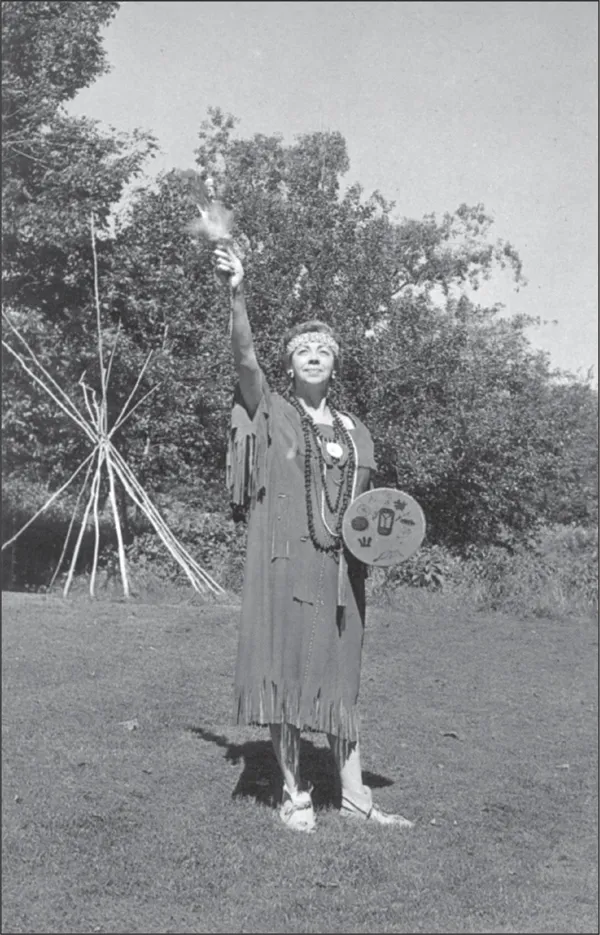
Princess White Flower (1919–1988), chief of the Nipmuc tribe, lived at and presided over the reservation for many years. She was a direct descendant of a line of chiefs and traced her lineage to James the Printer, a Nipmuc who helped translate the Bible into the Indian language. Princess White Flower was president of an electrical and ecological consulting company, a draftsperson, a technical writer, and a fashion designer.

Annual tribal gatherings at the reservation began in the 1920s and have continued to the present day. The Annual Hassanamisco Indian Fair engages the public in tribal ceremonies. The reservation today is maintained by the Nipmuc Nation Tribal Council and continues to be the focus of Nipmuc cultural activities.

Between 2003 and 2014, faculty and students from the Fiske Center for Archeological Research at the University of Massachusetts at Boston excavated a site on Keith Hill hoping to identify the early praying Indian village established by the Reverend John Eliot in 1660. Their work uncovered the home of Sarah Boston, a Nipmuc who lived there in the early 1800s. It is believed that the homestead at this site dates from an earlier time, when it was the home of Sarah and Peter Muckamaug, whose family was part of the original Hassanamesit Plantation and who lived on this property after King Philip’s War (1675–1676). (Courtesy of Heather Law Pezzarossi, Fiske Center, UMass Boston.)
Two
FARMING
Grafton was a farming community at its founding and remained so for almost 250 years. The Willard family, the first English family to settle in Hassanamesit, established a farm in the north end in 1716. All but one of the original Grafton investors were farmers, and after purchasing land from the Nipmucs in 1728, they divided the town into many large farms. Most of these became family farms and were handed down from generation to generation. Farm supply businesses flourished. By the mid-20th century, there were poultry farms, piggeries, turkey farms, vegetable farms, and many dairy farms.
In 1901, Grafton State Hospital was established as a therapeutic farm colony for “chronic insane” patients. A dairy farm was put into operation in 1905, and the farm expanded in 1912 to include a piggery, a poultry plant, vegetable gardens, and an orchard. The hospital operated one of the many large farms in Grafton.
With the development of local manufacturing and the growth of the villages, local farmers provided food for mill workers as well as for their families. When the local farmers could not supply enough food for the fast-growing mill populations, the North Grafton mill established its own farm to help meet the demand.
Grafton has a long history of orcharding, as well. The Nipmucs grew apples and other fruits before the English settlers came to the Grafton area. Orchards were cultivated well into the 20th century in all sections of Grafton. In Grafton Center, the Mortimer Peach Farm on Keith Hill became Fiske Farms Orchards, one of the largest growers of apples in New England. In The Depot section of North Grafton, orchards dotted the landscape. In the 20th century, Stearns Davenport established Creeper Hill Orchard and reclaimed 60 vintage varieties of apples. Orchards bearing a variety of fruits grew in many places in South Grafton.
Grafton retained its rural aspect for almost 250 years. By the 1960s, improved transportation and refrigeration made it possible to ship food from areas of the country that could grow food more cheaply and more efficiently. Over the next 50 years, most of the farms disappeared from all three sections of Grafton.

The Willards were the first family to settle in Grafton. In 1716, Joseph Willard moved to Hassanamesit with his wife, Martha. He was one of the original petitioners for the purchase of the Nipmuc land. The farm included a clock shop, where their grandsons learned the trade. Benjamin, Simon, Ephraim, and Aaron Willard are renowned as premier American clock makers. The farm is now the Willard House and Clock Museum.

John McClellan (1806–1886) owned this property on Pleasant Street, calling it Intervale Farm. It was one of the largest and best cultivated farms in town. In earlier days, the area was known as Leland’s Landing because the farm was situated across from a boat landing where the Blackstone Canal joined the Blackstone River.

The Royal Keith farm was located at 23 Keith Hill Road. Keith (1769–1857) was one of Gra...
Table of contents
- Cover Page
- Title Page
- Copyright Page
- Dedication
- Table of Contents
- Acknowledgments
- Introduction
- 1. Hassanamesit
- 2. Farming
- 3. Grafton Center
- 4. North Grafton
- 5. South Grafton
- 6. Schools
- 7. Coming Together
Frequently asked questions
Yes, you can cancel anytime from the Subscription tab in your account settings on the Perlego website. Your subscription will stay active until the end of your current billing period. Learn how to cancel your subscription
No, books cannot be downloaded as external files, such as PDFs, for use outside of Perlego. However, you can download books within the Perlego app for offline reading on mobile or tablet. Learn how to download books offline
Perlego offers two plans: Essential and Complete
- Essential is ideal for learners and professionals who enjoy exploring a wide range of subjects. Access the Essential Library with 800,000+ trusted titles and best-sellers across business, personal growth, and the humanities. Includes unlimited reading time and Standard Read Aloud voice.
- Complete: Perfect for advanced learners and researchers needing full, unrestricted access. Unlock 1.4M+ books across hundreds of subjects, including academic and specialized titles. The Complete Plan also includes advanced features like Premium Read Aloud and Research Assistant.
We are an online textbook subscription service, where you can get access to an entire online library for less than the price of a single book per month. With over 1 million books across 990+ topics, we’ve got you covered! Learn about our mission
Look out for the read-aloud symbol on your next book to see if you can listen to it. The read-aloud tool reads text aloud for you, highlighting the text as it is being read. You can pause it, speed it up and slow it down. Learn more about Read Aloud
Yes! You can use the Perlego app on both iOS and Android devices to read anytime, anywhere — even offline. Perfect for commutes or when you’re on the go.
Please note we cannot support devices running on iOS 13 and Android 7 or earlier. Learn more about using the app
Please note we cannot support devices running on iOS 13 and Android 7 or earlier. Learn more about using the app
Yes, you can access Grafton by Linda Marean Casey,Grafton Historical Society in PDF and/or ePUB format, as well as other popular books in History & North American History. We have over one million books available in our catalogue for you to explore.