- 96 pages
- English
- ePUB (mobile friendly)
- Available on iOS & Android
eBook - ePub
The Baltimore & Ohio Railroad's Pittsburgh Division
About this book
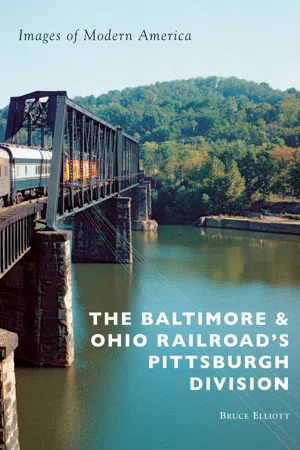
The Pittsburgh Division had its earliest beginnings in 1837, but what would be known as the main line was not completed until 1871. At its height, the Pittsburgh Division consisted of five distinct main lines and 14 branch lines, and the division had trackage rights over the Western Maryland and Pittsburgh & Lake Erie Railroads. Images of Modern America: The Baltimore & Ohio Railroad's Pittsburgh Division looks at five of these lines: the B&O Main Line from Cumberland to Pittsburgh; the Pittsburgh and Western; the Somerset and Cambria; the Fairmont, Morgantown and Pittsburgh; and the Wheeling, Pittsburgh and Baltimore.
Trusted by 375,005 students
Access to over 1 million titles for a fair monthly price.
Study more efficiently using our study tools.
Information
Topic
HistoriaSubtopic
Historia de NorteaméricaOne
THE MAIN LINE
EAST SLOPE
EAST SLOPE

The east slope of Sand Patch grade starts here, at ND Tower at Viaduct Junction in Cumberland, Maryland, and ends at the west portal of Sand Patch tunnel. On the B&O, this is one of the more famous grades in the railroads’ assault on the Allegheny Mountains. Compared to the west slope, it is so short and steep that the railroad required a helper station at Hyndman, Pennsylvania, to get westbound trains over the top. The PRR is known for Horseshoe curve. The B&O has its own Horseshoe curve at Mance, Pennsylvania; though only two tracks, it is every bit as important and impressive as its PRR counterpart. CSX and Amtrak wrestle with this today, just as the B&O did for decades before them. Though long gone today, interlocking towers dotted the hill at strategic points to control traffic. Today, there are only two tracks on the hill. This is the beginning, or east end, of the Pittsburgh Division, the tracks straight ahead. The two tracks to the left of this tower are part of the Cumberland Division. The interlocking plant was controlled by an armstrong interlocking mechanism. All immediate switches were thrown from inside the tower. Old US Highway 40 is located above the concrete retaining wall to the right. This photograph was taken January 21, 1973.

In June 1978, GP-9 No. 6483 and a steam generator–equipped GP-9, No. 6618, lead two Western Maryland–lettered units through Viaduct Junction with a westbound train headed to Connellsville, Pennsylvania. To the left of the lead locomotive, in this photograph from the second floor of ND Tower, you can see old US Highway 40, and the overhead bridge in the background is Frederick Street.

It is June 1978, and this view of ND Tower is taken from the east end of the Cumberland Division’s West End. Chessie has recently modernized the tower’s appearance with new siding and fewer windows. Note the double bank of relay boxes in the left front of the tower. A red dwarf signal in the foreground indicates that switches are thrown against any eastbound train movement from the West End. GP-30 No. 6961 was in the lead of this eastbound coal drag that was en route to Curtis Bay, Baltimore. Caboose C-3810, a Class C-26, is shown here bringing up “the markers” (end-of-train marker lights) as the train arrives in Cumberland, Maryland.

On a trip to Cumberland on March 15, 1986, I finally got the nerve to go inside ND Tower. I realized that a lot of what I had taken for granted over the years about the railroad was, in all probability, going to go away. This photograph shows what some call a “model board,” an electronic diagram of the main tracks controlled by the tower operator. From this panel, traffic was routed east to Baltimore and west to Grafton and Pittsburgh. Tracks to the left of center show the main tracks entering the massive Cumberland yards, the tracks in the upper right are heading to Grafton and St. Louis, and the lower-right tracks are going to Connellsville and Chicago.

On August 16, 1986, I was able to capture two trains, on two divisions in different directions at Viaduct Junction. Extra No. 7580 is eastbound, coming off the Cumberland Division’s West End with a coal drag from Grafton, and is entering the Cumberland Division East End and Cumberland yards. Extra No. 4271 is headed west, entering the Pittsburgh Division, with a long string of empty coal cars headed back to the mines. Most railfans live for such photographic opportunities; I was just at the right place at the right time.

On June 28, 1986, I was at Knox Street, the first grade crossing west of Viaduct Junction, as Extra No. 4260 West was approaching with a westbound load of iron ore. Most likely, the train originated at the Curtis Bay yards in Baltimore and was headed west for a steel mill, perhaps in Pittsburgh, Youngstown, or in the Chicago area on the southeast side. The extreme weight of the train dictated the extra power up front, as there is 15,000 horsepower shown, and there will no doubt be at least another 6,000 horsepower added at Hyndman to get the train up and over Sand Patch.

On January 9, 1976, from the US Highway 40 overpass, I caught an eastbound grain train crossing over Franklin Street. Its final destination was the Locust Point yards in Baltimore, Maryland. The Buchanan Lumber Company yards are at the right. The siding at the left was a “team” track for local businesses on the west end of town. About 20 years earlier, my father photographed a Western Maryland “local” switching on that track with a steam locomotive. The red 1969 Camaro adjacent to the team track was my everyday transportation at the time.

Gently easing under US Highway 40 and past the Bennett Transfer Co. warehouse, we find Extra No. 7617 and an unidentified GP-30 westbound on September 6, 1986. It must have been a hot day, as one of the crew has opted to get a little fresh air as the train enters the Narrows. The red block signal indicates that tracks at Viaduct Junction are yet to be aligned.

This photograph was taken at the same location, but this time looking west, on March 28, 1987. No. 4425 is on the point of the westbound Queen City Flyer, with No. 4052 assisting. Eastbound, we have Extra No. 4300 on the point of a Baltimore-bound freight. This is another photograph of opportunity, as both trains are moving and in the right place at the right time.

This location is called “Red Rock,” and aptly so, as these rocks have a decidedly reddish brown tint. On March 7, 1987, in the early evening, we see Extra No. 3535 west, entering the Narrows. To the right of the train is a concrete telephone booth used by the railroad. To the right of the telephone booth is Wills Creek, and on the other side of Wills Creek are old US Highway 40 and the Western Maryland Railroad to Connellsville. It is a narrow passage through the mountain, with a lot of traffic. In the early part of the 20th century, there was also a trolley line on this route.
...
Table of contents
- Cover Page
- Title Page
- Copyright Page
- Table of Contents
- Acknowledgments
- Introduction
- 1. The Main Line East Slope
- 2. The Main Line West Slope
- 3. The Pittsburgh & Western
- 4. The Somerset & Cambria
- 5. The Fairmont, Morgantown & Pittsburgh
- 6. The Wheeling, Pittsburgh & Baltimore
Frequently asked questions
Yes, you can cancel anytime from the Subscription tab in your account settings on the Perlego website. Your subscription will stay active until the end of your current billing period. Learn how to cancel your subscription
No, books cannot be downloaded as external files, such as PDFs, for use outside of Perlego. However, you can download books within the Perlego app for offline reading on mobile or tablet. Learn how to download books offline
Perlego offers two plans: Essential and Complete
- Essential is ideal for learners and professionals who enjoy exploring a wide range of subjects. Access the Essential Library with 800,000+ trusted titles and best-sellers across business, personal growth, and the humanities. Includes unlimited reading time and Standard Read Aloud voice.
- Complete: Perfect for advanced learners and researchers needing full, unrestricted access. Unlock 1.4M+ books across hundreds of subjects, including academic and specialized titles. The Complete Plan also includes advanced features like Premium Read Aloud and Research Assistant.
We are an online textbook subscription service, where you can get access to an entire online library for less than the price of a single book per month. With over 1 million books across 990+ topics, we’ve got you covered! Learn about our mission
Look out for the read-aloud symbol on your next book to see if you can listen to it. The read-aloud tool reads text aloud for you, highlighting the text as it is being read. You can pause it, speed it up and slow it down. Learn more about Read Aloud
Yes! You can use the Perlego app on both iOS and Android devices to read anytime, anywhere — even offline. Perfect for commutes or when you’re on the go.
Please note we cannot support devices running on iOS 13 and Android 7 or earlier. Learn more about using the app
Please note we cannot support devices running on iOS 13 and Android 7 or earlier. Learn more about using the app
Yes, you can access The Baltimore & Ohio Railroad's Pittsburgh Division by Bruce Elliott in PDF and/or ePUB format, as well as other popular books in Historia & Historia de Norteamérica. We have over one million books available in our catalogue for you to explore.