- 128 pages
- English
- ePUB (mobile friendly)
- Available on iOS & Android
eBook - ePub
Belmont
About this book
Belmont lies between the South Fork and Catawba Rivers of western North Carolina. The Catawba Indians occupied the area for nearly five centuries prior to the mid-1700s, when the king of England granted large tracts of land to prominent citizens. Other land was settled by German and Scotch Irish farmers. The coming of the Charlotte & Atlanta Railroad in 1872 established a focal point around which the community grew, and by 1895, Belmont had been incorporated. As Belmont's population grew, so did the need for jobs other than farming. In 1901, brothers Robert Lee and Samuel Pinckney Stowe organized the first of many successful cotton mills, thus establishing Belmont's development as a textile center. By the late 1900s, textiles had faded and high-density residential areas replaced the former farmland. Today, Belmont residents continue to remember and celebrate their past through local venues, such as the world-class Daniel Stowe Botanical Gardens, as well as community events like the Belmont Fall Festival and Garibaldifest.
Trusted by 375,005 students
Access to over 1.5 million titles for a fair monthly price.
Study more efficiently using our study tools.
Information
One
EARLY SETTLERS
AND LANDOWNERS
AND LANDOWNERS
1700S–1900S

OLDEST PICTURE OF BELMONT’S MAIN STREET. From around 1850, this photograph is thought to be the oldest picture of the community, which was first called Garibaldi and later renamed Belmont. The community was incorporated in 1895. The view in this photograph faces north on what became Main Street. At the very top of the street is the first Presbyterian church built in Belmont. This church was later moved east one block to the corner of Catawba Street and Glenway Street. It was rebuilt as a brick structure, and this move made room for the mill office. The church has in recent years moved once again and a new building was constructed on the corner of Main Street and Central Avenue. (Courtesy of Millican Pictorial History Museum.)
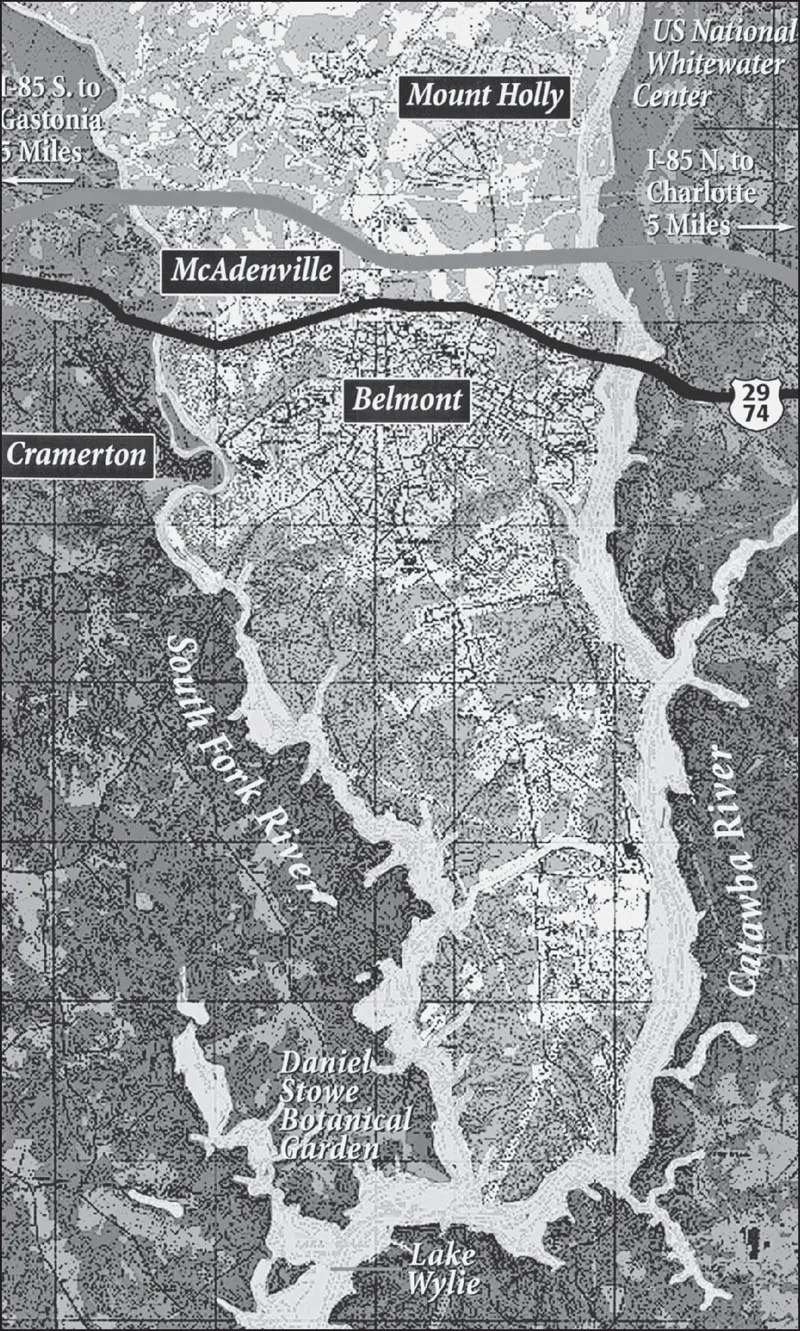
MAP OF SOUTH POINT PENINSULA. The land between the South Fork River and the Catawba River has been recently referred to as the South Point Peninsula. These two rivers were once smaller streams; however, they comprise Lake Wylie today. The most productive farmland has now been covered by the lake. The loss of this fertile land forced farmers to seek other employment to support their families. (Courtesy of Millican Pictorial History Museum.)
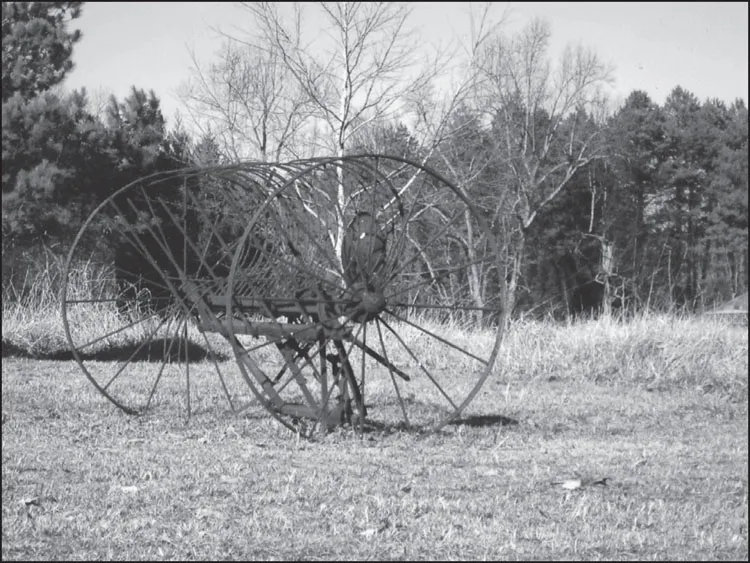
ABANDONED HAY RAKE. This hay rake sits idle with its tongue missing and seat sitting akimbo. For many years, farmers on “the Point” used machinery like this to bring in their crops. This hay rake was powered by a pair of horses, but today, there are no fields of hay to be gathered and no more farm horses to be seen. (Courtesy of Jack Page.)

DIXON DAIRY FARM. As space for field crops diminished, many farmers converted their fields to pastureland. Some farmers, like Palmer Dixon, became dairymen. Some of these dairymen bottled their milk and established routes that supplied milk to customers throughout the Belmont area. Some dairymen placed their milk in large milk containers and put the containers beside the road to be picked up and delivered to a milk processing plant in Shelby, North Carolina. (Photograph by Jack Page.)

TYPICAL SOUTH POINT CONSTRUCTION. A.A. Cathey’s stable lies deserted along the lower Armstrong Road. Cathey was noted as an efficient farmer. All of his children attended college, and several of them became teachers in the Gaston County school system. (Photograph by Jack Page.)
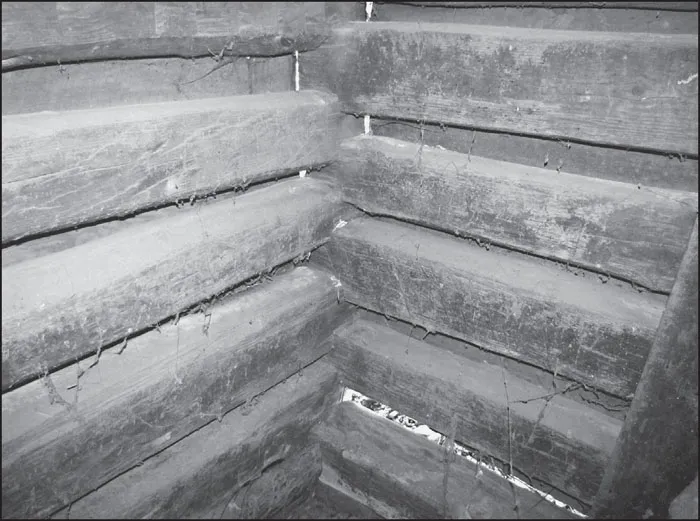
TYPICAL SOUTH POINT CONSTRUCTION TECHNIQUE. This technique of joining logs at corners has been handed down for many generations. It was popular throughout the South for its efficiency and ease of construction. (Photograph by Jack Page.)
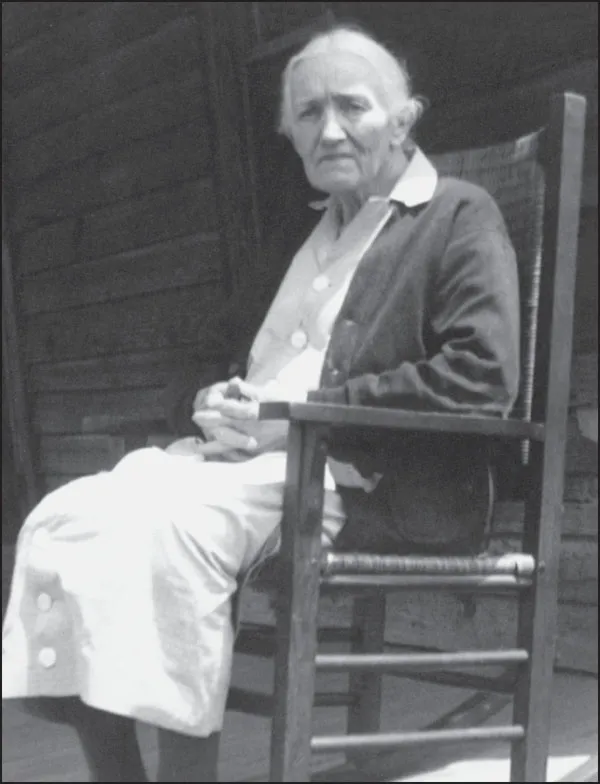
EMMA JANE LEEPER WILSON. Emma Wilson was the widow of Samuel W. Wilson. The Leeper family of the South Point community is one of the oldest families that settled the South Point area. Robert Leeper, a great uncle of hers, was one of the first known settlers of the land near the junction of the South Fork and the Catawba Rivers, on 350 acres issued in 1750. Robert was one of the four residents on the Point who helped construct a log fort near the junction of the two rivers. (Courtesy of Millican Pictorial History Museum.)
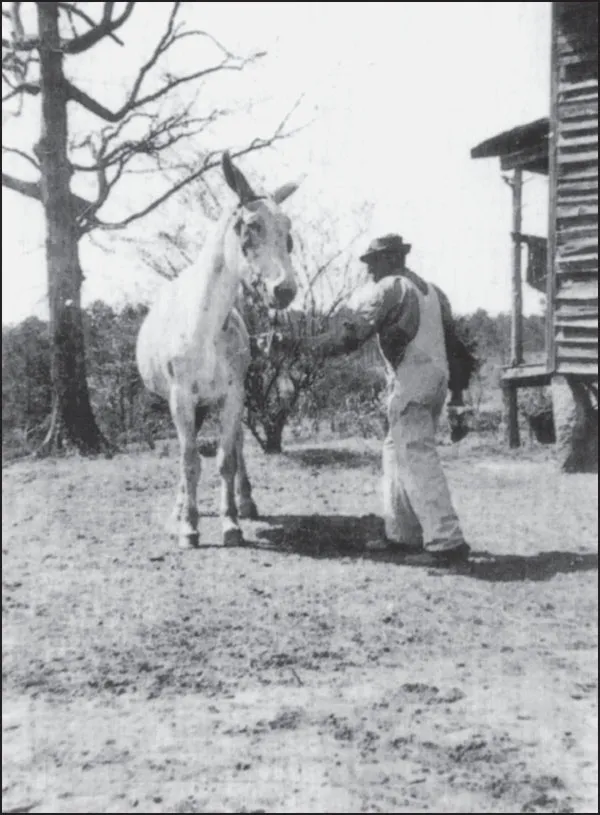
GREEN HAND. Green Hand raised a large family and was noted for his religious fervor, having served in various capacities in more than one church. His work ethic was passed on to his children, several of whom have distinguished themselves through hard work, higher education, and outstanding citizenship. (Courtesy of Millican Pictorial History Museum.)

EARLY RESIDENTS OF SOUTH POINT, BELMONT. This group of South Point farmers has gathered for a social event: marksmanship practice. From left to right are Jim Leeper, Dick Hall, Frank Hoffman, A.A. Cathey (foreground), Archie Robinson, Tom Smith, and Justus Armstrong. The surnames of these men are very familiar because their descendants became prominent citizens in Gaston County for many years. (Courtesy of Millican Pictorial History Museum.)

CARRIE HANKS. Carrie Hanks was descended from slaves who worked in the fields and in the kitchens of farm homes in this area. This house is typical of the homes of local African Americans at the time. The society did not offer these people much in the way of employment beyond manual labor and domestic work. Most black children at this time had limited opportunities for getting an education; however, there were some notable exceptions. The most common avenues for upward mobility were through teaching and the ministry. (Courtesy of Millican Pictorial History Museum.)

ALBERT ARMSTRONG HOUSE ON NIXON ROAD. Following the pattern of farmhouses all over Piedmont North Carolina, the Albert Armstrong house remains empty today. This design had a long hallway down its center and bedrooms on the second floor. The kitchen is located at the rear of the house, and indoor plumbing is a retrofit to these homes, which commonly had outhouses. This particular house lost a chimney on the left side to Hurricane Hugo, but the remaining chimney is a duplicate to the one lost. (Photograph by Jack Page.)

ABRAM STOWE HOUSE. The oldest known surviving structure in Belmont, the Abram Stowe House was built around 1868. This is a log structure later covered with clapboards. Stowe was the second postmaster, taking over after Alex Beaty. He was the first mayor of Garibaldi and also the first depot agent. Stowe had a country store and was a contractor for the Atlanta and Charlotte Air Line Railway to manage the wood supply for the train. (Courtesy of Millican Pi...
Table of contents
- Cover Page
- Title Page
- Copyright Page
- Dedication
- Table of Contents
- Acknowledgments
- Introduction
- 1. Early Settlers and Landowners: 1700s–1900s
- 2. Textile Era: 1900–1980s
- 3. Evolution of Belmont: 1970s–Present
Frequently asked questions
Yes, you can cancel anytime from the Subscription tab in your account settings on the Perlego website. Your subscription will stay active until the end of your current billing period. Learn how to cancel your subscription
No, books cannot be downloaded as external files, such as PDFs, for use outside of Perlego. However, you can download books within the Perlego app for offline reading on mobile or tablet. Learn how to download books offline
Perlego offers two plans: Essential and Complete
- Essential is ideal for learners and professionals who enjoy exploring a wide range of subjects. Access the Essential Library with 800,000+ trusted titles and best-sellers across business, personal growth, and the humanities. Includes unlimited reading time and Standard Read Aloud voice.
- Complete: Perfect for advanced learners and researchers needing full, unrestricted access. Unlock 1.5M+ books across hundreds of subjects, including academic and specialized titles. The Complete Plan also includes advanced features like Premium Read Aloud and Research Assistant.
We are an online textbook subscription service, where you can get access to an entire online library for less than the price of a single book per month. With over 1.5 million books across 990+ topics, we’ve got you covered! Learn about our mission
Look out for the read-aloud symbol on your next book to see if you can listen to it. The read-aloud tool reads text aloud for you, highlighting the text as it is being read. You can pause it, speed it up and slow it down. Learn more about Read Aloud
Yes! You can use the Perlego app on both iOS and Android devices to read anytime, anywhere — even offline. Perfect for commutes or when you’re on the go.
Please note we cannot support devices running on iOS 13 and Android 7 or earlier. Learn more about using the app
Please note we cannot support devices running on iOS 13 and Android 7 or earlier. Learn more about using the app
Yes, you can access Belmont by Allen Millican,Gearl-Dean Page,Jack Page in PDF and/or ePUB format, as well as other popular books in History & North American History. We have over 1.5 million books available in our catalogue for you to explore.