- 128 pages
- English
- ePUB (mobile friendly)
- Available on iOS & Android
eBook - ePub
Nevada Test Site
About this book
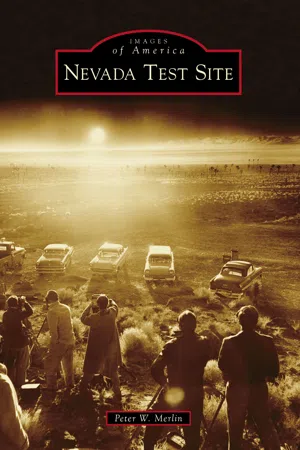
Since Pres. Harry Truman established the Nevada Test Site (NTS) in December 1950, it has played a vital role in the security of the United States. For four decades, the test site's primary purpose was developmental testing of nuclear explosives. Atmospheric tests conducted over Yucca Flat and Frenchman Flat between 1951 and 1962 involved thousands of Army troops and Marines simulating nuclear battlefield conditions. Civil defense planners studied blast and radiation effects and evaluated bomb shelter designs. Testing moved underground in 1963 to eliminate radioactive fallout. Other projects at the NTS included nuclear rocket engine development for space travel, training for NASA's Apollo astronauts, excavation experiments, radioactive waste storage studies, and aircraft testing. Since the last underground nuclear test in 1992, this geographically diverse testing and training complex north of Las Vegas--known since 2010 as the Nevada National Security Site--has been used to support nuclear stockpile stewardship and as a unique outdoor laboratory for government and industry research and development efforts.
Trusted by 375,005 students
Access to over 1.5 million titles for a fair monthly price.
Study more efficiently using our study tools.
Information
One
ATMOSPHERIC TESTING

An aerial view shows Camp Mercury on March 30, 1957. As the main NTS base camp, Mercury provided overnight accommodations and served as a warehousing, communication, repair, fabrication, and field administration center. The camp population was estimated at approximately 2,700 in 1955 and exploded to nearly 3,500 during the 1957 test series. The road at upper right led north to the Frenchman Flat and Yucca Flat test areas.

Facilities at Mercury included a hospital, theater, bowling alley, swimming pool, cafeteria, dormitories, and post office. Other buildings housed laboratories and instrument calibration facilities. Although Mercury is the second-largest community in Nye County, it has no schools or family housing and is operated much like a military camp due to security and work requirements.

A sign at the main security gate at Mercury identifies the test site by its early name, Nevada Proving Ground. The Atomic Energy Commission (AEC) administered the site as part of the multi-service/agency Joint Test Organization (JTO). At one time, as many as a hundred 47-passenger buses carried employees to and from Las Vegas through this gate every day. (DOE.)
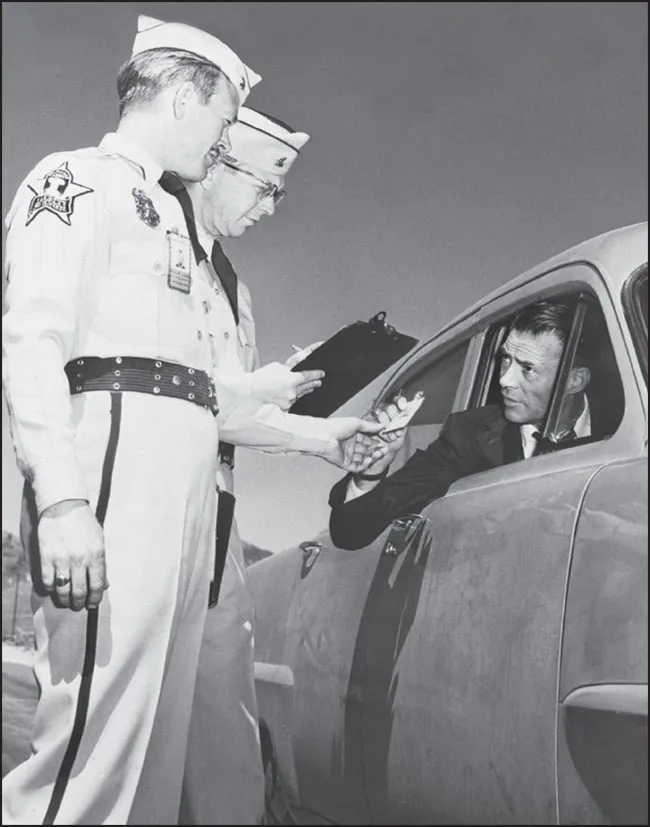
All personnel were required to show identification when entering and leaving the NTS. Here, guards Milton Miller (left) and John Metcalf inspect the pass of Frank Waters, a writer with the JTO Test Information Office. NTS security guards at the time worked for Federal Services, Inc., under contract to the AEC.

A sign at the security gate reminds workers that secrecy is paramount. Test site workers had to be aware that information about their work was highly classified and restricted on a need-to-know basis. They were not authorized to share details with friends, family, and other uncleared persons. Not everyone at the NTS had a clearance, and not all clearances were equal. (DOE.)
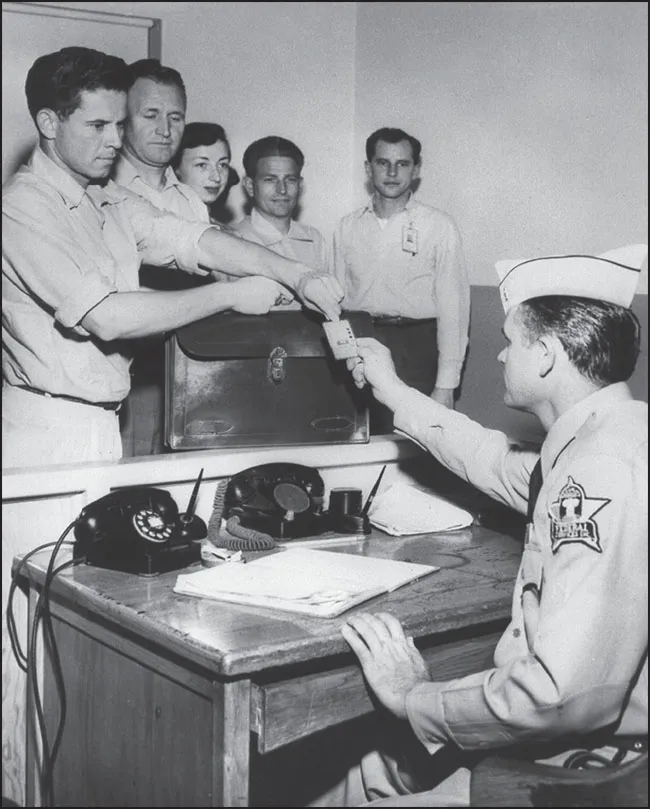
Credentials were checked each time a person entered or exited the Administration Building or other secure area. Picture identification badges had to be worn at all times while on duty, displayed conspicuously on outer clothing. Badges or passes could not be displayed or worn outside NTS limits.
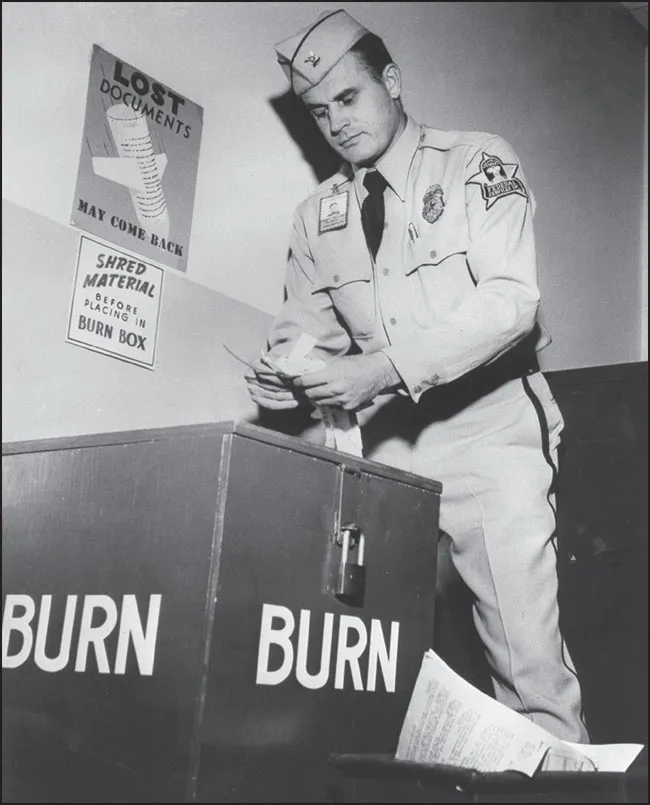
To prevent espionage, guards ensured that all discarded papers were shredded or carefully torn into tiny pieces and put into this locked box. At the end of each day, they took the box into the Incinerator Building at Mercury and burned the contents. No printed matter was to be left in wastepaper baskets.

Guards underwent extensive training in all fields of security. Here, Sgt. Marion E. Addington instructs a class on proper use and maintenance of the Thompson M1A1 submachine gun. Produced in large quantities during World War II, the .45-caliber weapon was renowned for its stopping power. Test site guards typically carried them while patrolling the perimeter and forward areas.
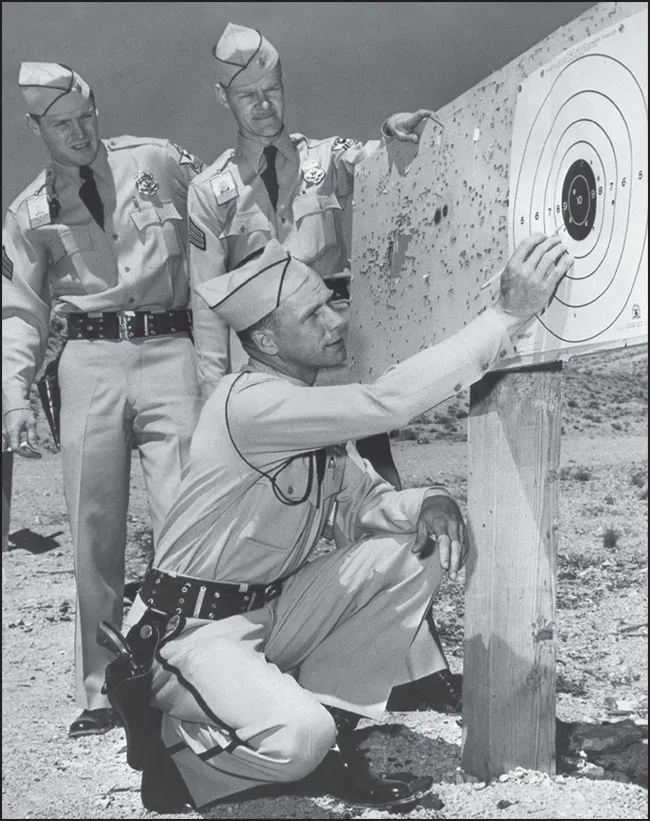
Marksmanship training was taken seriously at the NTS. In this 1953 photograph, guards armed with .38 Special Smith & Wesson pistols hold daily practice on the Mercury pistol range. Lt. Robert P. Keller inspects a target as Sgt. J. Brady (left) and Sgt. Marion E. Addington look on.

Female NTS workers were housed in 16 trailers at Mercury. During the 1950s, most women at the test site worked in clerical, custodial, or commissary jobs. There were relatively few female NTS employees when this picture was taken in March 1955. That year, during the Operation Teapot nuclear test series, these trailers held approximately 32 occupants.

Marilyn White, employed by the Olympic Commissary Company, emerges from a trailer home she shared with two other women employees. Olympic was responsible for housing and feeding test site workers. For White, working at the NTS was a family affair. Her husband was assigned to the Air Force Air Weather Detachment at Mercury.

Mercury initially consisted largely of temporary structures, but this changed as the test site workforce grew to 10,000. In 1962, a supplemental AEC appropriations bill included $15 million for construction of new buildings. The camp’s first postal facility, established in March 1952, was replaced with a permanent post office in October 1964.

Here is the first temporary telephone switchboard at Mercury, as it looked in 1952. Public telephones for personal use were located in the Camp Services Building and the recreation hall as well as at the forward area’s Control Point. The switchboard was one of the few NTS facilities staffed exclusively by women.

AEC test manager Carroll L. Tyler (left) enjoys a light moment on June 8, 1953, with William E. Ogle, Los Alamos Scientific Laboratory (LASL) deputy for weapons development, and an unidentified woman. On the chalkboard, Albert Alligator from Walt Kelly’s Pogo comic strip says, “They is nothin more pleasant than a day with the lumps took out of it.” Note the steel bear trap on top of the filing cabinet.

Recreational facilities at Mercury were originally limited to a single building with provisions for cards, pool tables, ping-pong, shuffleboard, and pinball machines. Movies were shown in a converted Quonset hut. An Olympic-sized swimming pool and eight-lane bowling alley open...
Table of contents
- Cover Page
- Title Page
- Copyright Page
- Table of Contents
- Acknowledgments
- Introduction
- 1. Atmospheric Testing
- 2. Underground Testing
- 3. Beyond the Bomb
Frequently asked questions
Yes, you can cancel anytime from the Subscription tab in your account settings on the Perlego website. Your subscription will stay active until the end of your current billing period. Learn how to cancel your subscription
No, books cannot be downloaded as external files, such as PDFs, for use outside of Perlego. However, you can download books within the Perlego app for offline reading on mobile or tablet. Learn how to download books offline
Perlego offers two plans: Essential and Complete
- Essential is ideal for learners and professionals who enjoy exploring a wide range of subjects. Access the Essential Library with 800,000+ trusted titles and best-sellers across business, personal growth, and the humanities. Includes unlimited reading time and Standard Read Aloud voice.
- Complete: Perfect for advanced learners and researchers needing full, unrestricted access. Unlock 1.5M+ books across hundreds of subjects, including academic and specialized titles. The Complete Plan also includes advanced features like Premium Read Aloud and Research Assistant.
We are an online textbook subscription service, where you can get access to an entire online library for less than the price of a single book per month. With over 1.5 million books across 990+ topics, we’ve got you covered! Learn about our mission
Look out for the read-aloud symbol on your next book to see if you can listen to it. The read-aloud tool reads text aloud for you, highlighting the text as it is being read. You can pause it, speed it up and slow it down. Learn more about Read Aloud
Yes! You can use the Perlego app on both iOS and Android devices to read anytime, anywhere — even offline. Perfect for commutes or when you’re on the go.
Please note we cannot support devices running on iOS 13 and Android 7 or earlier. Learn more about using the app
Please note we cannot support devices running on iOS 13 and Android 7 or earlier. Learn more about using the app
Yes, you can access Nevada Test Site by Peter W. Merlin in PDF and/or ePUB format, as well as other popular books in History & Military & Maritime History. We have over 1.5 million books available in our catalogue for you to explore.