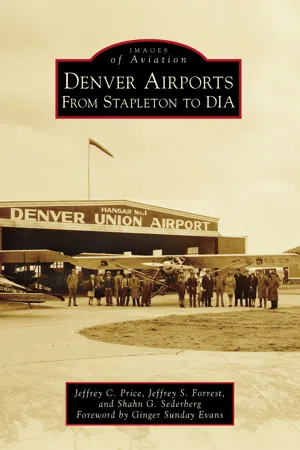
eBook - ePub
Denver Airports
From Stapleton to DIA
- 128 pages
- English
- ePUB (mobile friendly)
- Available on iOS & Android
eBook - ePub
About this book
On the cusp of the Great Depression, Denver mayor Benjamin Stapleton pushed for the development of the first city-operated airport. Denver Municipal Airport opened in 1929 with three hub airlines. While Stapleton would be honored to later have the airport named after him, by the mid-1980s, the name Stapleton had become synonymous with congestion, flight delays, and frequent closures when the snow moved in. To solve the problem, Denver mayor Federico Peña envisioned a massive new airport, but when Denver International Airport (DIA) opened in 1995, its three hub airlines had whittled away to just one, and critics warned of dire consequences. Yet the airport persevered, and today, with its iconic tent roof, six runways, and 53 square miles of land, it stands amongst the most beautiful and busiest airports in the world. This is the story of three airports and how they brought the city from cow town to boomtown.
Trusted by 375,005 students
Access to over 1.5 million titles for a fair monthly price.
Study more efficiently using our study tools.
Information
One
AVIATION COMES TO COLORADO
THE ORIGIN OF THE DENVER AIRPORT

Benjamin Stapleton, mayor of Denver (1923–1931 and 1935–1947) and Charles Vail, a famous highway engineer, envisioned an airport that would establish Denver at the forefront of the fledgling aviation industry. Their vision established Denver Municipal Airport, which would later evolve into the fifth busiest airport in the United States and the 18th busiest in the world. Initial construction of Denver Municipal Airport was completed by the summer of 1929 and included just an administration building and a hangar with a lean-to maintenance shop. A smaller building housed the airport’s fire-fighting equipment, ambulance, and a central heating plant. The airport opened despite strong opposition from city councilmen who contended that its land was bought to pay back political favors. Citizen complaints about tax dollars being used for aviation and businessmen complaining that it was too far away from the city also caused problems for the airport. Despite these problems, Denver Municipal Airport was established initially with three airlines committed to starting air service. (Courtesy of DPL.)

Located in east Denver, the original Denver Municipal Airport would undergo a name change to Stapleton Airport, then eventually a move 23 miles northeast of downtown Denver to become Denver International Airport. In an epic evening known as “Push Night,” airport operators closed one international airport and opened another within hours of each other. Today, Denver International Airport features six runways and over 100 airline gates, and occupies 53 square miles of land, making it larger than the island of Manhattan in New York City. (Courtesy of DPL.)

The Rocky Mountains were an obstacle for travel to and from early Denver. This photograph taken between 1885 and 1890 shows that only the most stalwart pioneers, using mule teams and wagons, dared to travel through Ute Pass in El Paso County, Colorado. The Rockies proved too much of a challenge for both the railroads and the air mail service, which both headed north to Cheyenne to bypass Denver’s higher mountain ranges. (Courtesy of WH-DPL.)

Railroads, rivers, and territorial boundaries can be seen in this c. 1862 gold rush map promoting Nebraska City as a supply center. Despite its position near the middle of the United States, Denver has long struggled to establish and maintain itself as an essential waypoint for travelers heading west, due to the challenge of crossing the Rocky Mountains. (Courtesy of WH-DPL.)

The opening of the American frontier made the West a popular tourist attraction. Reflective of today’s airliners, Trains hauled luggage and cargo and had certain cars dedicated to business clientele and leisure passengers. Seen here, 19th-century leisure passengers take a break on an excursion trip up Clear Creek Canyon in Jefferson County, Colorado. (Courtesy of the Dr. Nolie Mumey collection and DPL.)

In the early days of expansion across the country, the wagon trains found it just as difficult as the railroads and the early air mail industry to cross the Colorado Rockies. The major trails went north to Wyoming or south to New Mexico, where the mountains were easier to cross. (Courtesy of Shahn Sederberg.)

This is believed to be the first known image of an airplane flying in the Denver area, an early biplane flying over a flat landscape. Even the invention of the airplane did not immediately solve Denver’s proximity to the Rockies issue. Many pilots felt that aircraft could not climb high enough to fly over the mountains, coupled with the fact that Denver itself sits at an elevation of 5,280 feet. Many early aircraft had difficulty taking off at higher elevations. (Courtesy of HR-DPL.)

In 1909, The Denver Post offered $10,000 for the first successful demonstration of mechanically propelled flight in Colorado. On February 1, 1910, just over a month after the deadline, Louis Paulhan, the French “birdman” took off from Overland Park in southwest Denver. Between 40,000 and 50,000 people were in attendance. Paulhan unfortunately crashed the plane two days later, injuring three people and seeing much of his plane stolen by souvenir seekers. (Courtesy of HR-DPL.)

Private investors opened Curtiss Aviation Field, one of the first aerodromes in Denver. Situated on Colorado Boulevard in the northeast section of Denver, it was later renamed Park Hill Airport, and then Hayden Airport. Many of the nation’s original airports were operated by private enterprise out of necessity. The growing desire to use aircraft required building airports. (Courtesy of DPL.)

In 1925, Carrie Bella became Denver’s first parachutist. Parachute designs of the time were similar to what would later be used in World War II, most famously during the assault by the 82nd and 101st Airborne Divisions during the invasion of Normandy. (Both, courtesy of HR-DPL.)

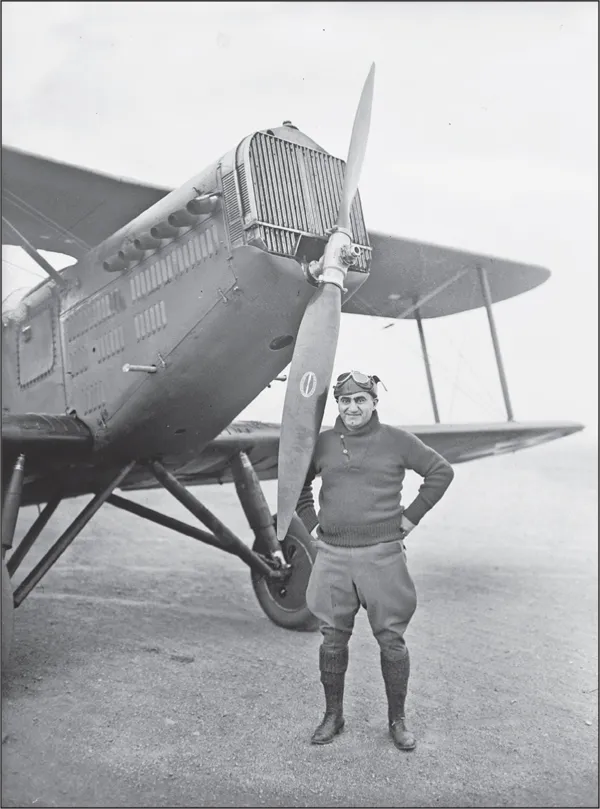
Noted physician Dr. Nolie Mumey is pictured in front of a water-cooled airplane. Many of the photographs in this book are attributed to him. Mumey was a member of the US Army Medical Corps in France during World War I and flew in the Colorado National Guard. He passed away in 1984. (Courtesy of DPL.)

Denver’s second transportation crisis came when the transcontinental airmail routes were mapped and Cheyenne was again selected over Denver as the central western mail...
Table of contents
- Cover Page
- Title Page
- Copyright Page
- Dedication
- Table of Contents
- Foreword
- Acknowledgments
- Introduction
- 1. Aviation Comes to Colorado:The Origin of the Denver Airport
- 2. Stapleton International Airport:The Golden Age of Flight
- 3. We Said Hello, Goodbye:One Legacy Begins as Another Ends
- 4. Building the Field of Dreams:If You Build It, Will They Come?
- 5. Denver International Airport:Proving the Critics Wrong Once Again
- 6. Everything’s Changed: Air Travel Then and Now
- Bibliography
Frequently asked questions
Yes, you can cancel anytime from the Subscription tab in your account settings on the Perlego website. Your subscription will stay active until the end of your current billing period. Learn how to cancel your subscription
No, books cannot be downloaded as external files, such as PDFs, for use outside of Perlego. However, you can download books within the Perlego app for offline reading on mobile or tablet. Learn how to download books offline
Perlego offers two plans: Essential and Complete
- Essential is ideal for learners and professionals who enjoy exploring a wide range of subjects. Access the Essential Library with 800,000+ trusted titles and best-sellers across business, personal growth, and the humanities. Includes unlimited reading time and Standard Read Aloud voice.
- Complete: Perfect for advanced learners and researchers needing full, unrestricted access. Unlock 1.5M+ books across hundreds of subjects, including academic and specialized titles. The Complete Plan also includes advanced features like Premium Read Aloud and Research Assistant.
We are an online textbook subscription service, where you can get access to an entire online library for less than the price of a single book per month. With over 1.5 million books across 990+ topics, we’ve got you covered! Learn about our mission
Look out for the read-aloud symbol on your next book to see if you can listen to it. The read-aloud tool reads text aloud for you, highlighting the text as it is being read. You can pause it, speed it up and slow it down. Learn more about Read Aloud
Yes! You can use the Perlego app on both iOS and Android devices to read anytime, anywhere — even offline. Perfect for commutes or when you’re on the go.
Please note we cannot support devices running on iOS 13 and Android 7 or earlier. Learn more about using the app
Please note we cannot support devices running on iOS 13 and Android 7 or earlier. Learn more about using the app
Yes, you can access Denver Airports by Jeffrey C. Price,Jeffrey S. Forrest,Shahn G. Sederberg in PDF and/or ePUB format, as well as other popular books in Technology & Engineering & Aviation. We have over 1.5 million books available in our catalogue for you to explore.