- 128 pages
- English
- ePUB (mobile friendly)
- Available on iOS & Android
eBook - ePub
Columbus
About this book
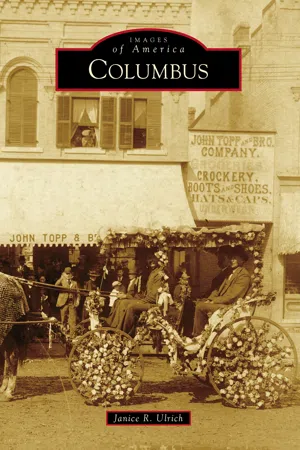
From the earliest days of Columbus, rural dwellers and city residents have shared a common goal of making the area a comfortable place to call home. The early Welsh and German settlers found fertile soil, lumber, a source of water in the Crawfish River, and generally adequate rainfall to successfully grow crops for their families and to sell for income. They needed little else except their own industrious spirits. With the establishment of the Columbus Canning Company in 1900, the village was transformed into an industrial hub that thrived for the next 75 years. Businesses related to the production of canned peas, corn, pumpkin, tomatoes, and beans flourished, benefiting both growers and processors. Columbus offers a quiet, low-key environment with access to post-secondary education and world-class cultural experiences within an hour's drive.
Tools to learn more effectively

Saving Books

Keyword Search

Annotating Text

Listen to it instead
Information
One
A CITY IS BORN
Lewis Ludington’s land purchases were registered in the Green Bay Office of Land Management in 1839, signaling that a settlement had been established. In 1847, the state legislature declared that Columbus should become the county seat of justice, but that designation only lasted until 1851, when Portage became the county seat.
By the 1850s, the settlement in Columbus had become well established with a harness shop, milliner, several grocery stores, grain warehouses, lumberyard, three blacksmiths, wagon shop, cabinet shop, tailors, tin shop, lawyers, druggist, and two physicians. Although most of the structures were wood, some stone and brick buildings also began to appear. The surrounding countryside was also becoming inhabited by adventurous families, establishing themselves as the farmers and responding to the needs of not only their own families, but also to the people in this city and beyond. Early on, the relationship between the farmers and the city dwellers was a symbiotic one—they needed each other to prosper. That fact was evident from the beginning and still is today. Columbus is an agriculture-based city.
In 1864, the settlement at Columbus was incorporated as a village. On February 26, 1874, the village officially became incorporated as a city. With that designation came the right to establish a free public education system and volunteer fire protection organization.
Photographs of the men and women who have served as the city’s mayor hang in the courtroom/conference room of city hall. The amenities and services that make life comfortable for the city’s residents are illustrated here, in roughly the time frame in which they developed.
The story continues to the present day with this endeavor hopefully highlighting many of the events, buildings, and people who have shaped Columbus into what it has become today, with this volume focusing on roughly the first 125 years. The author expects to generate another book to cover the city’s history from about 1950 to the current time.

The following photographs chronicle the evolution of the public education facilities in Columbus. In 1843, the first school was held in Jeremiah Drake’s dingy blacksmith shop; at that time, teacher Benjamin Nute taught about seven to twelve students. In 1846, the first school building (60 feet by 25 feet) was erected at 426 South Ludington Street (then called Madison Street). That structure also served as a church and the seat for town government offices. The original structure has been remodeled and added to several times since then, but the building remains today as a residence and is pictured here.

In 1857, two buildings were erected on Broadway: one to house the first through third grades and the other to house the fourth through eighth grades. Those first two buildings are shown on the right, from the back or playground side. When the city was incorporated in 1874, free public education became mandated; the first high school graduate matriculated in 1877. The building on the left is the first high school, constructed in 1881 at the corner of Broadway and School Street.

In 1895, a four-story building with massive stone steps at its main entrance was built to consolidate the elementary school grades. Later on, a covered walkway at the second-floor level was built to connect it with the 1881 building. Shown here is that 1895 building, as painted by Susan Stare in 1983. The interesting black feature at the left of this picture is a tubular fire escape. Additions to this building occurred in 1910, when a kindergarten was added on the ground level and two classrooms on the second level; in 1935, when a gymnasium was erected; and in 1946, when a kitchen was built off the small gymnasium. More changes to this building occurred since 1963 and will be detailed in the follow-up book by this author. This building on Dickason Boulevard (formerly Broadway) has served as the city’s main education facility. At various points in its history, it has hosted kindergarten through high school students and is commonly referred to as Dickason School.

In 1952, the Fuller Street elementary school, illustrated here, was built to house kindergarten through grade four. Subsequent additions have occurred to that building in 1995 and again in 2000. This school is within a block and a half of the larger Dickason School; houses previously located between the two school buildings were razed in 2014 to provide parking for both facilities. (Courtesy of Columbus Public Schools Administration Office.)

In 1958, the current Columbus High School, pictured, opened on Farnham Street. Additions to it have meant more space for technology education, a gymnasium, and enhanced classroom facilities. It is conveniently located adjacent to Fireman’s Park, which provides practice space for athletic teams. (Courtesy of Walcott Studio.)

The first firefighters in Columbus belonged to the Germania Fire Company in 1876, later becoming Columbus Steamer Company No. 1. When city hall was built in 1892, an area was set aside at the southwest corner for storage of fire equipment, with two entrances on James Street. An auxiliary water tank was installed underneath the auditorium stage. In order to dry hoses, a system of pulleys stretched them to the rafters at the edge of the auditorium stage. While fire equipment was still horse drawn, the horses were kept at Lueders Livery Stable, with the equipment stored there too in the upper level before the city hall was built. This c. 1905 photograph shows the Germania Fire Company with David Williams driving two teams of horses belonging to the Columbus Canning Company. Shown are, from left to right, John Hatzinger, Ed Pietzner, Ed Link, William Killian, Remigus Dubrowa, Reese Roberts, William Klatt, Rudy Lueders, Joseph Berdoll, Frank Klatt, and William Breese. This steamer, purchased in 1886, generated power to draft water, with force, from the cisterns scattered throughout downtown and nearby residential areas. Beginning in 1896, water mains and fire hydrants were installed throughout the town.

The fire department building on Harrison Street, located next to the back of the post office, was built in 1946. Two of the four trucks can be identified. The truck at the far left is a 1946 Pirsch pumper, manufactured in Kenosha, which was used for rural fires; the second from right is a 1925 American LaFrance pumper, used for city fires. (Courtesy of Chief Randall Koehn and the Columbus Fire Department.)

The current fire station at South Ludington and West Harrison Streets, built in 1974, is shown here. The bell that summoned firefighters when the department was in city hall stands proudly outside the station. Firefighters have been called by sirens (fire whistles) from atop city hall. Early on, fire calls were answered in certain firemen’s homes or at Earl’s Cafe. (Earl Witthuhn was a fireman.) Fire whistles have been replaced by more specific notification methods today. The fire department currently has about 40 members. (Courtesy of Marlys Weihert.)

This 2002 photograph shows fire department members at the tim...
Table of contents
- Cover Page
- Title Page
- Copyright Page
- Dedication
- Table of Contents
- Acknowledgments
- Introduction
- 1. A City Is Born
- 2. City Hall
- 3. Fireman’s Park
- 4. Area Farms
- 5. Monuments and Memorials
- 6. Churches and Other Buildings
- 7. Columbus Canning Company
- 8. Businesses
Frequently asked questions
Yes, you can cancel anytime from the Subscription tab in your account settings on the Perlego website. Your subscription will stay active until the end of your current billing period. Learn how to cancel your subscription
No, books cannot be downloaded as external files, such as PDFs, for use outside of Perlego. However, you can download books within the Perlego app for offline reading on mobile or tablet. Learn how to download books offline
Perlego offers two plans: Essential and Complete
- Essential is ideal for learners and professionals who enjoy exploring a wide range of subjects. Access the Essential Library with 800,000+ trusted titles and best-sellers across business, personal growth, and the humanities. Includes unlimited reading time and Standard Read Aloud voice.
- Complete: Perfect for advanced learners and researchers needing full, unrestricted access. Unlock 1.4M+ books across hundreds of subjects, including academic and specialized titles. The Complete Plan also includes advanced features like Premium Read Aloud and Research Assistant.
We are an online textbook subscription service, where you can get access to an entire online library for less than the price of a single book per month. With over 1 million books across 990+ topics, we’ve got you covered! Learn about our mission
Look out for the read-aloud symbol on your next book to see if you can listen to it. The read-aloud tool reads text aloud for you, highlighting the text as it is being read. You can pause it, speed it up and slow it down. Learn more about Read Aloud
Yes! You can use the Perlego app on both iOS and Android devices to read anytime, anywhere — even offline. Perfect for commutes or when you’re on the go.
Please note we cannot support devices running on iOS 13 and Android 7 or earlier. Learn more about using the app
Please note we cannot support devices running on iOS 13 and Android 7 or earlier. Learn more about using the app
Yes, you can access Columbus by Janice R. Ulrich in PDF and/or ePUB format, as well as other popular books in History & North American History. We have over one million books available in our catalogue for you to explore.