- 128 pages
- English
- ePUB (mobile friendly)
- Available on iOS & Android
eBook - ePub
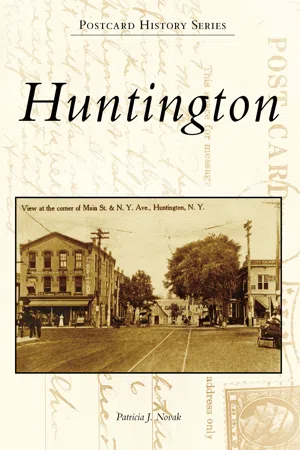
Huntington
About this book
The town of Huntington has a documented history that dates back to its founding in 1653. The harbors were principally involved in shipping and shipbuilding, and the lush land was ideal for agriculture. When the railroad arrived in the 1860s and then later the automobile, Huntington, part of the Gold Coast of Long Island, became a destination for city residents looking for an escape to fresh air, beaches, and comfortable surroundings. Stately mansions were built, and the villages bustled with new businesses, entertainment, and architecture. That era has been captured in the postcards sent and collected during that time, adding to the social history of Huntington.
Trusted by 375,005 students
Access to over 1.5 million titles for a fair monthly price.
Study more efficiently using our study tools.
Information
One
EDUCATION AND WORSHIP

The sender of this 1907 postcard of Elwood School was Anna R. Purtill, a 1906 graduate (one of four in her class) of Huntington High School. In September 1907, she started her career as a teacher at this school. She is likely the young lady standing in the doorway. She went on to teach throughout the township and in the Hicksville school system.

The Fair Ground School was built in 1906 at a cost of $6,500 and closed in 1913, when the Lowndes Avenue Grammar School was built. It had four rooms for primary classes. Later, it was used as a post office and a VFW hall before being demolished as part of the Huntington Station Renewal Project. This school was also referred to as the Station School and the School Street School.

This postcard of Lowndes Avenue Grammar School predates Arbor Day in 1914, when 40 maples were planted on the property. It was a modern structure for its day. In 1927, it was expanded and renamed Roosevelt School. In 1968, the town paid $465,000 for the then abandoned building and $19,000 to demolish it that same year as part of the Huntington Station Renewal Project.

The Huntington Union Free School District was formed in 1857. The Huntington Union School (above left) opened in 1858 at a cost of $6,000. The wooden structure was painted white, much to the displeasure of some taxpayers. The Main Street School (above right), which opened on February 26, 1900, with 225 pupils, was designed by Cady, Berg, and See, the same architectural firm that built the first Metropolitan Opera House in New York and Huntington’s Trade School. In late 1908, the Union School was torn down to make way for a new Huntington High School (below left), which was dedicated on January 31, 1910. It closed in 1952 after the new Huntington High School on Oakwood Road opened. The two remaining schools in the postcard below were annexed to form the current Huntington Town Hall.


The School Street School (above) in Northport was built in 1880. The first high school department graduating class at this facility was in 1900. By 1912, suggestions were first raised that a new school be built to alleviate overcrowding. In December 1923, advertisements popped up in local papers for over two dozen bricklayers to begin work on the new Northport High School (below) on Laurel Avenue. In 1924, all grades were moved to the new school, and in March 1925, the dedication and official opening took place. The School Street School was eventually torn down. Once again, with tremendous population growth in the Northport–East Northport district, a new Northport High School on Laurel Hill Road opened in 1966. The previous high school is now a middle school.


The Larkfield School in East Northport was built entirely by local laborers with a grant from the Public Works Administration. The architect was James Van Alst of Centerport. After a short parade by local businesses and organizations, the cornerstone was laid on July 2, 1938. The elementary-aged children moved into the new school in early November 1938.

Central High School opened in 1929. August H. Galow, a Huntington High School graduate, was the architect. It later became South Huntington High School and then Central Elementary School. The first South Huntington Public Library, which opened in 1961, was located in the basement at the southeast (left) corner. The building still stands today behind a modern facade near the corner of New York Avenue and Jericho Turnpike.

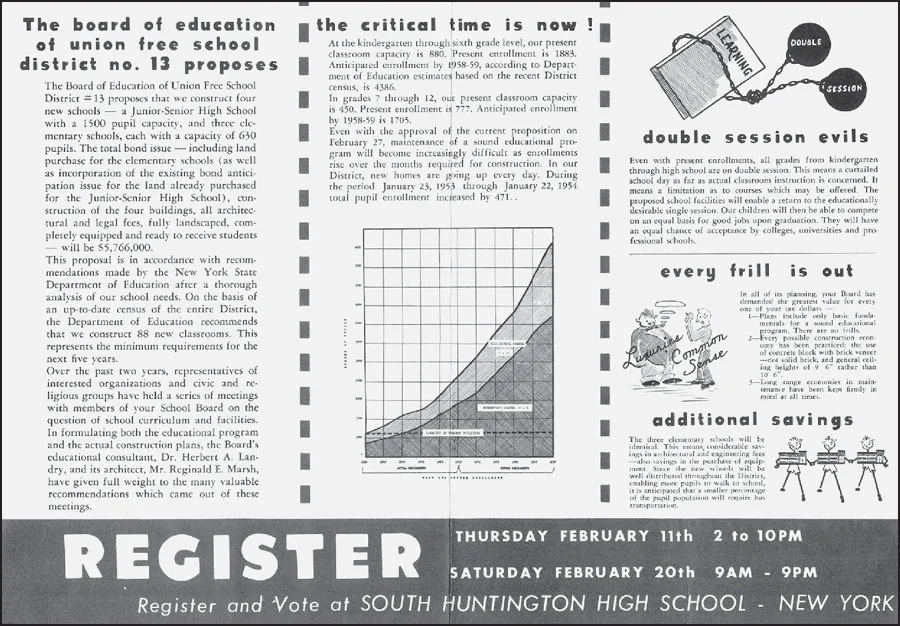
After World War II, there was a population explosion in Huntington Station, and as a result, several new public schools were needed. In 1954, a four-page proposal for the construction of four new schools was distributed in order to justify the ambitious project and garner the support of taxpayers. The proposal included three elementary schools (Birchwood, Maplewood, and Oakwood) and one junior-senior high, Walt Whitman High School. The total proposed cost to build and outfit the new schools was a remarkable $5,766,000. By 1965, Walt Whitman High School had an additional north wing, and there were nine elementary schools (Birchwood, Oakwood, Central, Beverly, Countrywood, Silas Wood, Maplewood, West Hills, and Pidgeon Hill) and two junior high schools (Memorial and Henry L. Stimson) operating in District 13.

The Lower Melville Methodist Episcopal Church, also known as the “Little White Church in the Wildwood,” is located at the far southwest corner of the town of Huntington. It was built in 1810. Many different religious and nonsectarian groups have held meetings in this church, including a Jamaica unit of the Ku Klux Klan. The building still stands, looking very much the same.

After the 1888 fire in Huntington village destroyed the Second Presbyterian Church, the church in this postcard was built. In 1899, New York state assemblyman Erastus F. Post introduced a bill to change the name of the church to the Central Presbyterian Church. This building and the rector’s house next door no longer exist, but the third Presbyterian church built on the same plot of land still stands.

The Presbyterian Church of Sweet Hollow sits in Melville near the southern border of Huntington. The building was completed on July 14, 1829, and opened two days later. Local residents, principally the Baylis and Smith families, wanted to establish a church in t...
Table of contents
- Cover Page
- Half title
- Front Matter
- BookTitle
- Copyright
- Table of Contents
- Acknowledgments
- Introduction
- 1. Education and Worship
- 2. Residences and Retreats
- 3. Businesses and Services
- 4. Hospitality
- 5. People and Events
- 6. On the Streets
- 7. Along the Harbors
Frequently asked questions
Yes, you can cancel anytime from the Subscription tab in your account settings on the Perlego website. Your subscription will stay active until the end of your current billing period. Learn how to cancel your subscription
No, books cannot be downloaded as external files, such as PDFs, for use outside of Perlego. However, you can download books within the Perlego app for offline reading on mobile or tablet. Learn how to download books offline
Perlego offers two plans: Essential and Complete
- Essential is ideal for learners and professionals who enjoy exploring a wide range of subjects. Access the Essential Library with 800,000+ trusted titles and best-sellers across business, personal growth, and the humanities. Includes unlimited reading time and Standard Read Aloud voice.
- Complete: Perfect for advanced learners and researchers needing full, unrestricted access. Unlock 1.5M+ books across hundreds of subjects, including academic and specialized titles. The Complete Plan also includes advanced features like Premium Read Aloud and Research Assistant.
We are an online textbook subscription service, where you can get access to an entire online library for less than the price of a single book per month. With over 1.5 million books across 990+ topics, we’ve got you covered! Learn about our mission
Look out for the read-aloud symbol on your next book to see if you can listen to it. The read-aloud tool reads text aloud for you, highlighting the text as it is being read. You can pause it, speed it up and slow it down. Learn more about Read Aloud
Yes! You can use the Perlego app on both iOS and Android devices to read anytime, anywhere — even offline. Perfect for commutes or when you’re on the go.
Please note we cannot support devices running on iOS 13 and Android 7 or earlier. Learn more about using the app
Please note we cannot support devices running on iOS 13 and Android 7 or earlier. Learn more about using the app
Yes, you can access Huntington by Patricia J. Novak in PDF and/or ePUB format, as well as other popular books in History & North American History. We have over 1.5 million books available in our catalogue for you to explore.